Division of Mental Health Services, Akershus University Hospital, Lørenskog, Norway.
Tiller Community Mental Health Centre, Department of Mental Health, St. Olavs Hospital, Trondheim, Norway.
BMC Psychiatry. 2021 May 4;21(1):231. doi: 10.1186/s12888-021-03237-8.
Crisis resolution teams (CRTs) are specialized multidisciplinary teams intended to provide assessment and short-term outpatient or home treatment as an alternative to hospital admission for people experiencing a mental health crisis. In Norway, CRTs have been established within mental health services throughout the country, but their fidelity to an evidence-based model for CRTs has been unknown.
We assessed fidelity to the evidence-based CRT model for 28 CRTs, using the CORE Crisis Resolution Team Fidelity Scale Version 2, a tool developed and first applied in the UK to measure adherence to a model of optimal CRT practice. The assessments were completed by evaluation teams based on written information, interviews, and review of patient records during a one-day visit with each CRT.
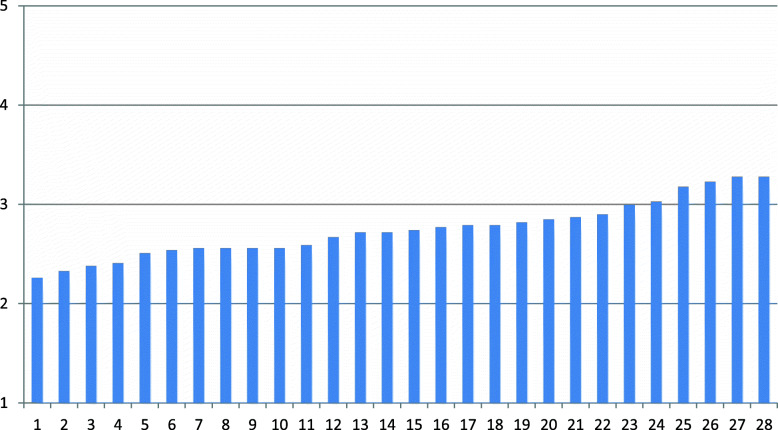
The fidelity scale was applicable for assessing fidelity of Norwegian CRTs to the CRT model. On a scale 1 to 5, the mean fidelity score was low (2.75) and with a moderate variation of fidelity across the teams. The CRTs had highest scores on the content and delivery of care subscale, and lowest on the location and timing of care subscale. Scores were high on items measuring comprehensive assessment, psychological interventions, visit length, service users' choice of location, and of type of support. However, scores were low on opening hours, gatekeeping acute psychiatric beds, facilitating early hospital discharge, intensity of contact, providing medication, and providing practical support.
The CORE CRT Fidelity Scale was applicable and relevant to assessment of Norwegian CRTs and may be used to guide further development in clinical practice and research. Lower fidelity and differences in fidelity patterns compared to the UK teams may indicate that Norwegian teams are more focused on early interventions to a broader patient group and less on avoiding acute inpatient admissions for patients with severe mental illness.
危机解决小组(CRTs)是专门的多学科小组,旨在为经历心理健康危机的人提供评估和短期门诊或家庭治疗,作为住院治疗的替代方案。在挪威,CRTs 已经在全国各地的精神卫生服务机构中建立,但它们对基于证据的 CRT 模型的忠实程度尚不清楚。
我们使用 CORE 危机解决小组忠实度量表第 2 版评估了 28 个 CRT 对基于证据的 CRT 模型的忠实度,该工具是在英国开发并首次应用的,用于衡量对最佳 CRT 实践模型的遵守程度。评估团队根据书面信息、访谈以及对每个 CRT 的患者记录进行审查,在为期一天的访问中完成了评估。
忠实度量表适用于评估挪威 CRT 对 CRT 模型的忠实度。在 1 到 5 的量表上,平均忠实度评分为 2.75,团队之间的忠实度差异中等。CRTs 在护理内容和提供方面的得分最高,在护理地点和时间方面的得分最低。在衡量全面评估、心理干预、访问时间长度、服务使用者选择的地点以及支持类型的项目上得分较高。然而,在开放时间、急性精神病病床的把关、促进早期出院、接触强度、提供药物和提供实际支持方面的得分较低。
CORE CRT 忠实度量表适用于评估挪威 CRT,并可用于指导临床实践和研究的进一步发展。与英国团队相比,忠实度较低且忠实度模式存在差异,这可能表明挪威团队更侧重于对更广泛患者群体的早期干预,而较少关注避免严重精神疾病患者的急性住院治疗。