Yale University School of Public Health, New Haven, CT, 06510, USA.
Yale University, Cushing/Whitney Medical Library, 333 Cedar St., New Haven, CT, 06510, USA.
Int J Equity Health. 2021 May 4;20(1):114. doi: 10.1186/s12939-021-01441-2.
Suboptimal breastfeeding rates in South Africa have been attributed to the relatively easy access that women and families have had to infant formula, in part as a result of programs to prevent maternal-to-child transmission (MTCT) of HIV. This policy may have had an undesirable spill-over effect on HIV-negative women as well. Thus, the aims of this scoping review were to: (a) describe EBF practices in South Africa, (b) determine how EBF has been affected by the WHO HIV infant feeding policies followed since 2006, and (c) assess if the renewed interest in The Code has had any impact on breastfeeding practices in South Africa.
We applied the Joanna Briggs Institute guidelines for scoping reviews and reported our work in compliance with the PRISMA Extension (PRISMA-ScR). Twelve databases and platforms were searched. We included all study designs (no language restrictions) from South Africa published between 2006 and 2020. Eligible participants were women in South Africa who delivered a healthy live newborn who was between birth and 24 months of age at the time of study, and with known infant feeding practices.
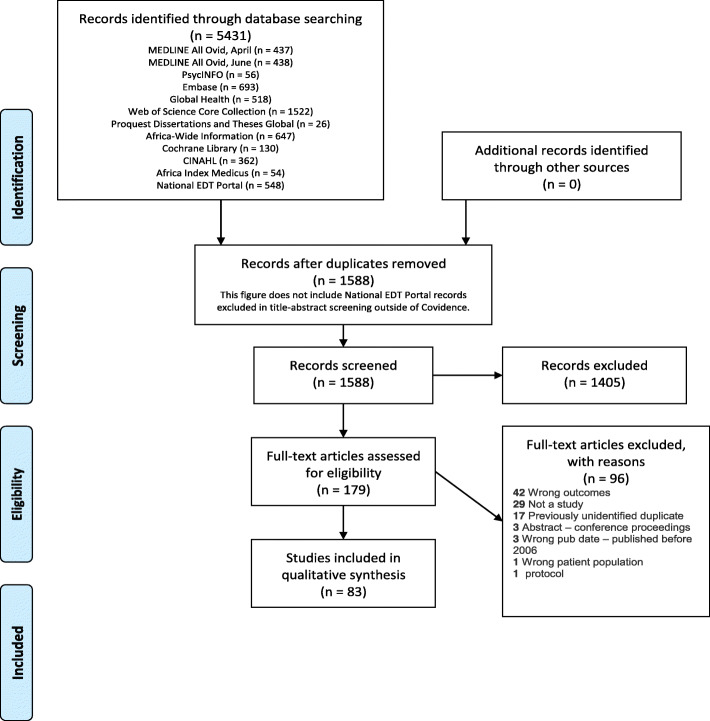
A total of 5431 citations were retrieved. Duplicates were removed in EndNote and by Covidence. Of the 1588 unique records processed in Covidence, 179 records met the criteria for full-text screening and 83 were included in the review. It was common for HIV-positive women who initiated breastfeeding to stop doing so prior to 6 months after birth (1-3 months). EBF rates rapidly declined after birth. School and work commitments were also reasons for discontinuation of EBF. HIV-positive women expressed fear of HIV MTCT transmission as a reason for not breastfeeding.
The Review found that while enforcing the most recent WHO HIV infant feeding guidelines and the WHO Code may be necessary to improve breastfeeding outcomes in South Africa, they may not be sufficient because there are additional barriers that impact breastfeeding outcomes. Mixed-methods research, including in-depth interviews with key informants representing different government sectors and civil society is needed to prioritize actions and strategies to improve breastfeeding outcomes in South Africa.
南非的母乳喂养率不理想,这归因于妇女和家庭相对容易获得婴儿配方奶粉,部分原因是预防母婴传播(MTCT)艾滋病毒的计划。这一政策也可能对 HIV 阴性妇女产生了不良的溢出效应。因此,本范围综述的目的是:(a)描述南非的纯母乳喂养做法,(b)确定自 2006 年以来遵循的世卫组织艾滋病毒婴儿喂养政策如何影响纯母乳喂养,以及(c)评估《守则》重新受到关注是否对南非的母乳喂养做法产生了任何影响。
我们应用乔安娜·布里格斯研究所(Joanna Briggs Institute)的范围综述指南,并按照 PRISMA 扩展(PRISMA-ScR)报告我们的工作。共检索了 12 个数据库和平台。我们纳入了 2006 年至 2020 年期间在南非发表的所有研究设计(无语言限制)。合格的参与者是在研究时分娩健康活产新生儿且婴儿在出生后至 24 个月之间的南非妇女,并且具有已知的婴儿喂养实践。
共检索到 5431 条引文。在 EndNote 和 Covidence 中删除了重复项。在 Covidence 中处理的 1588 条唯一记录中,有 179 条记录符合全文筛选标准,83 条记录被纳入综述。HIV 阳性妇女在产后 6 个月(1-3 个月)前开始母乳喂养后停止母乳喂养的情况很常见。母乳喂养率在产后迅速下降。上学和工作的承诺也是中断纯母乳喂养的原因。HIV 阳性妇女表示担心 HIV MTCT 传播是不母乳喂养的原因。
综述发现,尽管执行最近的世卫组织艾滋病毒婴儿喂养指南和世卫组织《守则》可能是改善南非母乳喂养结果所必需的,但这可能还不够,因为还有其他影响母乳喂养结果的障碍。需要采用混合方法研究,包括对代表不同政府部门和民间社会的主要利益攸关方进行深入访谈,以便确定优先行动和战略,以改善南非的母乳喂养结果。