Department of Epidemiology, Mailman School of Public Health, Columbia University, New York, New York.
Columbia Population Research Center, Columbia University, New York, New York.
Cancer Epidemiol Biomarkers Prev. 2021 Jul;30(7):1366-1374. doi: 10.1158/1055-9965.EPI-20-1823. Epub 2021 May 4.
Existing evidence indicates household income as a predictor of health-related quality of life (HRQoL) following a colorectal cancer diagnosis. This association likely varies with neighborhood socioeconomic status (nSES), but evidence is limited.
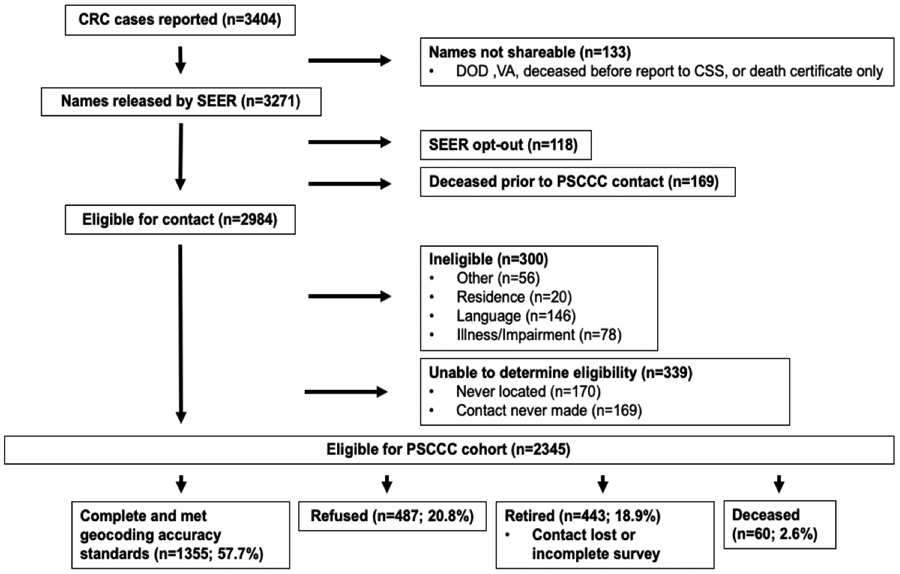
We included data from 1,355 colorectal cancer survivors participating in the population-based Puget Sound Colorectal Cancer Cohort (PSCCC). Survivors reported current annual household income; we measured HRQoL via the Functional Assessment of Cancer Therapy - Colorectal (FACT-C) tool. Using neighborhood data summarized within a 1-km radial buffer of Census block group centroids, we constructed a multidimensional nSES index measure. We employed survivors' geocoded residential addresses to append nSES score for Census block group of residence. With linear generalized estimating equations clustered on survivor location, we evaluated associations of household income with differences in FACT-C mean score, overall and stratified by nSES. We used separate models to explore relationships for wellbeing subscales.
We found lower household income to be associated with clinically meaningful differences in overall FACT-C scores [<$30K: -13.6; 95% confidence interval (CI): -16.8 to -10.4] and subscale wellbeing after a recent colorectal cancer diagnosis. Relationships were slightly greater in magnitude for survivors living in lower SES neighborhoods.
Our findings suggest that recently diagnosed lower income colorectal cancer survivors are likely to report lower HRQoL, and modestly more so in lower SES neighborhoods.
The findings from this work will aid future investigators' ability to further consider the contexts in which the income of survivors can be leveraged as a means of improving HRQoL.
现有证据表明,家庭收入是结直肠癌诊断后健康相关生活质量(HRQoL)的预测因素。这种关联可能因邻里社会经济地位(nSES)而异,但证据有限。
我们纳入了参与基于人群的普吉特湾结直肠癌队列(PSCCC)的 1355 名结直肠癌幸存者的数据。幸存者报告了当前的年收入;我们使用癌症治疗功能评估 - 结直肠癌(FACT-C)工具来衡量 HRQoL。利用在 1 公里半径的人口普查块组质心的径向缓冲区内汇总的邻里数据,我们构建了多维 nSES 指数衡量标准。我们采用幸存者的地理编码居住地址来附加居住的人口普查块组的 nSES 分数。使用线性广义估计方程按幸存者位置聚类,我们评估了家庭收入与 FACT-C 平均得分差异的关联,总体上以及按 nSES 分层。我们使用单独的模型来探索福祉子量表的关系。
我们发现,较低的家庭收入与最近诊断出的结直肠癌幸存者的整体 FACT-C 评分差异具有临床意义相关[<30K:-13.6;95%置信区间(CI):-16.8 至-10.4]和子量表幸福感。在社会经济地位较低的邻里中,幸存者的关系强度稍大。
我们的研究结果表明,最近诊断出的低收入结直肠癌幸存者可能报告的 HRQoL 较低,而在社会经济地位较低的邻里中则略高。
这项工作的结果将有助于未来的研究人员进一步考虑利用幸存者的收入来提高 HRQoL 的背景。