Department of Orthodontics, Nanjing Stomatological Hospital, Medical School of Nanjing University, Nanjing, China.
Department of Oral Sciences, Sir John Walsh Research Institute, Faculty of Dentistry, University of Otago, Dunedin, New Zealand.
J Cell Mol Med. 2021 Jun;25(11):4902-4911. doi: 10.1111/jcmm.16514. Epub 2021 May 5.
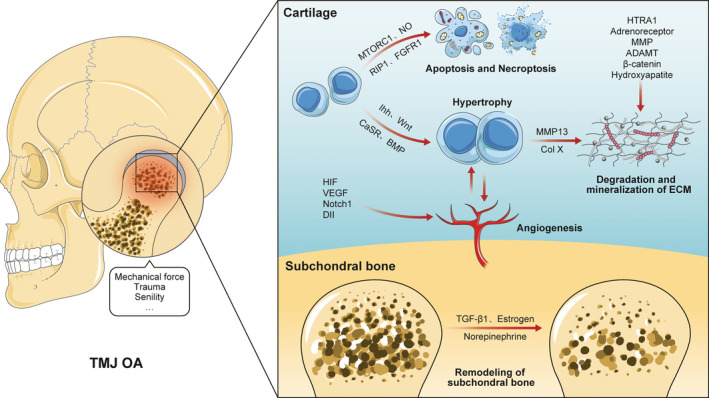
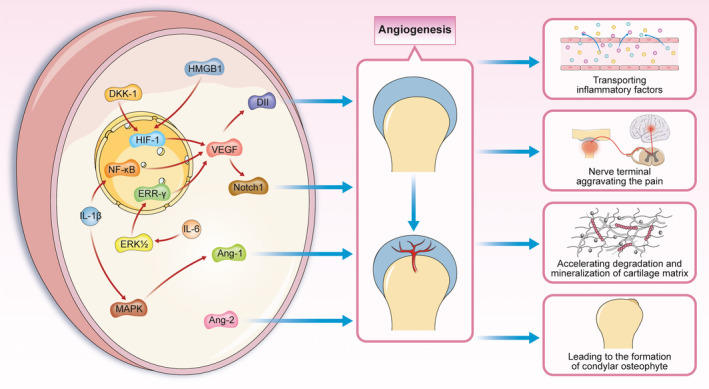
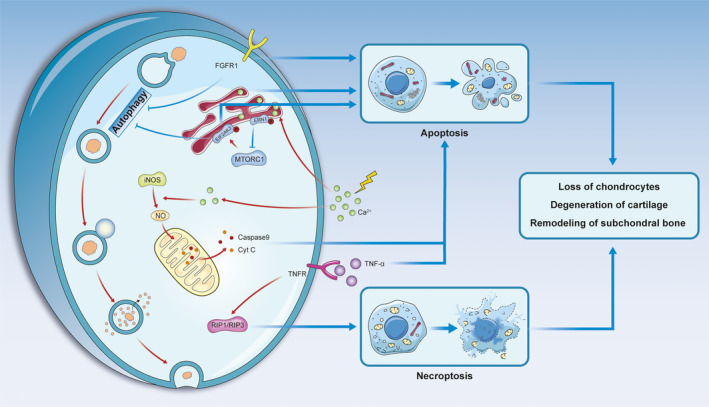
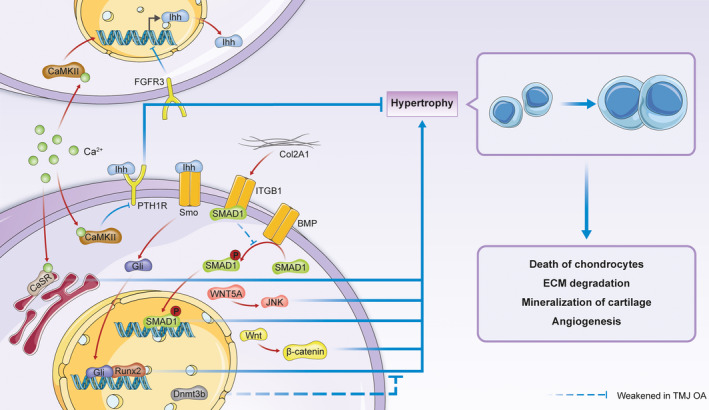
Temporomandibular joint (TMJ) osteoarthritis is a common chronic degenerative disease of the TMJ. In order to explore its aetiology and pathological mechanism, many animal models and cell models have been constructed to simulate the pathological process of TMJ osteoarthritis. The main pathological features of TMJ osteoarthritis include chondrocyte death, extracellular matrix (ECM) degradation and subchondral bone remodelling. Chondrocyte apoptosis accelerates the destruction of cartilage. However, autophagy has a protective effect on condylar chondrocytes. Degradation of ECM not only changes the properties of cartilage but also affects the phenotype of chondrocytes. The loss of subchondral bone in the early stages of TMJ osteoarthritis plays an aetiological role in the onset of osteoarthritis. In recent years, increasing evidence has suggested that chondrocyte hypertrophy and endochondral angiogenesis promote TMJ osteoarthritis. Hypertrophic chondrocytes secrete many factors that promote cartilage degeneration. These chondrocytes can further differentiate into osteoblasts and osteocytes and accelerate cartilage ossification. Intrachondral angiogenesis and neoneurogenesis are considered to be important triggers of arthralgia in TMJ osteoarthritis. Many molecular signalling pathways in endochondral osteogenesis are responsible for TMJ osteoarthritis. These latest discoveries in TMJ osteoarthritis have further enhanced the understanding of this disease and contributed to the development of molecular therapies. This paper summarizes recent cognition on the pathogenesis of TMJ osteoarthritis, focusing on the role of chondrocyte hypertrophy degeneration and cartilage angiogenesis.
颞下颌关节(TMJ)骨关节炎是一种常见的 TMJ 慢性退行性疾病。为了探讨其病因和病理机制,构建了许多动物模型和细胞模型来模拟 TMJ 骨关节炎的病理过程。TMJ 骨关节炎的主要病理特征包括软骨细胞死亡、细胞外基质(ECM)降解和软骨下骨重塑。软骨细胞凋亡加速了软骨的破坏。然而,自噬对髁突软骨细胞具有保护作用。ECM 的降解不仅改变了软骨的性质,而且影响了软骨细胞的表型。TMJ 骨关节炎早期软骨下骨的丢失在发病中起病因作用。近年来,越来越多的证据表明软骨细胞肥大和软骨内血管生成促进 TMJ 骨关节炎。肥大的软骨细胞分泌许多促进软骨退化的因子。这些软骨细胞可进一步分化为成骨细胞和骨细胞,并加速软骨骨化。软骨内血管生成和新生神经被认为是 TMJ 骨关节炎关节痛的重要触发因素。参与软骨内成骨的许多分子信号通路都与 TMJ 骨关节炎有关。TMJ 骨关节炎的这些最新发现进一步增强了对这种疾病的认识,并有助于开发分子治疗方法。本文总结了 TMJ 骨关节炎发病机制的最新认识,重点介绍了软骨细胞肥大变性和软骨血管生成的作用。