Center for Hearing and Balance, Johns Hopkins School of Medicine, Baltimore, Maryland.
Department of Biomedical Engineering, Johns Hopkins School of Medicine, Baltimore, Maryland.
J Neurophysiol. 2021 Jun 1;125(6):2444-2460. doi: 10.1152/jn.00450.2020. Epub 2021 May 5.
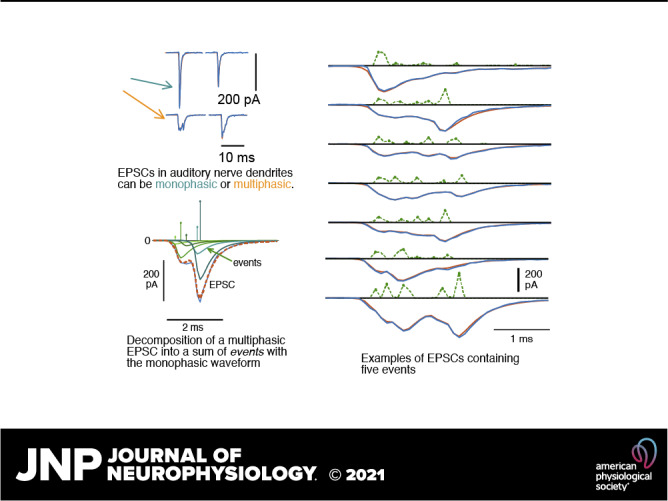
The synapse between inner hair cells and auditory nerve fiber dendrites shows large excitatory postsynaptic currents (EPSCs), which are either monophasic or multiphasic. Multiquantal or uniquantal (flickering) release of neurotransmitter has been proposed to underlie the unusual multiphasic waveforms. Here the nature of multiphasic waveforms is analyzed using EPSCs recorded in vitro in rat afferent dendrites. Spontaneous EPSCs were deconvolved into a sum of presumed release events having monophasic EPSC waveforms. Results include, first, the charge of EPSCs is about the same for multiphasic versus monophasic EPSCs. Second, EPSC amplitudes decline with the number of release events per EPSC. Third, there is no evidence of a mini-EPSC. Most results can be accounted for by versions of either uniquantal or multiquantal release. However, serial neurotransmitter release in multiphasic EPSCs shows properties that are not fully explained by either model, especially that the amplitudes of individual release events are established at the beginning of a multiphasic EPSC, constraining possible models of vesicle release. How do monophasic and multiphasic waveshapes arise in auditory-nerve dendrites; mainly are they uniquantal, arising from release of a single vesicle, or multiquantal, requiring several vesicles? The charge injected by excitatory postsynaptic currents (EPSCs) is the same for monophasic or multiphasic EPSCs, supporting uniquantal release. Serial adaptation of responses to sequential EPSCs favors a multiquantal model. Finally, neurotransmitter partitioning into similar sized release boluses occurs at the first bolus in the EPSC, not easily explained with either model.
内毛细胞和听神经纤维树突之间的突触表现出大的兴奋性突触后电流(EPSC),其为单相或多相。多量子或单量子(闪烁)神经递质释放被提出为异常多相波形的基础。这里使用在大鼠传入树突中体外记录的 EPSC 来分析多相波形的性质。自发 EPSC 被解卷积为具有单相 EPSC 波形的假定释放事件的总和。结果包括,首先,多相 EPSC 的 EPSC 电荷量与单相 EPSC 大致相同。其次,EPSC 幅度随每个 EPSC 的释放事件数而下降。第三,没有小 EPSC 的证据。大多数结果可以用单量子或多量子释放的版本来解释。然而,多相 EPSC 中的串联神经递质释放表现出两种模型都不能完全解释的特性,特别是释放事件的幅度在多相 EPSC 的开始时就确定了,这限制了囊泡释放的可能模型。听觉神经树突中的单相和多相波形成是如何产生的;它们主要是单量子的,来自单个囊泡的释放,还是多量子的,需要几个囊泡?兴奋性突触后电流(EPSC)注入的电荷量对于单相或多相 EPSC 是相同的,支持单量子释放。对顺序 EPSC 的响应的序列适应有利于多量子模型。最后,神经递质分配到 EPSC 中的第一个囊泡中具有相似大小的释放囊泡,这两种模型都不容易解释。