Shanghai National Clinical Research Center for Metabolic Diseases, Key Laboratory for Endocrine and Metabolic Diseases of Chinese Health Commission, Department of Endocrinology and Metabolism, Ruijin Hospital, Shanghai Jiao Tong University School of Medicine (SJTUSM), Shanghai 200025, China.
Institute of Neuroscience, State Key Laboratory of Neuroscience, Key Laboratory of Primate Neurobiology, Center for Excellence in Brain Science and Intelligence Technology, Chinese Academy of Sciences, Shanghai 200031, China.
J Clin Endocrinol Metab. 2021 Aug 18;106(9):e3619-e3633. doi: 10.1210/clinem/dgab297.
Vertical sleeve gastrectomy (VSG) is becoming a prioritized surgical intervention for obese individuals; however, the brain circuits that mediate its effective control of food intake and predict surgical outcome remain largely unclear.
We investigated VSG-correlated alterations of the gut-brain axis.
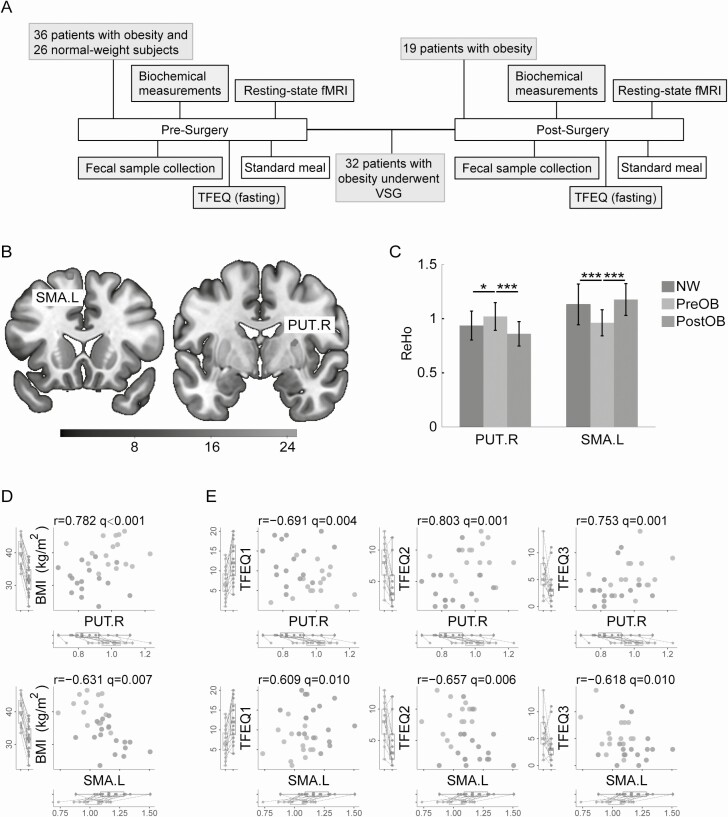
In this observational cohort study, 80 patients with obesity were screened. A total of 36 patients together with 26 normal-weight subjects were enrolled and evaluated using the 21-item Three-Factor Eating Questionnaire (TFEQ), MRI scanning, plasma intestinal hormone analysis, and fecal sample sequencing. Thirty-two patients underwent VSG treatment and 19 subjects completed an average of 4-month follow-up evaluation. Data-driven regional homogeneity (ReHo) coupled with seed-based connectivity analysis were used to quantify VSG-related brain activity. Longitudinal alterations of body weight, eating behavior, brain activity, gastrointestinal hormones, and gut microbiota were detected and subjected to repeated measures correlation analysis.
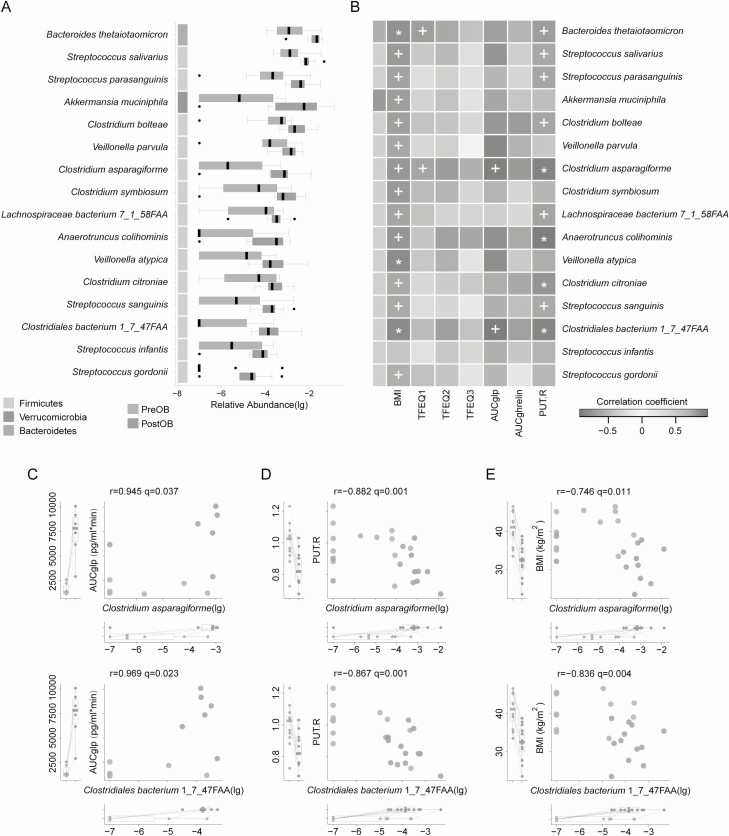
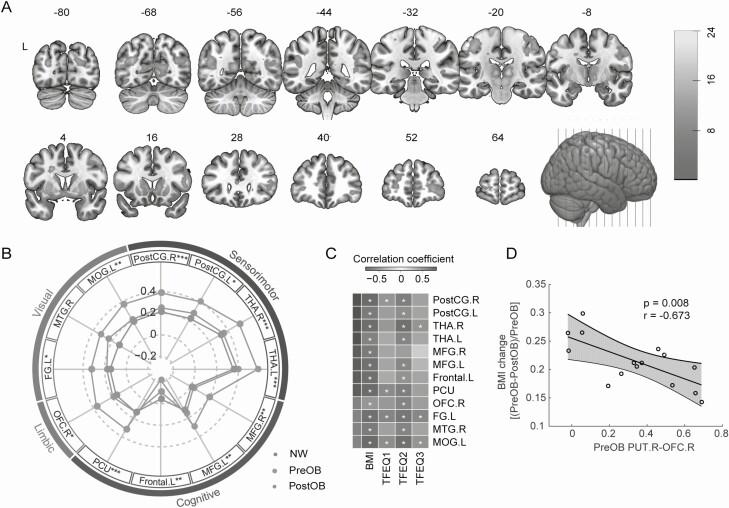
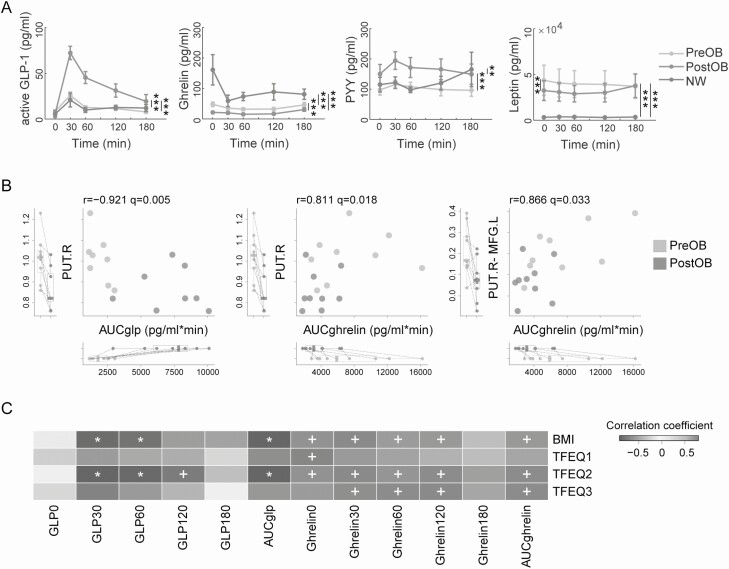
VSG induced significant functional changes in the right putamen (PUT.R) and left supplementary motor area, both of which correlated with weight loss and TFEQ scores. Moreover, postprandial levels of active glucagon-like peptide-1 (aGLP-1) and Ghrelin were associated with ReHo of PUT.R; meanwhile, relative abundance of Clostridia increased by VSG was associated with improvements in aGLP-1 secretion, PUT.R activity, and weight loss. Importantly, VSG normalized excessive functional connectivities with PUT.R, among which baseline connectivity between PUT.R and right orbitofrontal cortex was related to postoperative weight loss.
VSG causes correlated alterations of gut-brain axis, including Clostridia, postprandial aGLP-1, PUT.R activity, and eating habits. Preoperative connectivity of PUT.R may represent a potential predictive marker of surgical outcome in patients with obesity.
胃袖状切除术(VSG)正成为肥胖个体的首选手术干预措施;然而,介导其对食物摄入有效控制并预测手术效果的大脑回路在很大程度上仍不清楚。
我们研究了 VSG 相关的肠道-大脑轴的改变。
在这项观察性队列研究中,对 80 名肥胖患者进行了筛查。共纳入 36 名患者和 26 名正常体重受试者,并通过 21 项三因素饮食问卷(TFEQ)、MRI 扫描、血浆肠激素分析和粪便样本测序进行评估。32 名患者接受了 VSG 治疗,19 名受试者完成了平均 4 个月的随访评估。采用数据驱动的局部一致性(ReHo)结合种子点连接分析来量化 VSG 相关的大脑活动。检测体重、饮食行为、大脑活动、胃肠激素和肠道微生物群的纵向变化,并进行重复测量相关性分析。
VSG 诱导右侧壳核(PUT.R)和左侧辅助运动区的显著功能变化,两者均与体重减轻和 TFEQ 评分相关。此外,餐后活性胰高血糖素样肽-1(aGLP-1)和Ghrelin 水平与 PUT.R 的 ReHo 相关;同时,VSG 增加的梭菌属相对丰度与 aGLP-1 分泌、PUT.R 活性和体重减轻的改善相关。重要的是,VSG 使 PUT.R 与其他脑区的过度功能连接正常化,其中 PUT.R 与右侧眶额皮质之间的基线连接与术后体重减轻有关。
VSG 导致肠道-大脑轴的相关改变,包括梭菌属、餐后 aGLP-1、PUT.R 活性和饮食习惯。肥胖患者术前 PUT.R 的连接性可能代表手术效果的潜在预测标志物。