Montevideo Clinical and Research Unit, Avda Italia s/n, Hospital de Clinical, 11600, Montevideo, Uruguay.
UNDP/UNFPA/UNICEF/WHO/World Bank Special Programme of Research, Development and Research Training in Human Reproduction, Department of Reproductive Health and Research, World Health Organization, Avenue Appia 20, 1211, Geneva, Switzerland.
Reprod Health. 2017 Dec 13;14(1):175. doi: 10.1186/s12978-017-0436-9.
It is critical to increase the uptake of interventions proven to be effective to improve maternal and perinatal outcomes. Supply kits have been suggested to be a feasible strategy designed to ensure timely availability and effective follow-up of care.
We conducted a systematic review to summarize the evidence on the uptake, effectiveness and safety of supply kits for maternal care.
MEDLINE, the Cochrane Pregnancy and Childbirth Group's Trials Register, Campbell Collaboration, Lilacs, Embase and unpublished studies were searched.
Studies that reported the efficacy, safety and use of supply kits for maternal healthcare were eligible. Participants were pregnant women or in childbirth. Supply kits were defined as a collection of medicines, supplies or instruments packaged together with the aim of conducting a healthcare task.
Two reviewers independently performed the screening, data extraction, and methodological and quality assessment.
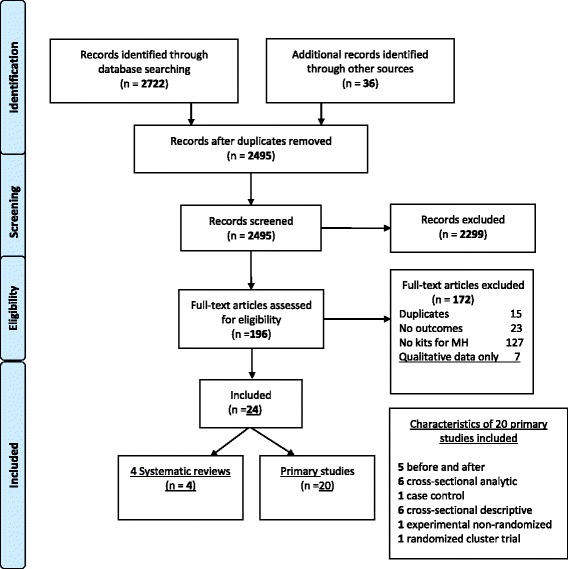
24 studies were included: 4 of them were systematic reviews and 20 primary studies. Eighteen studies evaluated a so-called "clean delivery kit". In all but two studies, the kits were used by more than half of the participants. A meta-analysis was deemed inappropriate due to the heterogeneity in study design, in the components of the interventions implemented, in the content of the kits, and in outcomes. Nine studies assessed neonatal outcomes and found statistically significant reductions in cord infection, sepsis and tetanus-related mortality in the intervention group. Three studies showed evidence of reduced neonatal mortality (OR 0.52, 0.60 and 0.71) with statistically significant confidence intervals in all cases. Four studies reported odd ratios for maternal mortality, but only one showed evidence of a statistically significant decrease in this outcome but it was ascribed to hand washing prior to childbirth and not with the use of kits.
This review suggests potential benefits in the use of supply kits to improve maternal and neonatal health. However, the observational nature of the studies, the heterogeneity and the use of kits incorporated within complex interventions limit the interpretation of the findings.
增加采用已证明能改善母婴围产期结局的干预措施至关重要。供应包已被提议为一种可行的策略,旨在确保及时提供和有效跟进护理。
我们进行了一项系统评价,以总结供应包用于产妇护理的采用情况、效果和安全性方面的证据。
检索了 MEDLINE、Cochrane 妊娠和分娩组试验注册库、坎贝尔协作、Lilacs、Embase 和未发表的研究。
报告供应包用于产妇保健的疗效、安全性和使用情况的研究符合条件。参与者为孕妇或分娩中的妇女。供应包被定义为一组包装在一起的药品、用品或器械,旨在开展医疗保健任务。
两名评审员独立进行筛选、数据提取以及方法学和质量评估。
纳入了 24 项研究:其中 4 项为系统评价,20 项为原始研究。18 项研究评估了所谓的“清洁分娩包”。除了两项研究外,所有研究中都有超过一半的参与者使用了套件。由于研究设计、实施干预措施的组成部分、套件的内容和结果存在异质性,因此认为不适合进行荟萃分析。9 项研究评估了新生儿结局,发现干预组脐带感染、败血症和破伤风相关死亡率有统计学显著降低。3 项研究表明,所有情况下新生儿死亡率的比值比(OR)均有统计学显著降低(OR 0.52、0.60 和 0.71)。4 项研究报告了孕产妇死亡率的比值比,但只有 1 项研究表明这一结果有统计学显著降低,但归因于分娩前洗手,而不是套件的使用。
本综述表明供应包的使用可能有助于改善母婴健康。然而,研究的观察性质、异质性以及纳入复杂干预措施的套件的使用限制了对研究结果的解释。