Graduate School of Medical Science and Engineering, Korea Advanced Institute of Science and Technology (KAIST), Daejeon, 34141, Republic of Korea.
Center for Epidemic Preparedness, KAIST, Daejeon, 34141, Republic of Korea.
Exp Mol Med. 2021 May;53(5):750-760. doi: 10.1038/s12276-021-00592-0. Epub 2021 May 6.
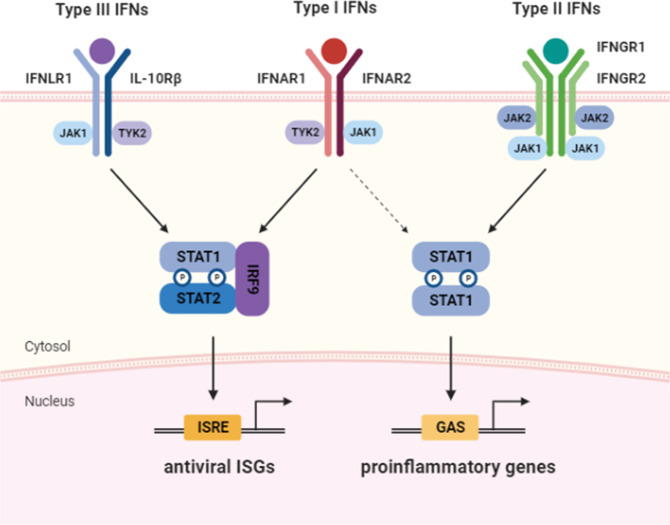
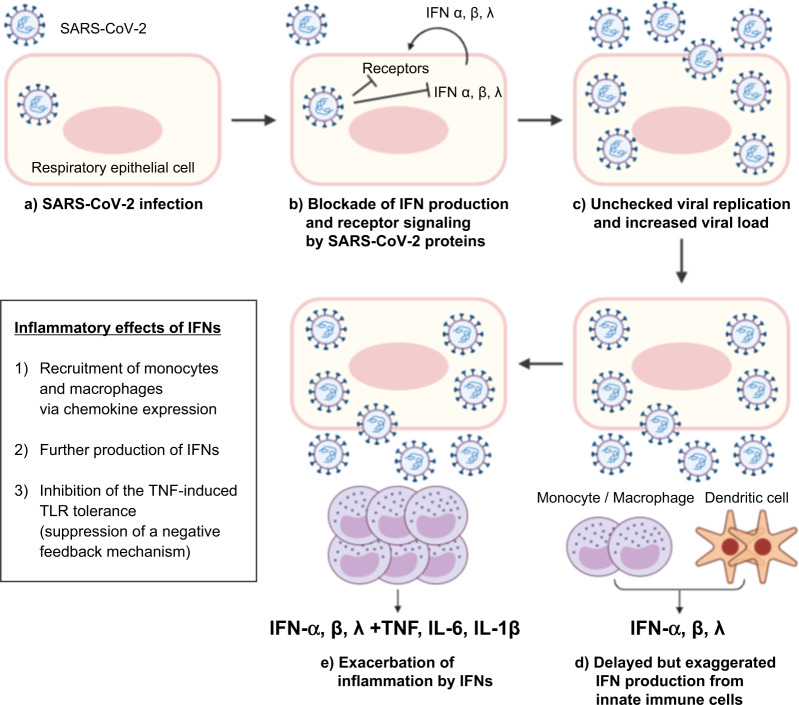
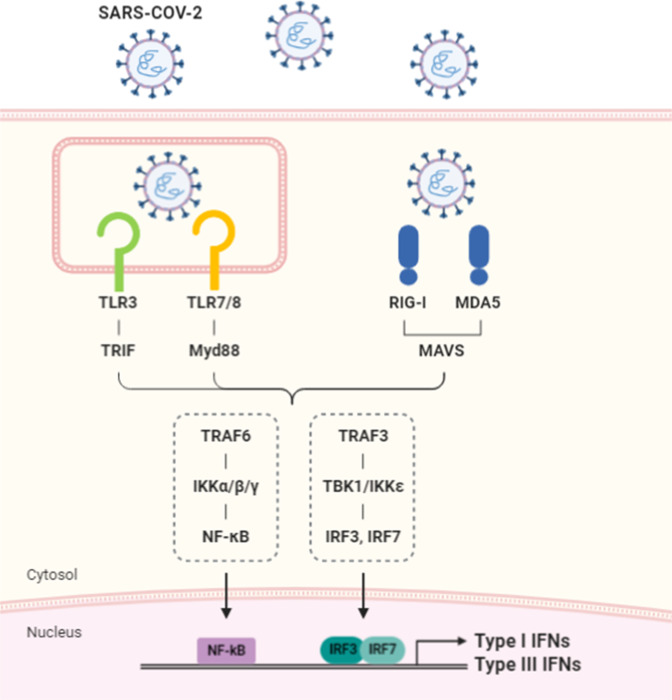
Coronavirus disease 2019 (COVID-19), the current pandemic disease, is caused by severe acute respiratory syndrome coronavirus 2 (SARS-CoV-2) infection. Type I and III interferons (IFNs) are innate cytokines that are important in the first-line defense against viruses. Similar to many other viruses, SARS-CoV-2 has evolved mechanisms for evading the antiviral effects of type I and III IFNs at multiple levels, including the induction of IFN expression and cellular responses to IFNs. In this review, we describe the innate sensing mechanisms of SARS-CoV-2 and the mechanisms used by SARS-CoV-2 to evade type I and III IFN responses. We also discuss contradictory reports regarding impaired and robust type I IFN responses in patients with severe COVID-19. Finally, we discuss how delayed but exaggerated type I IFN responses can exacerbate inflammation and contribute to the severe progression of COVID-19.
新型冠状病毒病(COVID-19),当前的大流行病,是由严重急性呼吸综合征冠状病毒 2(SARS-CoV-2)感染引起的。I 型和 III 型干扰素(IFN)是先天细胞因子,在对抗病毒的第一线防御中很重要。与许多其他病毒一样,SARS-CoV-2 在多个层面上进化出了逃避 I 型和 III 型 IFN 抗病毒作用的机制,包括 IFN 表达的诱导和细胞对 IFN 的反应。在这篇综述中,我们描述了 SARS-CoV-2 的先天感应机制,以及 SARS-CoV-2 逃避 I 型和 III 型 IFN 反应的机制。我们还讨论了关于重症 COVID-19 患者 I 型 IFN 反应受损和强烈的矛盾报告。最后,我们讨论了延迟但过度的 I 型 IFN 反应如何加剧炎症并导致 COVID-19 的严重进展。