Campana Chiara, Dariolli Rafael, Boutjdir Mohamed, Sobie Eric A
Department of Pharmacological Sciences, Icahn School of Medicine at Mount Sinai, New York, NY, United States.
Cardiovascular Research Program, VA New York Harbor Healthcare System, Brooklyn, NY, United States.
Front Pharmacol. 2021 Apr 19;12:598549. doi: 10.3389/fphar.2021.598549. eCollection 2021.
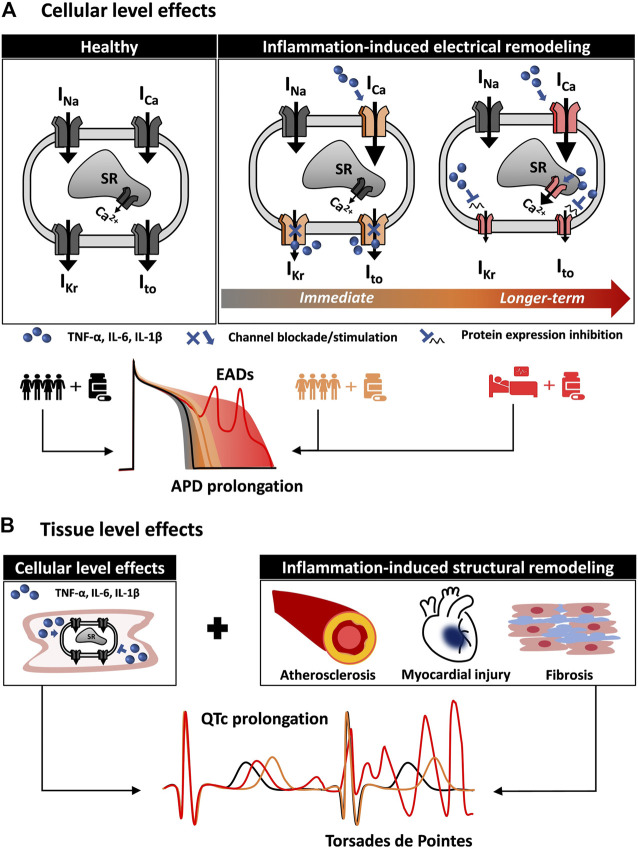
Numerous commonly prescribed drugs, including antiarrhythmics, antihistamines, and antibiotics, carry a proarrhythmic risk and may induce dangerous arrhythmias, including the potentially fatal Torsades de Pointes. For this reason, cardiotoxicity testing has become essential in drug development and a required step in the approval of any medication for use in humans. Blockade of the hERG K channel and the consequent prolongation of the QT interval on the ECG have been considered the gold standard to predict the arrhythmogenic risk of drugs. In recent years, however, preclinical safety pharmacology has begun to adopt a more integrative approach that incorporates mathematical modeling and considers the effects of drugs on multiple ion channels. Despite these advances, early stage drug screening research only evaluates QT prolongation in experimental and computational models that represent healthy individuals. We suggest here that integrating disease modeling with cardiotoxicity testing can improve drug risk stratification by predicting how disease processes and additional comorbidities may influence the risks posed by specific drugs. In particular, chronic systemic inflammation, a condition associated with many diseases, affects heart function and can exacerbate medications' cardiotoxic effects. We discuss emerging research implicating the role of inflammation in cardiac electrophysiology, and we offer a perspective on how modeling of inflammation may lead to improved evaluation of the proarrhythmic risk of drugs at their early stage of development.
许多常用药物,包括抗心律失常药、抗组胺药和抗生素,都存在促心律失常风险,可能诱发危险的心律失常,包括潜在致命的尖端扭转型室速。因此,心脏毒性测试已成为药物研发的关键环节,也是任何用于人类的药物获批的必要步骤。阻断人乙醚相关基因(hERG)钾通道以及随之而来的心电图QT间期延长,被视为预测药物致心律失常风险的金标准。然而近年来,临床前安全药理学已开始采用更综合的方法,该方法纳入数学建模并考虑药物对多个离子通道的影响。尽管有这些进展,但早期药物筛选研究仅在代表健康个体的实验和计算模型中评估QT间期延长情况。我们在此建议,将疾病建模与心脏毒性测试相结合,可以通过预测疾病进程和其他合并症如何影响特定药物所带来的风险,来改善药物风险分层。特别是,慢性全身炎症这种与多种疾病相关的情况,会影响心脏功能,并可能加剧药物的心脏毒性作用。我们讨论了有关炎症在心脏电生理学中作用的新兴研究,并就炎症建模如何在药物研发早期阶段改善对其促心律失常风险的评估提供了一个观点。