Department of Psychology and Neurosciences, Neuroimaging and Interindividual Differences, Leibniz Research Centre for Working Environment and Human Factors (IfADo), Dortmund, Germany.
Department of Biopsychology, Institute of Cognitive Neuroscience, Ruhr University Bochum, Bochum, Germany.
Mol Neurobiol. 2021 Aug;58(8):4145-4156. doi: 10.1007/s12035-021-02398-7. Epub 2021 May 5.
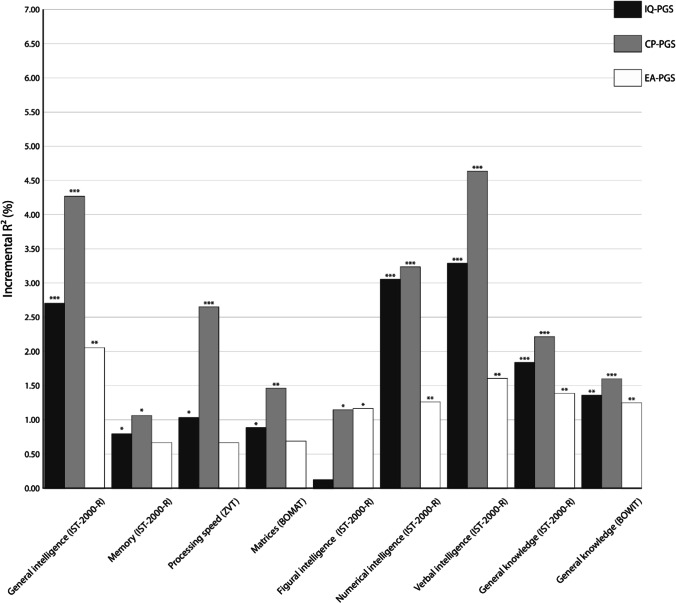
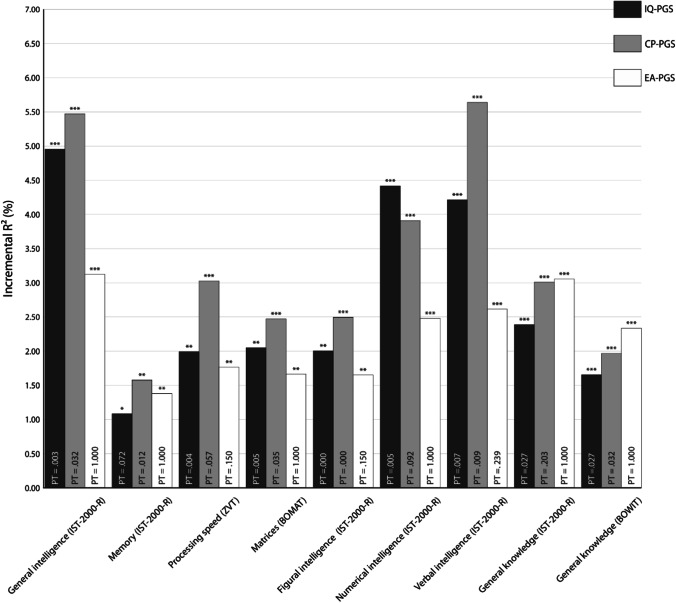
Intelligence is a highly polygenic trait and genome-wide association studies (GWAS) have identified thousands of DNA variants contributing with small effects. Polygenic scores (PGS) can aggregate those effects for trait prediction in independent samples. As large-scale light-phenotyping GWAS operationalized intelligence as performance in rather superficial tests, the question arises which intelligence facets are actually captured. We used deep-phenotyping to investigate the molecular determinants of individual differences in cognitive ability. We, therefore, studied the association between PGS of intelligence (IQ-PGS), cognitive performance (CP-PGS), and educational attainment (EA-PGS) with a wide range of intelligence facets in a sample of 557 healthy adults. IQ-PGS, CP-PGS, and EA-PGS had the highest incremental Rs for general (2.71%; 4.27%; 2.06%), verbal (3.30%; 4.64%; 1.61%), and numerical intelligence (3.06%; 3.24%; 1.26%) and the weakest for non-verbal intelligence (0.89%; 1.47%; 0.70%) and memory (0.80%; 1.06%; 0.67%). These results indicate that PGS derived from light-phenotyping GWAS do not reflect different facets of intelligence equally well, and thus should not be interpreted as genetic indicators of intelligence per se. The findings refine our understanding of how PGS are related to other traits or life outcomes.
智力是一个高度多基因特征,全基因组关联研究(GWAS)已经确定了数千个具有小效应的 DNA 变体。多基因评分(PGS)可以在独立样本中聚合这些效应,用于特征预测。由于大规模的轻表型 GWAS 将智力定义为相当肤浅的测试中的表现,因此出现了一个问题,即实际上捕捉到了哪些智力方面。我们使用深度表型研究来研究认知能力个体差异的分子决定因素。因此,我们在 557 名健康成年人的样本中研究了智力的 PGS(IQ-PGS)、认知表现(CP-PGS)和教育程度(EA-PGS)与广泛的智力方面之间的关联。IQ-PGS、CP-PGS 和 EA-PGS 对一般智力(2.71%;4.27%;2.06%)、言语智力(3.30%;4.64%;1.61%)和数字智力(3.06%;3.24%;1.26%)的增量 Rs 最高,而对非言语智力(0.89%;1.47%;0.70%)和记忆(0.80%;1.06%;0.67%)的增量 Rs 最弱。这些结果表明,源自轻表型 GWAS 的 PGS 并不能平等地反映智力的不同方面,因此不应被解释为智力的遗传指标。这些发现细化了我们对 PGS 与其他特征或生活结果的关系的理解。