Department of Genetics, School of Life Science, Graduate University for Advanced Studies (SOKENDAI), Mishima, Shizuoka, 411-8540, Japan.
SAITOU Laboratory, National Institute of Genetics, Mishima, Shizuoka, 411-8540, Japan.
J Hum Genet. 2022 Sep;67(9):527-532. doi: 10.1038/s10038-022-01039-8. Epub 2022 May 9.
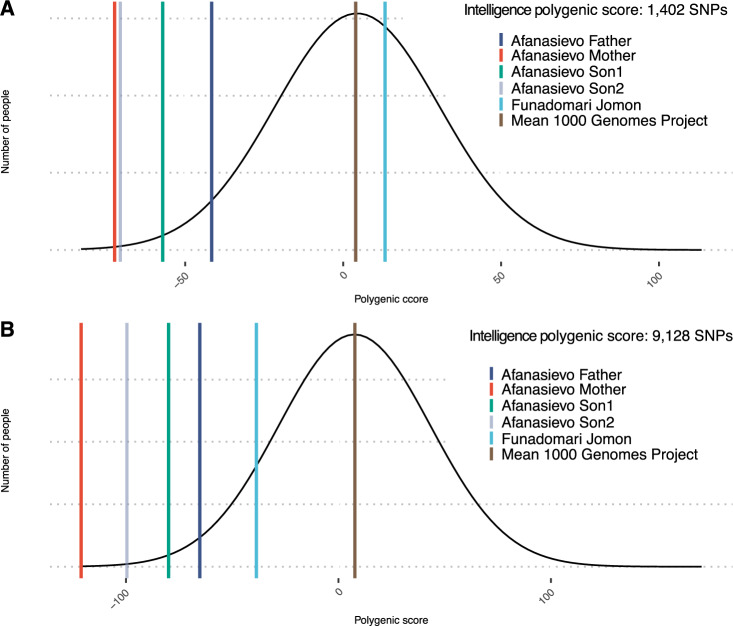
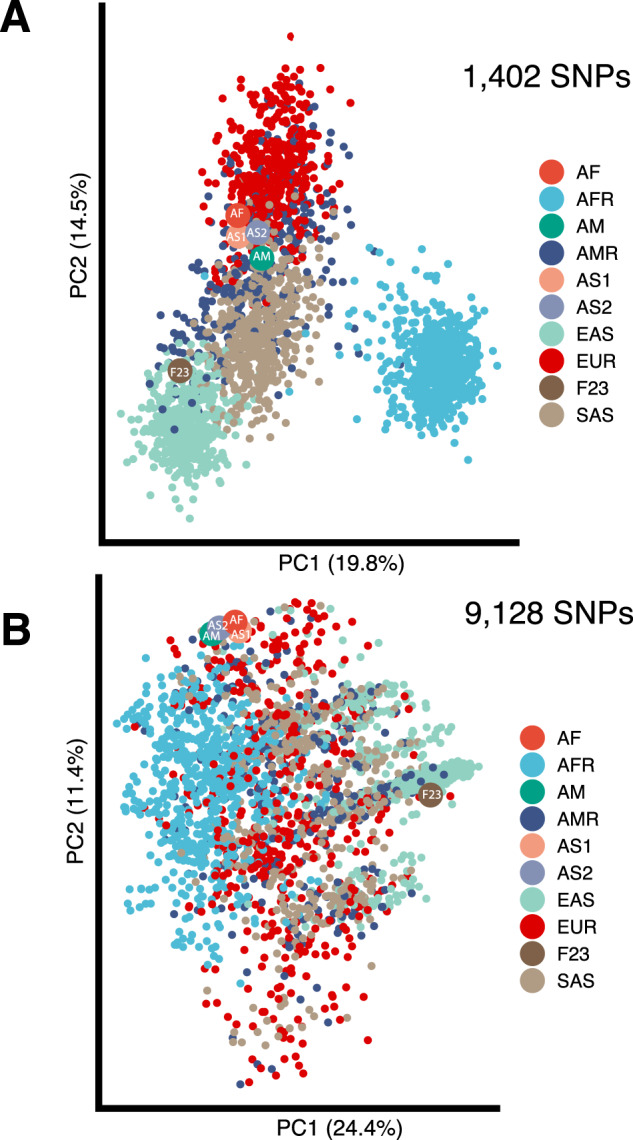
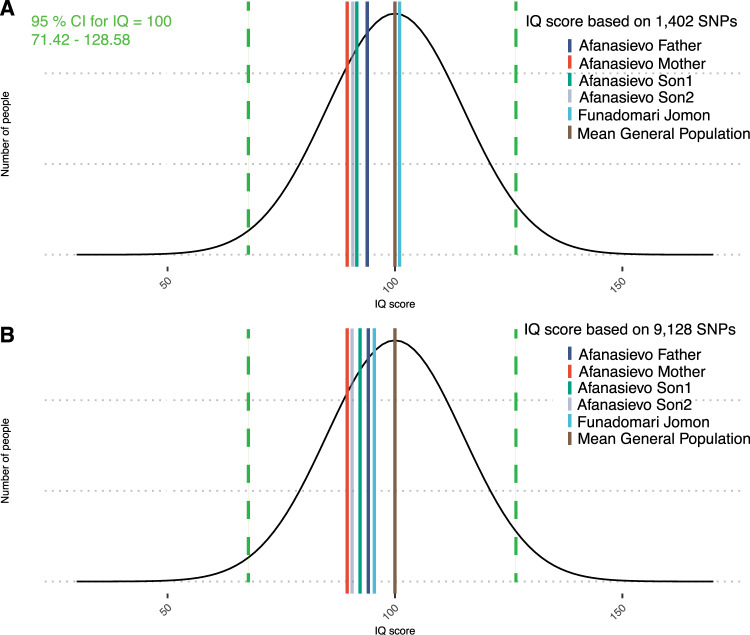
Quantification of ancient human intelligence has become possible with recent advances in polygenic prediction. Intelligence is a complex trait that has both environmental and genetic components and high heritability. Large-scale genome-wide association studies based on ~270,000 individuals have demonstrated highly significant single-nucleotide polymorphisms (SNPs) associated with intelligence in present-day humans. We utilized those previously reported 12,037 SNPs to estimate a genetic component of intelligence in ancient Funadomari Jomon individual from 3700 years BP as well as four individuals of Afanasievo nuclear family from about 4100 years BP and who are considered anatomically modern humans. We have demonstrated that ancient individuals could have been not inferior in intelligence compared to present-day humans through assessment of the genetic component of intelligence. We have also confirmed that alleles associated with intelligence tend to spread equally between ancestral and derived origin suggesting that intelligence may be a neutral trait in human evolution.
利用多基因预测的最新进展,对古代人类智力进行量化已成为可能。智力是一种复杂的特征,既有环境因素,也有遗传因素,具有高度遗传性。基于约 27 万人的大规模全基因组关联研究表明,单核苷酸多态性(SNP)与现代人的智力高度相关。我们利用先前报道的 12037 个 SNP 来估计 3700 年前来自古代船户绳文人个体以及 4100 年前被认为是解剖学上的现代人的阿凡纳谢沃核家庭的四个个体的智力遗传成分。通过评估智力的遗传成分,我们证明了古代个体的智力可能并不逊于现代人。我们还证实,与智力相关的等位基因在祖先和衍生起源之间平均分布,这表明智力可能是人类进化中的一个中性特征。