Institute of Biomedical and Health Engineering, Shenzhen Institutes of Advanced Technology, Chinese Academy of Sciences, Shenzhen, 518055, China.
Department of Radiation Oncology, National Cancer Center/National Clinical Research Center for Cancer/Cancer Hospital & Shenzhen Hospital, Chinese Academy of Medical Sciences and Peking Union Medical College, Shenzhen, 518116, China.
J Appl Clin Med Phys. 2021 Jun;22(6):146-153. doi: 10.1002/acm2.13252. Epub 2021 May 5.
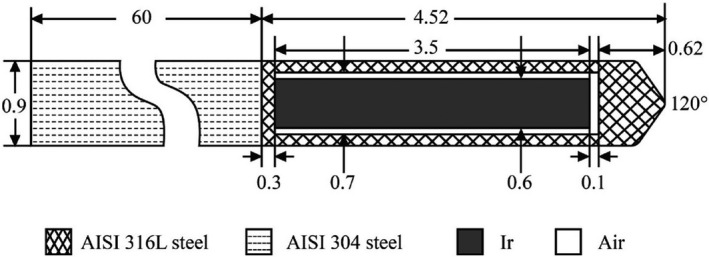
To develop a simulation model for GammaMed Plus high dose rate Ir brachytherapy source in TOPAS Monte Carlo software and validate it by calculating the TG-43 dosimetry parameters and comparing them with published data.
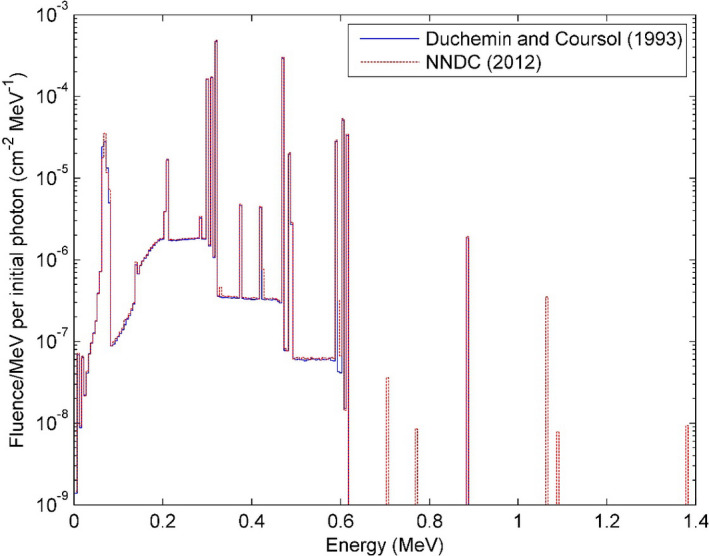
We built a model for GammaMed Plus high dose rate brachytherapy source in TOPAS. The TG-43 dosimetry parameters including air-kerma strength S , dose-rate constant Λ, radial dose function g (r), and 2D anisotropy function F(r,θ) were calculated using Monte Carlo simulation with Geant4 physics models and NNDC Ir spectrum. Calculations using an old Ir spectrum were also carried out to evaluate the impact of incident spectrum and cross sections. The results were compared with published data.
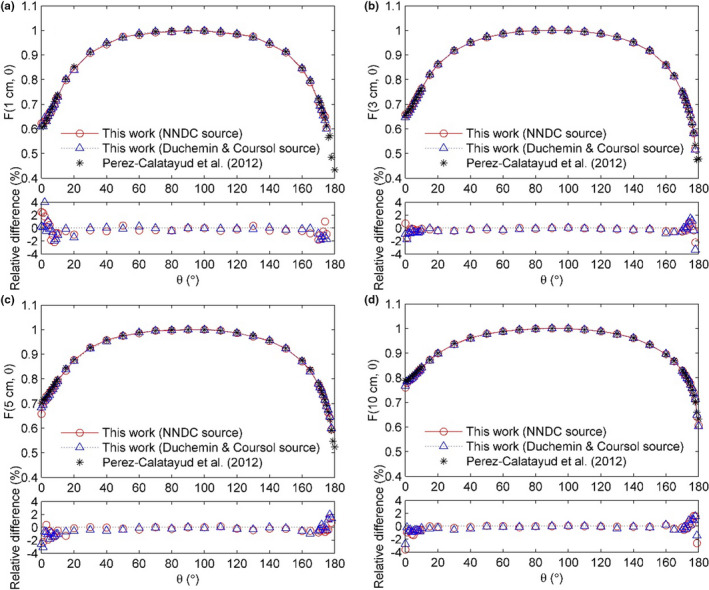
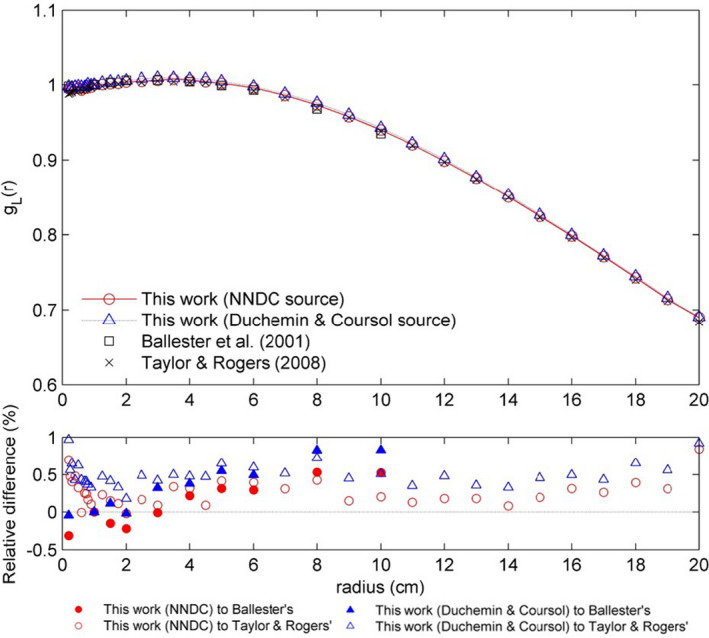
For calculations using the NNDC spectrum, the air-kerma strength per unit source activity S /A and Λ were 1.0139 × 10 U/Bq and 1.1101 cGy.h .U , which were 3.56% higher and 0.62% lower than the reference values, respectively. The g (r) agreed with reference values within 1% for radial distances from 2 mm to 20 cm. For radial distances of 1, 3, 5, and 10 cm, the agreements between F(r,θ) from this work and the reference data were within 1.5% for 15° < θ < 165°, and within 4% for all θ values. The discrepancies were attributed to the updated source spectrum and cross sections. They caused deviations of the S /A of 2.90% and 0.64%, respectively. As for g (r), they caused average deviations of -0.22% and 0.48%, respectively. Their impact on F(r,θ) was not quantified for the relatively high statistical uncertainties, but basically they did not result in significant discrepancies.
A model for GammaMed Plus high dose rate Ir brachytherapy source was developed in TOPAS and validated following TG-43 protocols, which can be used for future studies. The impact of updated incident spectrum and cross sections on the dosimetry parameters was quantified.
在 TOPAS 蒙特卡罗软件中开发 GammaMed Plus 高剂量率 Ir 近距离治疗源的仿真模型,并通过计算 TG-43 剂量学参数并与已发表的数据进行比较来验证该模型。
我们在 TOPAS 中为 GammaMed Plus 高剂量率近距离治疗源建立了一个模型。使用 Geant4 物理模型和 NNDC Ir 能谱对蒙特卡罗模拟计算 TG-43 剂量学参数,包括空气比释动能强度 S、剂量率常数 Λ、径向剂量函数 g(r)和二维各向异性函数 F(r,θ)。还使用旧的 Ir 能谱进行了计算,以评估入射谱和截面的影响。结果与已发表的数据进行了比较。
对于使用 NNDC 能谱的计算,单位源活度 S/A 和 Λ 的空气比释动能强度分别为 1.0139×10 U/Bq 和 1.1101 cGy·h·U ,分别比参考值高 3.56%和低 0.62%。g(r)在 2mm 至 20cm 的径向距离内与参考值的偏差在 1%以内。对于 1cm、3cm、5cm 和 10cm 的径向距离,本工作与参考数据的 F(r,θ)之间的一致性在 15°<θ<165°时为 1.5%以内,在所有 θ 值时为 4%以内。差异归因于更新的源谱和截面。它们分别导致 S/A 的偏差为 2.90%和 0.64%。至于 g(r),它们分别导致平均偏差为-0.22%和 0.48%。由于相对较高的统计不确定性,它们对 F(r,θ)的影响无法定量,但基本上不会导致显著的差异。
在 TOPAS 中开发了 GammaMed Plus 高剂量率 Ir 近距离治疗源的模型,并按照 TG-43 方案进行了验证,可用于未来的研究。量化了更新的入射谱和截面对剂量学参数的影响。