• 文献检索
  • 文档翻译
  • 深度研究
  • 学术资讯
  • Suppr Zotero 插件Zotero 插件
  • 邀请有礼
  • 套餐&价格
  • 历史记录
应用&插件
Suppr Zotero 插件Zotero 插件浏览器插件Mac 客户端Windows 客户端微信小程序
定价
高级版会员购买积分包购买API积分包
服务
文献检索文档翻译深度研究API 文档MCP 服务
关于我们
关于 Suppr公司介绍联系我们用户协议隐私条款
关注我们

Suppr 超能文献

核心技术专利:CN118964589B侵权必究
粤ICP备2023148730 号-1Suppr @ 2026

文献检索

告别复杂PubMed语法,用中文像聊天一样搜索,搜遍4000万医学文献。AI智能推荐,让科研检索更轻松。

立即免费搜索

文件翻译

保留排版,准确专业,支持PDF/Word/PPT等文件格式,支持 12+语言互译。

免费翻译文档

深度研究

AI帮你快速写综述,25分钟生成高质量综述,智能提取关键信息,辅助科研写作。

立即免费体验

使用美国医学物理学家协会(AAPM)和欧洲放射肿瘤学会(ESTRO)的形式体系对M-15高剂量率铱-192近距离放射治疗源进行剂量学表征。

Dosimetric characterization of the M-15 high-dose-rate Iridium-192 brachytherapy source using the AAPM and ESTRO formalism.

作者信息

Ho Than Minh-Tri, Munro Iii John J, Medich David C

机构信息

Worcester Polytechnic Institute.

出版信息

J Appl Clin Med Phys. 2015 May 8;16(3):5270. doi: 10.1120/jacmp.v16i3.5270.

DOI:10.1120/jacmp.v16i3.5270
PMID:26103489
原文链接:https://pmc.ncbi.nlm.nih.gov/articles/PMC5690138/
Abstract

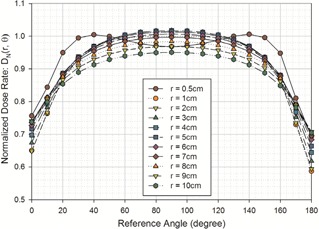
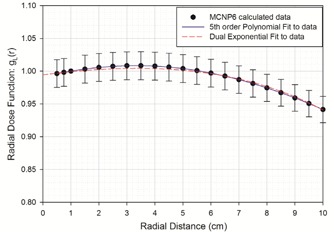
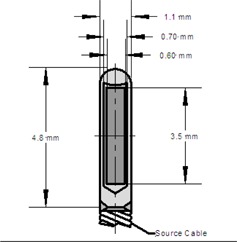
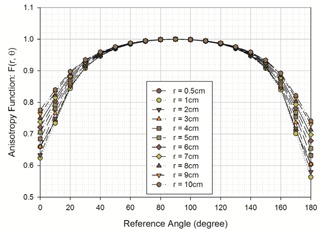
The Source Production & Equipment Co. (SPEC) model M-15 is a new Iridium-192 brachytherapy source model intended for use as a temporary high-dose-rate (HDR) brachytherapy source for the Nucletron microSelectron Classic afterloading system. The purpose of this study is to characterize this HDR source for clinical application by obtaining a complete set of Monte Carlo calculated dosimetric parameters for the M-15, as recommended by AAPM and ESTRO, for isotopes with average energies greater than 50 keV. This was accomplished by using the MCNP6 Monte Carlo code to simulate the resulting source dosimetry at various points within a pseudoinfinite water phantom. These dosimetric values next were converted into the AAPM and ESTRO dosimetry parameters and the respective statistical uncertainty in each parameter also calculated and presented. The M-15 source was modeled in an MCNP6 Monte Carlo environment using the physical source specifications provided by the manufacturer. Iridium-192 photons were uniformly generated inside the iridium core of the model M-15 with photon and secondary electron transport replicated using photoatomic cross-sectional tables supplied with MCNP6. Simulations were performed for both water and air/vacuum computer models with a total of 4 × 10⁹ sources photon history for each simulation and the in-air photon spectrum filtered to remove low-energy photons belowδ = 10 keV. Dosimetric data, including D·(r,θ), gL(r), F(r,θ), φan(r), and φ-an, and their statistical uncertainty were calculated from the output of an MCNP model consisting of an M-15 source placed at the center of a spherical water phantom of 100 cm diameter. The air kerma strength in free space, SK, and dose rate constant, Λ, also was computed from a MCNP model with M-15 Iridium-192 source, was centered at the origin of an evacuated phantom in which a critical volume containing air at STP was added 100 cm from the source center. The reference dose rate, D·(r0,θ0) ≡ D· (1cm,π/2), is found to be 4.038 ± 0.064 cGy mCi-1 h-1. The air kerma strength, SK, is reported to be 3.632 ± 0.086 cGy cm2 mCi-1 g-1, and the dose rate constant, Λ, is calculated to be 1.112 ± 0.029 cGy h-1 U-1. The normalized dose rate, radial dose function, and anisotropy function with their uncertainties were computed and are represented in both tabular and graphical format in the report. A dosimetric study was performed of the new M-15 Iridium-192 HDR brachytherapy source using the MCNP6 radiation transport code. Dosimetric parameters, including the dose-rate constant, radial dose function, and anisotropy function, were calculated in accordance with the updated AAPM and ESTRO dosimetric parameters for brachytherapy sources of average energy greater than 50 keV. These data therefore may be applied toward the development of a treatment planning program and for clinical use of the source.
https://cdn.ncbi.nlm.nih.gov/pmc/blobs/4874/5690138/33396c8fe331/ACM2-16-305-g004.jpg
https://cdn.ncbi.nlm.nih.gov/pmc/blobs/4874/5690138/1e51dd2225a8/ACM2-16-305-g001.jpg
https://cdn.ncbi.nlm.nih.gov/pmc/blobs/4874/5690138/9be2ae7cd924/ACM2-16-305-g002.jpg
https://cdn.ncbi.nlm.nih.gov/pmc/blobs/4874/5690138/36297bbd750c/ACM2-16-305-g003.jpg
https://cdn.ncbi.nlm.nih.gov/pmc/blobs/4874/5690138/33396c8fe331/ACM2-16-305-g004.jpg
https://cdn.ncbi.nlm.nih.gov/pmc/blobs/4874/5690138/1e51dd2225a8/ACM2-16-305-g001.jpg
https://cdn.ncbi.nlm.nih.gov/pmc/blobs/4874/5690138/9be2ae7cd924/ACM2-16-305-g002.jpg
https://cdn.ncbi.nlm.nih.gov/pmc/blobs/4874/5690138/36297bbd750c/ACM2-16-305-g003.jpg
https://cdn.ncbi.nlm.nih.gov/pmc/blobs/4874/5690138/33396c8fe331/ACM2-16-305-g004.jpg
摘要

源生产与设备公司(SPEC)的M-15型是一种新型铱-192近距离放射治疗源型号,旨在用作Nucletron microSelectron Classic后装系统的临时高剂量率(HDR)近距离放射治疗源。本研究的目的是按照美国医学物理学家协会(AAPM)和欧洲放射肿瘤学会(ESTRO)针对平均能量大于50 keV的同位素所推荐的方法,通过获取M-15的一整套蒙特卡罗计算剂量学参数,来对这种HDR源进行临床应用特性描述。这是通过使用MCNP6蒙特卡罗代码来模拟在一个虚拟无限水模体中各个点处产生的源剂量学来实现的。接下来,将这些剂量学值转换为AAPM和ESTRO剂量学参数,并计算并给出每个参数各自的统计不确定度。M-15源在MCNP6蒙特卡罗环境中根据制造商提供的物理源规格进行建模。铱-192光子在M-15型号的铱芯内部均匀产生,光子和二次电子传输使用MCNP6附带的光原子截面表进行复制。对水和空气/真空计算机模型都进行了模拟,每次模拟共有4×10⁹个源光子历史,并且对空气中的光子能谱进行滤波以去除低于δ = 1 keV的低能光子。剂量学数据,包括D·(r,θ)、gL(r)、F(r,θ)、φan(r)和φ - an,以及它们的统计不确定度,是从一个MCNP模型的输出中计算得到的,该模型由放置在直径为100 cm的球形水模体中心的一个M-15源组成。自由空间中的空气比释动能强度SK和剂量率常数Λ,也从一个带有M-15铱-192源的MCNP模型中计算得到,该模型位于一个抽空模体的原点处,在距源中心100 cm处添加了一个包含标准温度和压力下空气的临界体积。参考剂量率D·(r0,θ0)≡D·(1 cm,π/2)被发现为4.038±0.064 cGy mCi⁻¹ h⁻¹。空气比释动能强度SK据报道为3.632±0.086 cGy cm² mCi⁻¹ g⁻¹,剂量率常数Λ经计算为1.112±0.029 cGy h⁻¹ U⁻¹。归一化剂量率、径向剂量函数和各向异性函数及其不确定度已计算出来,并在报告中以表格和图形形式呈现。使用MCNP6辐射传输代码对新型M-15铱-192 HDR近距离放射治疗源进行了剂量学研究。根据针对平均能量大于50 keV的近距离放射治疗源的更新后的AAPM和ESTRO剂量学参数,计算了剂量学参数,包括剂量率常数、径向剂量函数和各向异性函数。因此,这些数据可用于治疗计划程序的开发以及该源的临床应用。

相似文献

1
Dosimetric characterization of the M-15 high-dose-rate Iridium-192 brachytherapy source using the AAPM and ESTRO formalism.使用美国医学物理学家协会(AAPM)和欧洲放射肿瘤学会(ESTRO)的形式体系对M-15高剂量率铱-192近距离放射治疗源进行剂量学表征。
J Appl Clin Med Phys. 2015 May 8;16(3):5270. doi: 10.1120/jacmp.v16i3.5270.
2
Dosimetric characterization of the GammaClip™ 169Yb low dose rate permanent implant brachytherapy source for the treatment of nonsmall cell lung cancer postwedge resection.GammaClip™169Yb 低剂量率永久植入近距离放射治疗源用于治疗非小细胞肺癌楔形切除术后的剂量学特征。
Med Phys. 2013 Aug;40(8):080701. doi: 10.1118/1.4812675.
3
Monte Carlo characterization of the M-19 high dose rate Iridium-192 brachytherapy source.M-19高剂量率铱-192近距离放射治疗源的蒙特卡罗特性描述
Med Phys. 2007 Jun;34(6):1999-2006. doi: 10.1118/1.2733809.
4
Monte Carlo dosimetric parameter study of a new (32)P brachytherapy source.新型³²P近距离治疗源的蒙特卡罗剂量学参数研究
Br J Radiol. 2016 Jun;89(1062):20150783. doi: 10.1259/bjr.20150783. Epub 2016 Apr 4.
5
Monte Carlo dosimetric study of best industries and Alpha Omega Ir-192 brachytherapy seeds.最佳工业公司和阿尔法欧米伽铱-192近距离放射治疗种子源的蒙特卡洛剂量学研究
Med Phys. 2004 Dec;31(12):3298-305. doi: 10.1118/1.1820013.
6
EGSnrc-based Monte Carlo dosimetry of CSA1 and CSA2 137Cs brachytherapy source models.基于EGSnrc的CSA1和CSA2 137Cs近距离治疗源模型的蒙特卡罗剂量测定法。
Med Phys. 2009 Sep;36(9):3870-9. doi: 10.1118/1.3176936.
7
Dosimetric characterization of an 192Ir brachytherapy source with the Monte Carlo code PENELOPE.应用蒙特卡罗代码 PENELOPE 对 192Ir 近距离放射治疗源进行剂量学特性描述。
Phys Med. 2010;26(3):132-9. doi: 10.1016/j.ejmp.2009.11.001. Epub 2010 Jan 14.
8
Study of encapsulated 170Tm sources for their potential use in brachytherapy.研究封装的 170Tm 源,以评估其在近距离治疗中的潜在应用。
Med Phys. 2010 Apr;37(4):1629-37. doi: 10.1118/1.3360441.
9
Simulation evaluation of NIST air-kerma rate calibration standard for electronic brachytherapy.电子近距离放射治疗中美国国家标准与技术研究院空气比释动能率校准标准的模拟评估
Med Phys. 2016 Mar;43(3):1119-29. doi: 10.1118/1.4940791.
10
A generic high-dose rate (192)Ir brachytherapy source for evaluation of model-based dose calculations beyond the TG-43 formalism.一种用于评估超越TG-43形式主义的基于模型剂量计算的通用高剂量率(192)铱近距离治疗源。
Med Phys. 2015 Jun;42(6):3048-61. doi: 10.1118/1.4921020.

本文引用的文献

1
Dose calculation for photon-emitting brachytherapy sources with average energy higher than 50 keV: report of the AAPM and ESTRO.光子发射近距离放射治疗源的剂量计算:AAPM 和 ESTRO 报告。
Med Phys. 2012 May;39(5):2904-29. doi: 10.1118/1.3703892.
2
Monte Carlo characterization of the M-19 high dose rate Iridium-192 brachytherapy source.M-19高剂量率铱-192近距离放射治疗源的蒙特卡罗特性描述
Med Phys. 2007 Jun;34(6):1999-2006. doi: 10.1118/1.2733809.
3
Approaches to calculating AAPM TG-43 brachytherapy dosimetry parameters for 137Cs, 125I, 192Ir, 103Pd, and 169Yb sources.
计算用于137铯、125碘、192铱、103钯和169镱源的美国医学物理师协会(AAPM)TG-43近距离治疗剂量学参数的方法。
Med Phys. 2006 Jun;33(6):1729-37. doi: 10.1118/1.2199987.
4
Monte Carlo characterization of an ytterbium-169 high dose rate brachytherapy source with analysis of statistical uncertainty.镱-169高剂量率近距离治疗源的蒙特卡罗特性及统计不确定性分析
Med Phys. 2006 Jan;33(1):163-72. doi: 10.1118/1.2147767.
5
Phantom size in brachytherapy source dosimetric studies.近距离放射治疗源剂量学研究中的模体尺寸
Med Phys. 2004 Jul;31(7):2075-81. doi: 10.1118/1.1759826.
6
High dose rate brachytherapy: its clinical applications and treatment guidelines.高剂量率近距离放射治疗:其临床应用及治疗指南
Technol Cancer Res Treat. 2004 Jun;3(3):269-87. doi: 10.1177/153303460400300305.
7
Update of AAPM Task Group No. 43 Report: A revised AAPM protocol for brachytherapy dose calculations.美国医学物理学家协会第43任务组报告更新:用于近距离放射治疗剂量计算的修订版美国医学物理学家协会协议。
Med Phys. 2004 Mar;31(3):633-74. doi: 10.1118/1.1646040.
8
Functional fitting of interstitial brachytherapy dosimetry data recommended by the AAPM Radiation Therapy Committee Task Group 43. American Association of Physicists in Medicine.美国医学物理学家协会放射治疗委员会任务组43推荐的组织间近距离治疗剂量测定数据的功能拟合
Med Phys. 1999 Feb;26(2):153-60. doi: 10.1118/1.598497.
9
Prognostic factors in patients with carcinoma of the uterine cervix treated with external beam irradiation and IR-192 high-dose-rate brachytherapy.接受体外照射和铱-192高剂量率近距离放射治疗的子宫颈癌患者的预后因素
Int J Radiat Oncol Biol Phys. 1998 Oct 1;42(3):531-40. doi: 10.1016/s0360-3016(98)00255-7.
10
Carcinoma of the cervix: analysis of complications after primary external beam radiation and Ir-192 HDR brachytherapy.子宫颈癌:原发性体外照射和铱-192高剂量率近距离放射治疗后并发症分析
Radiother Oncol. 1997 Feb;42(2):143-53. doi: 10.1016/s0167-8140(96)01881-6.