College of Health and Human Sciences, San José State University, San José, California, United States of America.
School of Social Welfare, University of California, Berkeley, California, United States of America.
PLoS One. 2021 May 6;16(5):e0249125. doi: 10.1371/journal.pone.0249125. eCollection 2021.
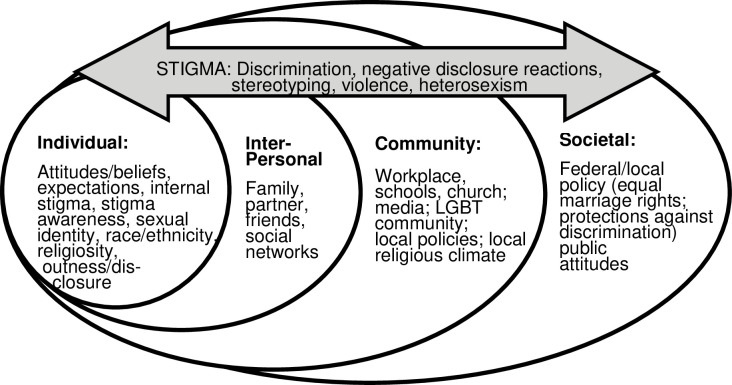
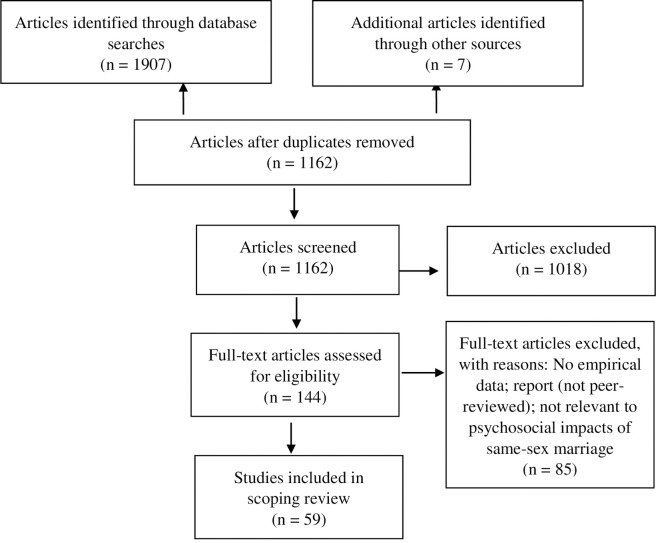
A growing body of literature provides important insights into the meaning and impact of the right to marry a same-sex partner among sexual minority people. We conducted a scoping review to 1) identify and describe the psychosocial impacts of equal marriage rights among sexual minority adults, and 2) explore sexual minority women (SMW) perceptions of equal marriage rights and whether psychosocial impacts differ by sex. Using Arksey and O'Malley's framework we reviewed peer-reviewed English-language publications from 2000 through 2019. We searched six databases (PubMed, PsycINFO, CINAHL, Web of Science, JSTOR, and Sociological Abstracts) to identify English language, peer-reviewed journal articles reporting findings from empirical studies with an explicit focus on the experiences and perceived impact of equal marriage rights among sexual minority adults. We found 59 studies that met our inclusion criteria. Studies identified positive psychosocial impacts of same-sex marriage (e.g., increased social acceptance, reduced stigma) across individual, interpersonal (dyad, family), community (sexual minority), and broader societal levels. Studies also found that, despite equal marriage rights, sexual minority stigma persists across these levels. Only a few studies examined differences by sex, and findings were mixed. Research to date has several limitations; for example, it disproportionately represents samples from the U.S. and White populations, and rarely examines differences by sexual or gender identity or other demographic characteristics. There is a need for additional research on the impact of equal marriage rights and same-sex marriage on the health and well-being of diverse sexual minorities across the globe.
越来越多的文献为我们深入了解性少数群体与同性伴侣结婚的权利的意义和影响提供了重要的见解。我们进行了范围界定审查,以:1)确定和描述性少数成年人平等婚姻权利的社会心理影响;2)探索性少数妇女(SMW)对平等婚姻权利的看法,以及社会心理影响是否因性别而异。我们使用阿特塞和奥马利的框架,回顾了 2000 年至 2019 年期间的同行评议英文出版物。我们在六个数据库(PubMed、PsycINFO、CINAHL、Web of Science、JSTOR 和 Sociological Abstracts)中进行了检索,以确定明确关注性少数成年人平等婚姻权利的经验和感知影响的英文同行评议期刊文章。我们发现了 59 项符合我们纳入标准的研究。研究发现,同性婚姻具有积极的社会心理影响(例如,增加社会接受度,减少耻辱感),涉及个人、人际关系(伴侣、家庭)、社区(性少数群体)和更广泛的社会层面。研究还发现,尽管有平等的婚姻权利,但性少数群体的耻辱感仍然存在于这些层面。只有少数研究考察了性别差异,而且结果不一致。迄今为止的研究存在一些局限性;例如,它不成比例地代表了来自美国和白人人口的样本,很少研究性或性别认同或其他人口特征的差异。需要对平等婚姻权利和同性婚姻对全球不同性少数群体的健康和幸福的影响进行更多的研究。