Brain Rehabilitation Research Center, Malcom Randall VA Medical Center, Gainesville, Florida, United States of America.
Department of Chemical Engineering, College of Engineering, University of Florida, Gainesville, Florida, United States of America.
PLoS One. 2021 May 6;16(5):e0250431. doi: 10.1371/journal.pone.0250431. eCollection 2021.
Pilot testing of real time functional magnetic resonance imaging (rt-fMRI) and real time functional near infrared spectroscopy (rt-fNIRS) as brain computer interface (BCI) neural feedback systems combined with motor learning for motor recovery in chronic severely impaired stroke survivors.
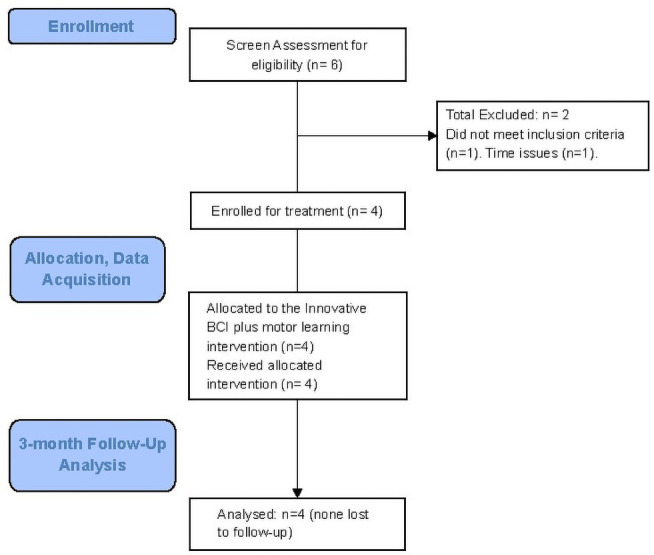
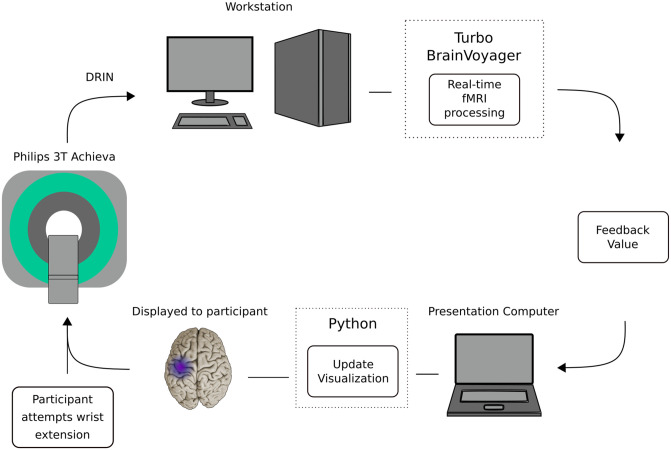
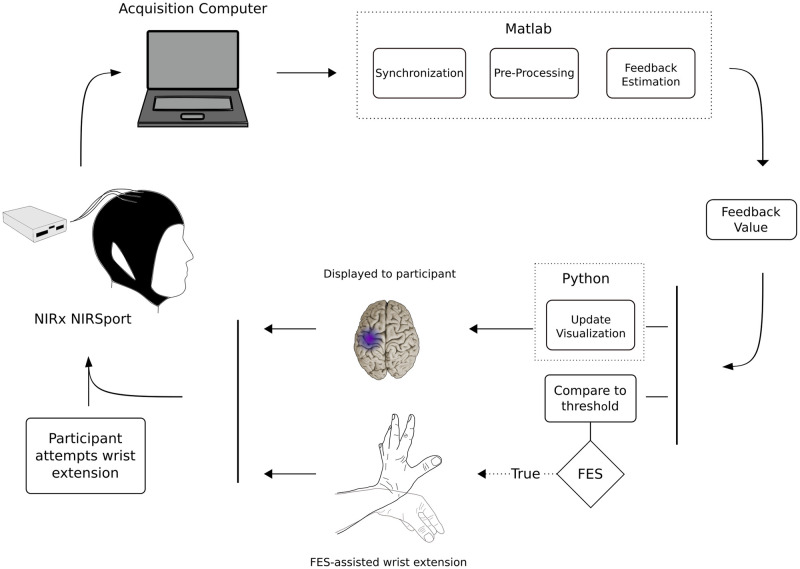
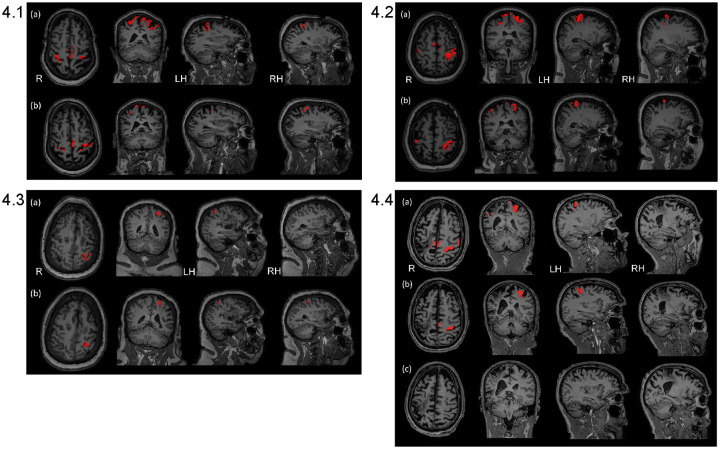
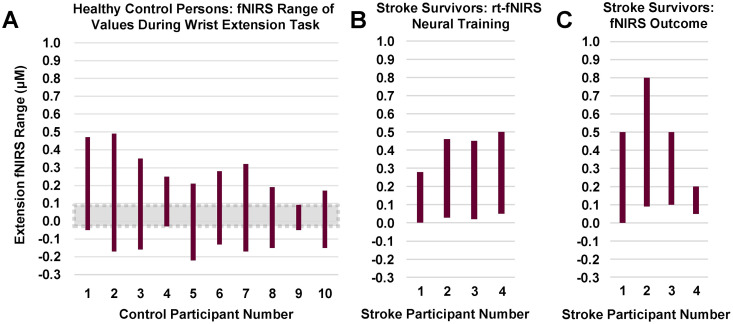
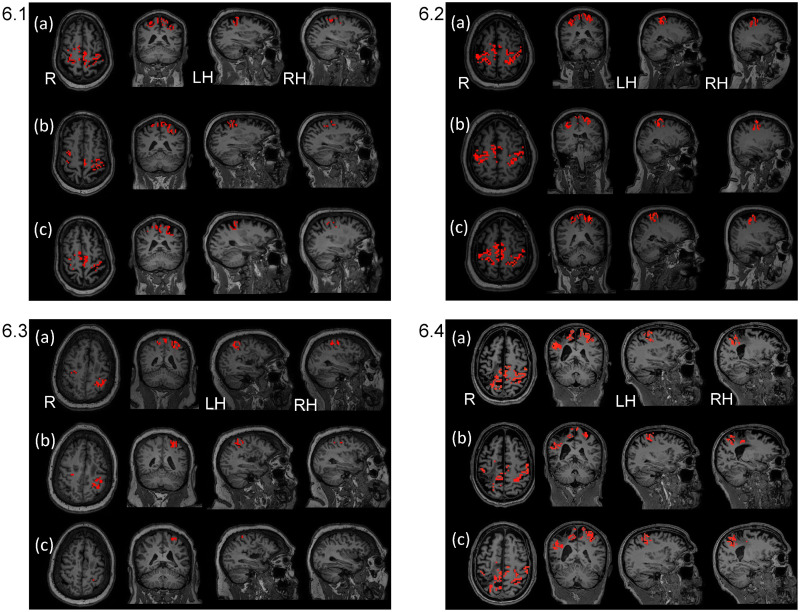
We enrolled a four-case series and administered three sequential rt-fMRI and ten rt-fNIRS neural feedback sessions interleaved with motor learning sessions. Measures were: Arm Motor Assessment Tool, functional domain (AMAT-F; 13 complex functional tasks), Fugl-Meyer arm coordination scale (FM); active wrist extension range of motion (ROM); volume of activation (fMRI); and fNIRS HbO concentration. Performance during neural feedback was assessed, in part, using percent successful brain modulations during rt-fNIRS.
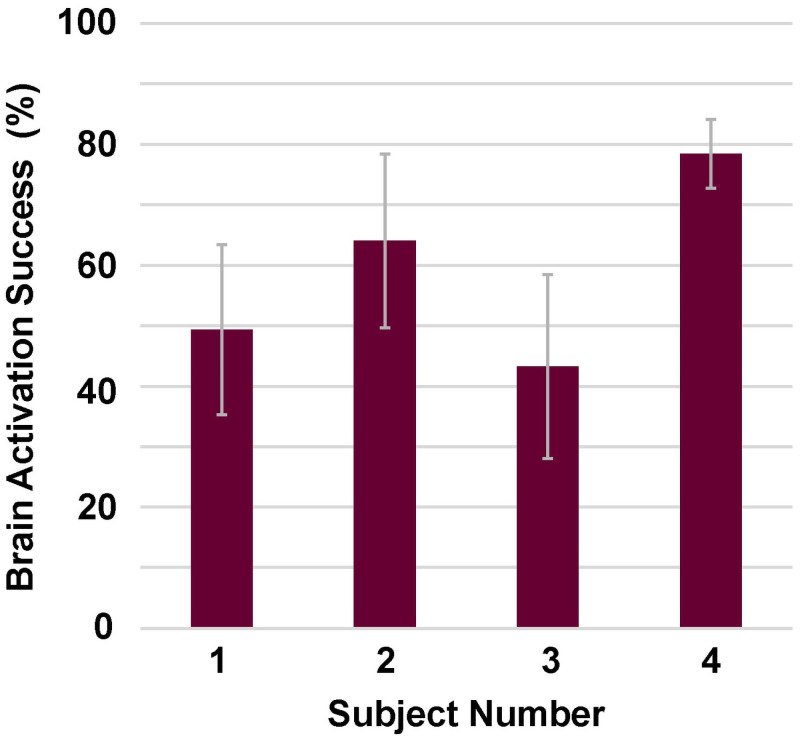
Pre-/post-treatment mean clinically significant improvement in AMAT-F (.49 ± 0.22) and FM (10.0 ± 3.3); active wrist ROM improvement ranged from 20° to 50°. Baseline to follow-up change in brain signal was as follows: fMRI volume of activation was reduced in almost all ROIs for three subjects, and for one subject there was an increase or no change; fNIRS HbO was within normal range, except for one subject who increased beyond normal at post-treatment. During rt-fNIRS neural feedback training, there was successful brain signal modulation (42%-78%).
Severely impaired stroke survivors successfully engaged in spatially focused BCI systems, rt-fMRI and rt-fNIRS, to clinically significantly improve motor function. At the least, equivalency in motor recovery was demonstrated with prior long-duration motor learning studies (without neural feedback), indicating that no loss of motor improvement resulted from substituting neural feedback sessions for motor learning sessions. Given that the current neural feedback protocol did not prevent the motor improvements observed in other long duration studies, even in the presence of fewer sessions of motor learning in the current work, the results support further study of neural feedback and its potential for recovery of motor function in stroke survivors. In future work, expanding the sophistication of either or both rt-fMRI and rt-fNIRS could hold the potential for further reducing the number of hours of training needed and/or the degree of recovery. ClinicalTrials.gov ID: NCT02856035.
实时功能磁共振成像(rt-fMRI)和实时功能近红外光谱(rt-fNIRS)作为脑机接口(BCI)神经反馈系统与运动学习相结合,对慢性严重受损的中风幸存者进行脑康复的初步测试。
我们招募了一个四例系列,并进行了三次 rt-fMRI 和十次 rt-fNIRS 神经反馈测试,穿插运动学习。测量包括:上肢运动评估工具,功能域(AMAT-F;13 个复杂的功能任务)、Fugl-Meyer 上肢协调量表(FM)、主动腕伸展活动范围(ROM)、激活体积(fMRI)和 fNIRS-HbO 浓度。部分使用 rt-fNIRS 期间的成功大脑调制百分比来评估神经反馈期间的性能。
在 AMAT-F(.49±0.22)和 FM(10.0±3.3)方面,治疗前/后出现具有临床意义的平均显著改善;主动腕 ROM 改善范围为 20°至 50°。大脑信号的基线到随访变化如下:对于三名受试者,几乎所有 ROI 的 fMRI 激活体积都减少,对于一名受试者,激活体积增加或没有变化;fNIRS-HbO 在正常范围内,除了一名受试者在治疗后超出正常范围。在 rt-fNIRS 神经反馈训练期间,大脑信号调制成功(42%-78%)。
严重受损的中风幸存者成功参与了空间聚焦的 BCI 系统,rt-fMRI 和 rt-fNIRS,使运动功能得到了显著改善。至少,与先前的长时间运动学习研究(无神经反馈)相比,运动恢复具有等效性,表明从运动学习替代神经反馈不会导致运动改善的损失。鉴于目前的神经反馈方案没有阻止在其他长时间研究中观察到的运动改善,即使在当前工作中运动学习的次数较少,结果支持进一步研究神经反馈及其在中风幸存者中恢复运动功能的潜力。在未来的工作中,提高 rt-fMRI 和 rt-fNIRS 的复杂程度都有可能进一步减少所需的训练时间和/或恢复程度。ClinicalTrials.gov 注册号:NCT02856035。