Department of Rehabilitation Medicine, Shuguang Hospital, Shanghai University of Traditional Chinese Medicine, Shanghai, China.
School of Rehabilitation Science, Shanghai University of Traditional Chinese Medicine, Shanghai, China.
J Neuroeng Rehabil. 2024 May 29;21(1):91. doi: 10.1186/s12984-024-01387-w.
The most challenging aspect of rehabilitation is the repurposing of residual functional plasticity in stroke patients. To achieve this, numerous plasticity-based clinical rehabilitation programs have been developed. This study aimed to investigate the effects of motor imagery (MI)-based brain-computer interface (BCI) rehabilitation programs on upper extremity hand function in patients with chronic hemiplegia.
A 2010 Consolidated Standards for Test Reports (CONSORT)-compliant randomized controlled trial.
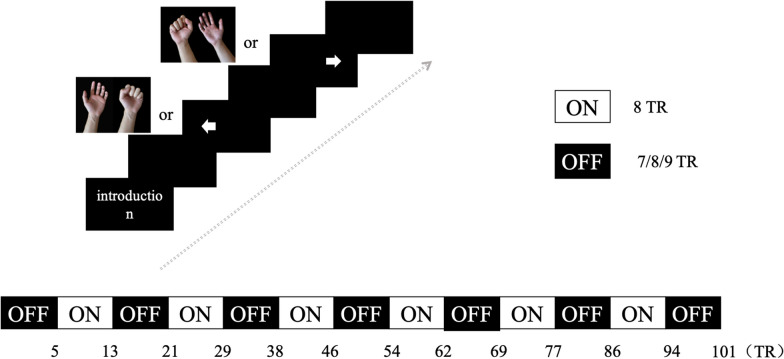
Forty-six eligible stroke patients with upper limb motor dysfunction participated in the study, six of whom dropped out. The patients were randomly divided into a BCI group and a control group. The BCI group received BCI therapy and conventional rehabilitation therapy, while the control group received conventional rehabilitation only. The Fugl-Meyer Assessment of the Upper Extremity (FMA-UE) score was used as the primary outcome to evaluate upper extremity motor function. Additionally, functional magnetic resonance imaging (fMRI) scans were performed on all patients before and after treatment, in both the resting and task states. We measured the amplitude of low-frequency fluctuation (ALFF), regional homogeneity (ReHo), z conversion of ALFF (zALFF), and z conversion of ReHo (ReHo) in the resting state. The task state was divided into four tasks: left-hand grasping, right-hand grasping, imagining left-hand grasping, and imagining right-hand grasping. Finally, meaningful differences were assessed using correlation analysis of the clinical assessments and functional measures.
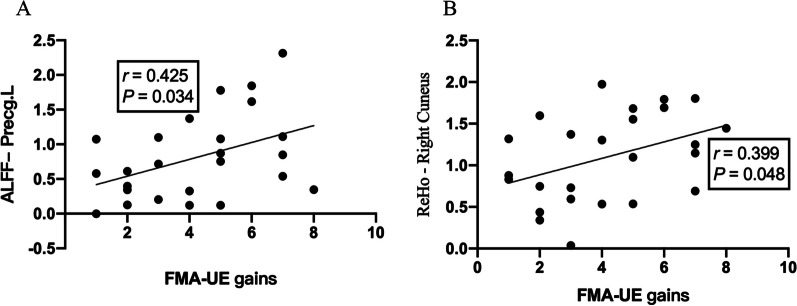
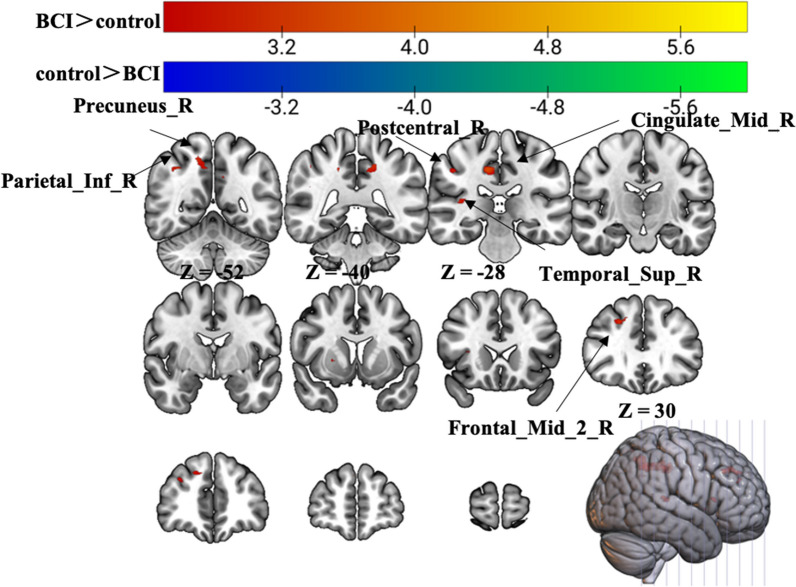
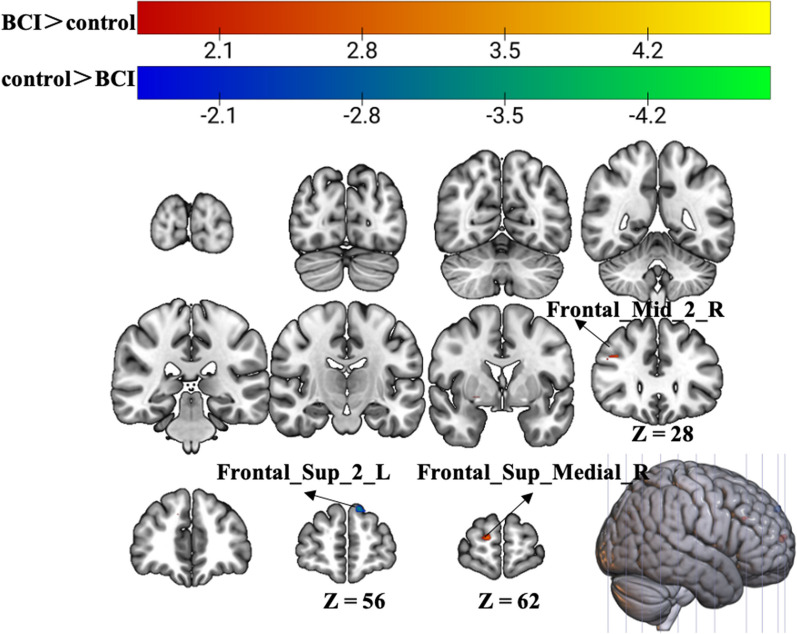
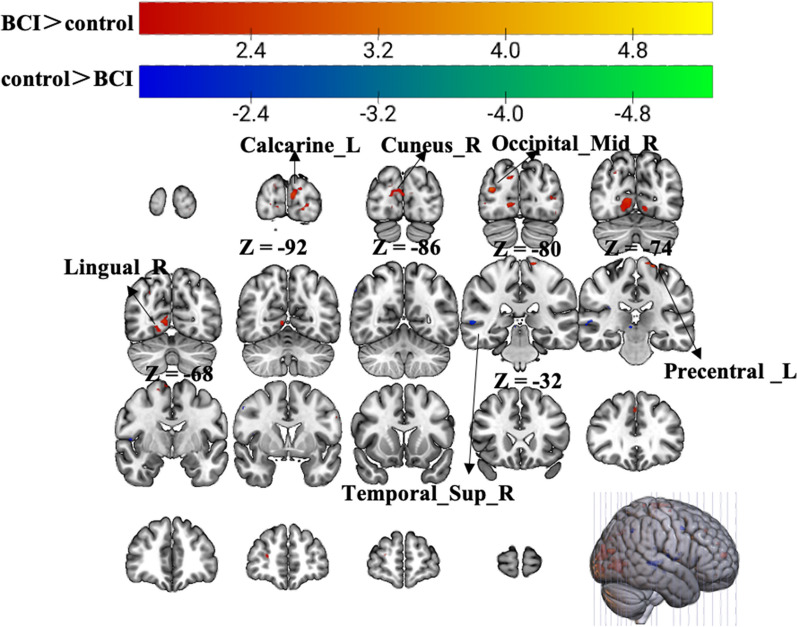
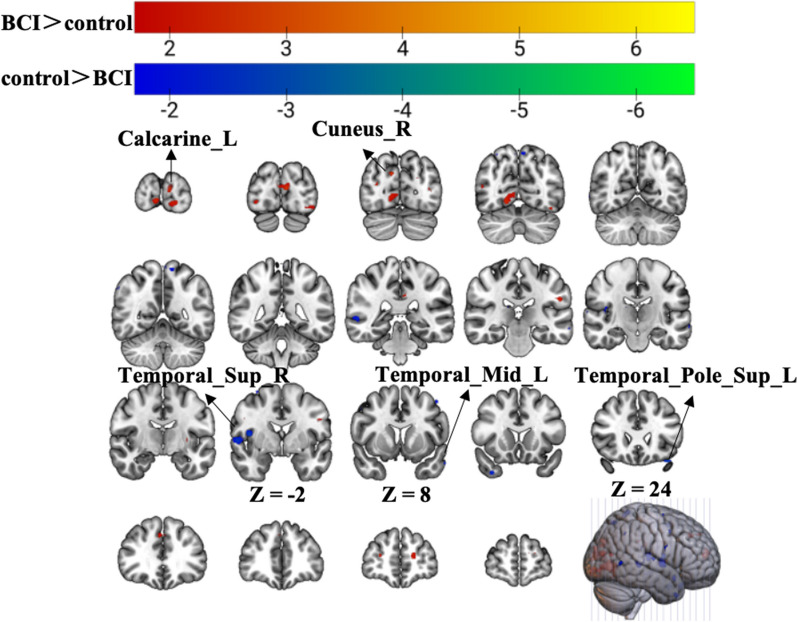
A total of 40 patients completed the study, 20 in the BCI group and 20 in the control group. Task-related blood-oxygen-level-dependent (BOLD) analysis showed that when performing the motor grasping task with the affected hand, the BCI group exhibited significant activation in the ipsilateral middle cingulate gyrus, precuneus, inferior parietal gyrus, postcentral gyrus, middle frontal gyrus, superior temporal gyrus, and contralateral middle cingulate gyrus. When imagining a grasping task with the affected hand, the BCI group exhibited greater activation in the ipsilateral superior frontal gyrus (medial) and middle frontal gyrus after treatment. However, the activation of the contralateral superior frontal gyrus decreased in the BCI group relative to the control group. Resting-state fMRI revealed increased zALFF in multiple cerebral regions, including the contralateral precentral gyrus and calcarine and the ipsilateral middle occipital gyrus and cuneus, and decreased zALFF in the ipsilateral superior temporal gyrus in the BCI group relative to the control group. Increased zReHo in the ipsilateral cuneus and contralateral calcarine and decreased zReHo in the contralateral middle temporal gyrus, temporal pole, and superior temporal gyrus were observed post-intervention. According to the subsequent correlation analysis, the increase in the FMA-UE score showed a positive correlation with the mean zALFF of the contralateral precentral gyrus (r = 0.425, P < 0.05), the mean zReHo of the right cuneus (r = 0.399, P < 0.05).
In conclusion, BCI therapy is effective and safe for arm rehabilitation after severe poststroke hemiparesis. The correlation of the zALFF of the contralateral precentral gyrus and the zReHo of the ipsilateral cuneus with motor improvements suggested that these values can be used as prognostic measures for BCI-based stroke rehabilitation. We found that motor function was related to visual and spatial processing, suggesting potential avenues for refining treatment strategies for stroke patients.
The trial is registered in the Chinese Clinical Trial Registry (number ChiCTR2000034848, registered July 21, 2020).
康复最具挑战性的方面是重新利用中风患者的剩余功能可塑性。为了实现这一目标,已经开发了许多基于可塑性的临床康复计划。本研究旨在探讨基于运动想象(MI)的脑机接口(BCI)康复计划对上肢手功能的影响在慢性偏瘫患者中。
符合 2010 年 CONSORT 报告标准(CONSORT)的随机对照试验。
46 名符合条件的上肢运动功能障碍的中风患者参加了研究,其中 6 名退出。患者被随机分为 BCI 组和对照组。BCI 组接受 BCI 治疗和常规康复治疗,而对照组仅接受常规康复。使用上肢 Fugl-Meyer 评估(FMA-UE)评分作为主要结果来评估上肢运动功能。此外,所有患者在治疗前后进行了功能磁共振成像(fMRI)扫描,包括静息状态和任务状态。我们测量了低频波动的幅度(ALFF)、区域同质性(ReHo)、ALFF 的 z 转换(zALFF)和 ReHo 的 z 转换(ReHo)在静息状态下。任务状态分为四个任务:左手抓握、右手抓握、想象左手抓握和想象右手抓握。最后,使用临床评估和功能测量的相关性分析评估了有意义的差异。
共有 40 名患者完成了研究,BCI 组 20 名,对照组 20 名。与运动相关的血氧水平依赖性(BOLD)分析表明,当使用受影响的手进行运动抓握任务时,BCI 组在同侧中央扣带回、楔前叶、下顶叶、中央后回、中额回、上颞回和对侧中央扣带回中表现出明显的激活。当想象受影响的手进行抓握任务时,BCI 组在治疗后表现出对侧额上回(内侧)和中额回的更大激活。然而,与对照组相比,BCI 组对侧额上回的激活减少。静息状态 fMRI 显示,多个脑区的 zALFF 增加,包括对侧中央前回和楔前叶,以及同侧中枕叶和楔叶,而同侧颞上回的 zALFF 减少。BCI 组同侧楔叶和对侧楔前叶的 zReHo 增加,对侧颞中回、颞极和颞上回的 zReHo 减少。随后的相关性分析表明,FMA-UE 评分的增加与对侧中央前回的平均 zALFF 呈正相关(r=0.425,P<0.05),与右侧楔叶的平均 zReHo 呈正相关(r=0.399,P<0.05)。
总之,BCI 治疗对严重中风后偏瘫上肢康复是有效和安全的。对侧中央前回的 zALFF 和同侧楔叶的 zReHo 与运动改善的相关性表明,这些值可作为基于 BCI 的中风康复的预后指标。我们发现运动功能与视觉和空间处理有关,这表明可能需要改进中风患者的治疗策略。