Department of Oncology, The Affiliated Hospital of Southwest Medical University, Luzhou, 646000, Sichuan, People's Republic of China.
Department of Radiologic Technology, Center of Excellence for Molecular Imaging (CEMI), Faculty of Associated Medical Sciences, Chiang Mai University, Chiang Mai, 50200, Thailand.
Cell Commun Signal. 2021 May 6;19(1):50. doi: 10.1186/s12964-021-00705-2.
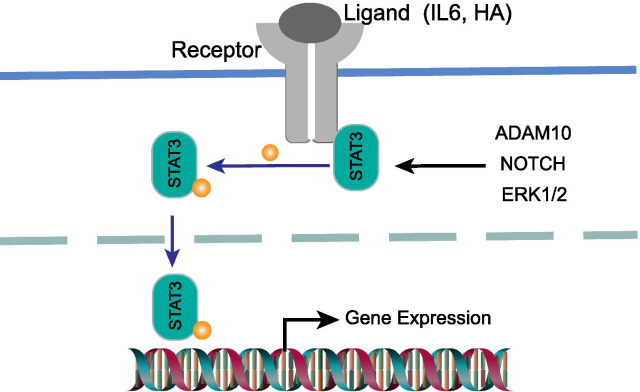
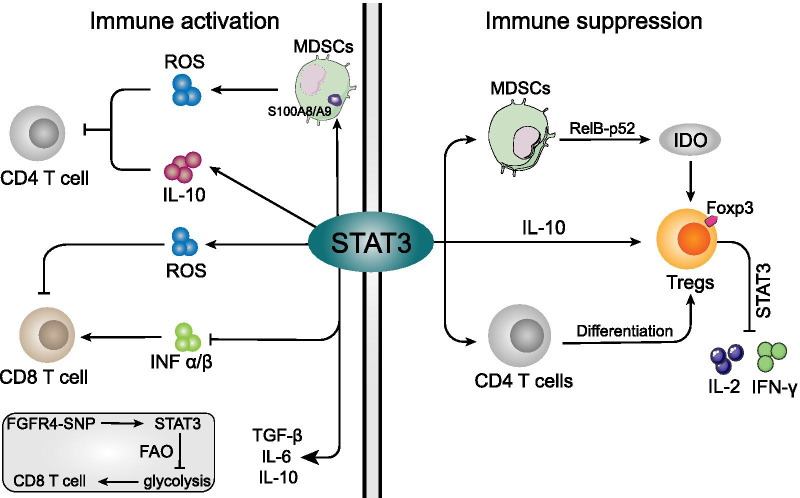
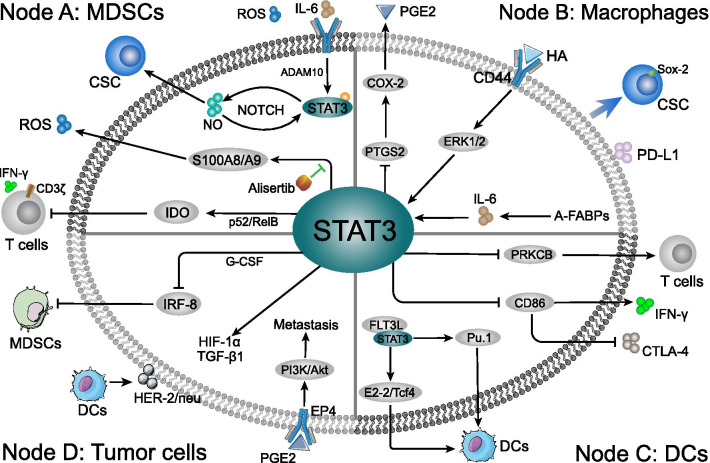
Recent insights into the molecular and cellular mechanisms underlying cancer development have revealed the tumor microenvironment (TME) immune cells to functionally affect the development and progression of breast cancer. However, insufficient evidence of TME immune modulators limit the clinical application of immunotherapy for advanced and metastatic breast cancers. Intercellular STAT3 activation of immune cells plays a central role in breast cancer TME immunosuppression and distant metastasis. Accumulating evidence suggests that targeting STAT3 and/or in combination with radiotherapy may enhance anti-cancer immune responses and rescue the systemic immunologic microenvironment in breast cancer. Indeed, apart from its oncogenic role in tumor cells, the functions of STAT3 in TME of breast cancer involve multiple types of immunosuppression and is associated with tumor cell metastasis. In this review, we summarize the available information on the functions of STAT3-related immune cells in TME of breast cancer, as well as the specific upstream and downstream targets. Additionally, we provide insights about the potential immunosuppression mechanisms of each type of evaluated immune cells. Video abstract.
近年来,对癌症发展中分子和细胞机制的深入了解揭示了肿瘤微环境 (TME) 免疫细胞在功能上影响乳腺癌的发生和发展。然而,TME 免疫调节剂的证据不足限制了免疫疗法在晚期和转移性乳腺癌中的临床应用。免疫细胞的细胞间 STAT3 激活在乳腺癌 TME 免疫抑制和远处转移中发挥核心作用。越来越多的证据表明,靶向 STAT3 及其与放疗联合应用可能增强抗肿瘤免疫反应并挽救乳腺癌的全身免疫微环境。事实上,除了在肿瘤细胞中的致癌作用外,STAT3 在乳腺癌 TME 中的功能还涉及多种类型的免疫抑制,并且与肿瘤细胞转移相关。在这篇综述中,我们总结了关于 STAT3 相关免疫细胞在乳腺癌 TME 中的功能的现有信息,以及特定的上游和下游靶点。此外,我们还提供了关于每种评估免疫细胞的潜在免疫抑制机制的见解。视频摘要。