Matsumoto Kotaro, Kurasawa Takahiko, Yoshimoto Keiko, Suzuki Katsuya, Takeuchi Tsutomu
Division of Rheumatology, Department of Internal Medicine, Keio University School of Medicine, 35 Shinanomachi, Shinjuku-ku, Tokyo, Japan.
Department of Rheumatology and Clinical Immunology, Saitama Medical Center, Saitama Medical University, 1981 Kamoda, Kawagoe, Saitama, Japan.
Arthritis Res Ther. 2021 May 6;23(1):136. doi: 10.1186/s13075-021-02510-1.
Leukocyte activation by anti-neutrophil cytoplasmic antibody (ANCA) and the subsequent leukocyte-endothelium interaction play a key role in the development of endothelial damage in ANCA-associated vasculitis (AAV). In contrast to that of leukocyte activation, the exact role of the leukocyte-endothelium interaction via integrin remains unclear. Here, we performed microarray and validation analyses to explore association between the expression levels of lymphocyte function-associated antigen-1 (LFA-1) and the clinical characteristics of patients with AAV.
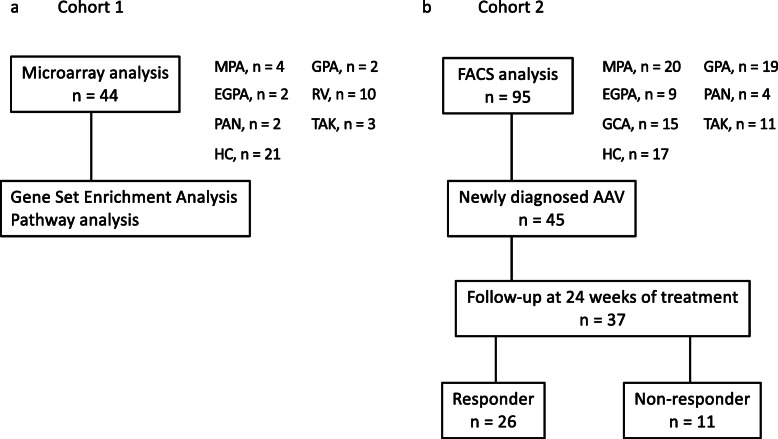
We performed gene set enrichment analysis (GSEA) to identify the functional gene sets differentially expressed between patients with AAV and other types of vasculitis and the healthy controls (HCs). Flow cytometry was performed to validate the GSEA results. Treatment-naïve patients were monitored until 24 weeks of treatment. To examine the role of LFA-1 in the neutrophil-endothelium interaction, we performed a leukocyte adhesion and transmigration assay using peripheral blood and human umbilical vein endothelial cells (HUVECs).
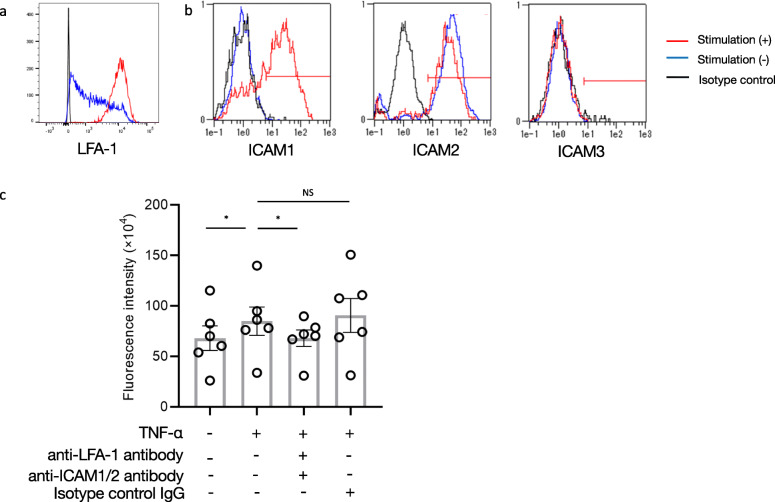
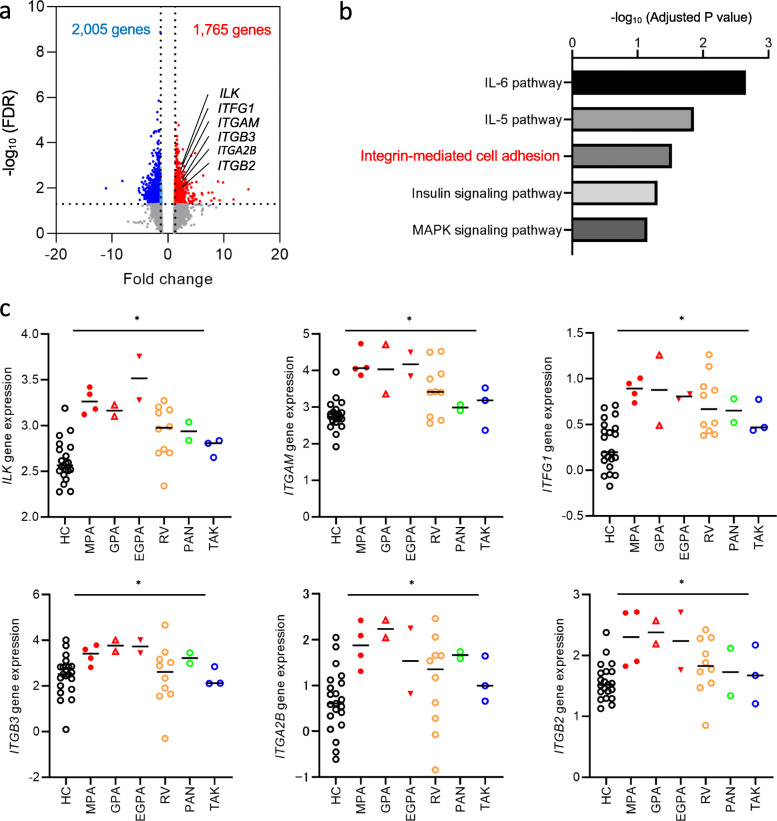
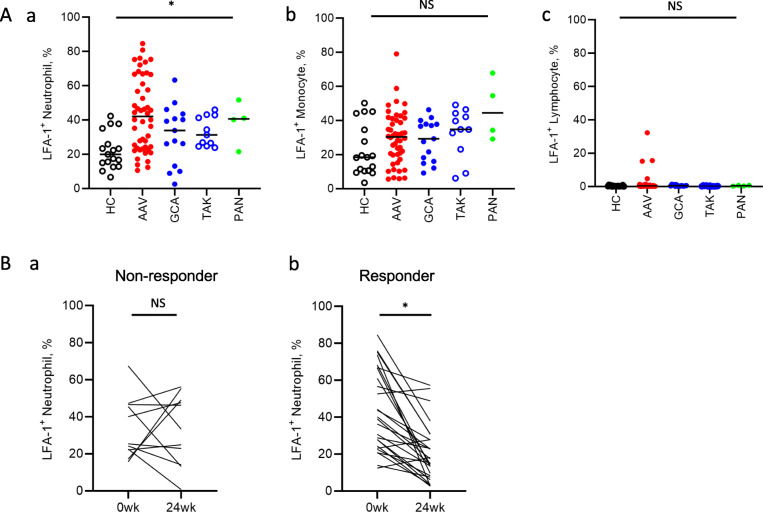
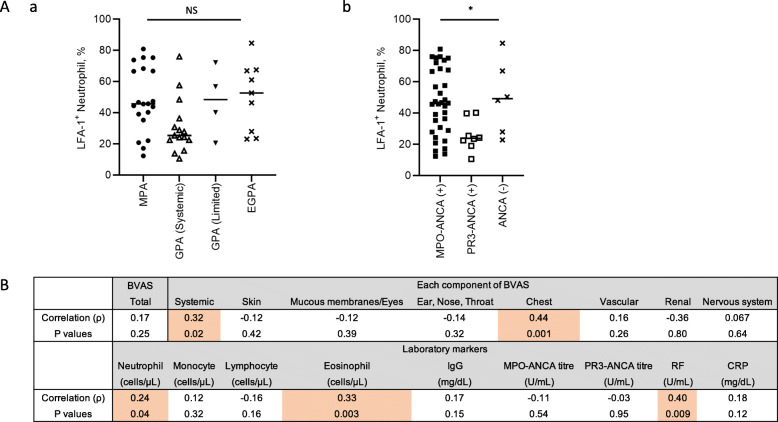
GSEA revealed that the molecular pathways involving integrin-related genes were significantly upregulated in patients with AAV compared to that in patients with other types of vasculitis and the HCs. Flow cytometry revealed that the percentage of neutrophils expressing LFA-1 was significantly higher in patients with AAV than in those with large-vessel vasculitis or polyarteritis nodosa and the HCs. LFA-1 levels in the neutrophils were higher in patients with MPO-ANCA-positive expression than in those with a positive PR3-ANCA expression and correlated with the peripheral eosinophil count, serum rheumatoid factor titre, serum C-reactive protein levels, and the vasculitis activity score of systemic and chest components. After 24 weeks of treatment, including prednisolone, cyclophosphamide, rituximab, azathioprine, methotrexate, and/or tacrolimus, neutrophil LFA-1 expression remained high in the non-responder patients, but decreased in the responder patients. The in vitro assay showed that leukocyte migration toward HUVECs was dependent on the interaction between LFA-1 and intercellular adhesion molecule-1 (ICAM1); the migration of leukocytes was inhibited by blocking the adhesion of LFA-1 to ICAM1.
The expression of LFA-1 in neutrophils is increased in patients with AAV. Neutrophil LFA-1 levels correlate with the clinical features of AAV. Inhibiting the adhesion of LFA-1 and ICAM1 impedes the neutrophil-endothelium interaction and may have a therapeutic role in AAV.
抗中性粒细胞胞浆抗体(ANCA)介导的白细胞活化以及随后的白细胞与内皮细胞相互作用在ANCA相关性血管炎(AAV)的内皮损伤发展中起关键作用。与白细胞活化不同,整合素介导的白细胞与内皮细胞相互作用的确切作用尚不清楚。在此,我们进行了微阵列和验证分析,以探讨淋巴细胞功能相关抗原-1(LFA-1)表达水平与AAV患者临床特征之间的关联。
我们进行了基因集富集分析(GSEA),以鉴定AAV患者与其他类型血管炎患者及健康对照(HC)之间差异表达的功能基因集。采用流式细胞术验证GSEA结果。对未经治疗的患者进行24周的治疗监测。为了研究LFA-1在中性粒细胞与内皮细胞相互作用中的作用,我们使用外周血和人脐静脉内皮细胞(HUVEC)进行了白细胞黏附和迁移试验。
GSEA显示,与其他类型血管炎患者和HC相比,AAV患者中涉及整合素相关基因的分子途径显著上调。流式细胞术显示,AAV患者中表达LFA-1的中性粒细胞百分比显著高于大血管血管炎或结节性多动脉炎患者及HC。MPO-ANCA阳性表达患者中性粒细胞中的LFA-1水平高于PR3-ANCA阳性表达患者,且与外周嗜酸性粒细胞计数、血清类风湿因子滴度、血清C反应蛋白水平以及全身和胸部成分的血管炎活动评分相关。在包括泼尼松龙、环磷酰胺、利妥昔单抗、硫唑嘌呤、甲氨蝶呤和/或他克莫司在内的24周治疗后,无反应患者中性粒细胞LFA-1表达仍较高,而有反应患者中性粒细胞LFA-1表达降低。体外试验表明,白细胞向HUVEC的迁移依赖于LFA-1与细胞间黏附分子-1(ICAM1)之间的相互作用;阻断LFA-1与ICAM1的黏附可抑制白细胞迁移。
AAV患者中性粒细胞中LFA-1表达增加。中性粒细胞LFA-1水平与AAV的临床特征相关。抑制LFA-1与ICAM1的黏附可阻碍中性粒细胞与内皮细胞的相互作用,可能对AAV具有治疗作用。