Kim Yaerim, Lee Soojin, Lee Yeonhee, Park Sehoon, Park Sanghyun, Paek Jin Hyuk, Park Woo Yeong, Jin Kyubok, Han Seungyeup, Kim Yong Chul, Han Seung Seok, Lee Hajeong, Lee Jung Pyo, Joo Kwon Wook, Lim Chun Soo, Kim Yon Su, Han Kyungdo, Kim Dong Ki
Department of Internal Medicine, Keimyung University School of Medicine, Daegu, Korea.
Department of Internal Medicine, Seoul National University Hospital, Seoul, Korea.
Clin Kidney J. 2020 Dec 29;14(5):1356-1363. doi: 10.1093/ckj/sfaa238. eCollection 2021 May.
The estimated glomerular filtration rate (eGFR) is a biomarker not only for kidney function, but also for major clinical outcomes. We aimed to evaluate the patterns of mortality across the entire eGFR percentile spectrum using a population-based dataset.
We retrospectively reviewed the National Health Insurance Service (NHIS) database for people who received nationwide health check-ups from 2009 to 2012. Subjects who were ≥45 years old and had one or more serum creatinine values available were included in the study. The primary outcome was all-cause mortality as a function of eGFR percentile.
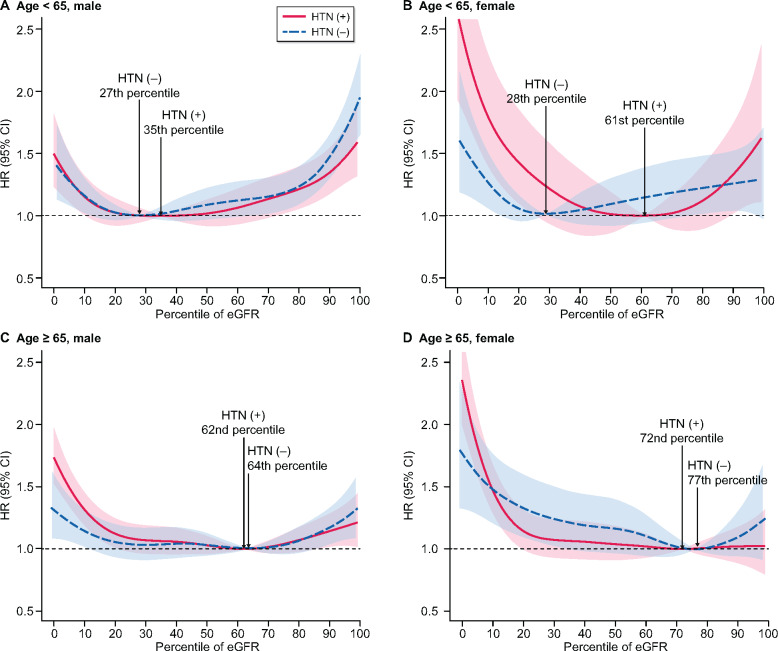
The middle-aged group (45-64 years) showed a U-shaped pattern of association between eGFR percentile and all-cause mortality. The minimum-mortality eGFR percentile was shifted upward in the elderly group (≥65 years). Specifically, the minimum-mortality eGFR percentiles were the 28th percentile (83.8 mL/min/1.73 m) for middle-aged males, the 63rd percentile (86.2 mL/min/1.73 m) for elderly males, the 42nd percentile (102.8 mL/min/1.73 m) for middle-aged females and the 75th percentile (90.1 mL/min/1.73 m) for elderly females. Diabetes and hypertension shifted the minimum-mortality eGFR percentile upward in the middle-aged group. This pattern was attenuated in the elderly group.
The eGFR percentile showing minimum mortality moves upward in the aged population as well as patients with diabetes and hypertension, which might reduce the clinical significance of hyperfiltration. Risk stratification for mortality should be approached differently according to the specific conditions of the patient group.
估算肾小球滤过率(eGFR)不仅是肾功能的生物标志物,也是主要临床结局的生物标志物。我们旨在使用基于人群的数据集评估整个eGFR百分位数范围内的死亡率模式。
我们回顾性分析了2009年至2012年接受全国健康检查的人群的国民健康保险服务(NHIS)数据库。纳入研究的对象为年龄≥45岁且有一个或多个血清肌酐值的人。主要结局是作为eGFR百分位数函数的全因死亡率。
中年组(45 - 64岁)eGFR百分位数与全因死亡率之间呈U形关联模式。老年组(≥65岁)最低死亡率的eGFR百分位数向上偏移。具体而言,中年男性最低死亡率的eGFR百分位数为第28百分位数(83.8 mL/min/1.73 m²),老年男性为第63百分位数(86.2 mL/min/1.7^{3} m²),中年女性为第42百分位数(102.8 mL/min/1.73 m²),老年女性为第75百分位数(90.1 mL/min/1.73 m²)。糖尿病和高血压使中年组最低死亡率的eGFR百分位数向上偏移。这种模式在老年组中减弱。
显示最低死亡率 的eGFR百分位数在老年人群以及糖尿病和高血压患者中向上移动,这可能会降低高滤过的临床意义。应根据患者群体的具体情况采用不同的死亡率风险分层方法。