Centre for Psychiatry Research, Department of Clinical Neuroscience, Karolinska Institutet, Norra Stationsgatan 69, Plan 7, 113 64, Stockholm, Sweden.
Stockholm Health Care Services, Region Stockholm, Stockholm, Sweden.
BMC Psychiatry. 2023 Aug 7;23(1):566. doi: 10.1186/s12888-023-05053-8.
Patients with severe mental disorders suffer from higher rates of poor somatic health and have shorter life expectancy than the average population. Physical activity can treat and prevent several diseases, e.g. cardiovascular and metabolic disorders as well as psychiatric symptoms. It is therefore of utmost importance to develop effective methods to integrate physical activity into psychiatric care. To meet this need, the physical activity intervention Braining was developed. This study aims to describe Braining, to assess the number of patients reached during the first years of pilot testing, to analyze clinical data in the group of patients participating in Braining 2017-2020 and to assess the intervention.
In this descriptive retrospective study we analyzed data from all patients participating in Braining training sessions ≥ 3 times (n = 239), the Braining Participants. Regular patients at the clinic served as a comparison. Furthermore, medical records were studied for a smaller cohort (n = 51), the Braining Pilot Cohort. Data was analyzed using Chi-square and Fisher's tests.
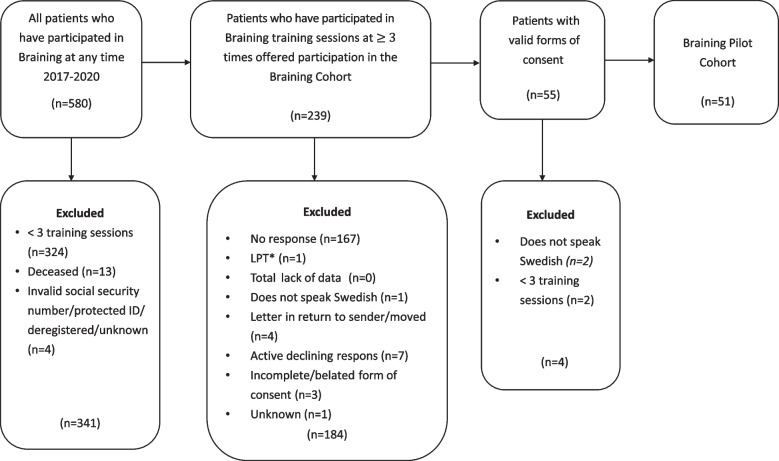
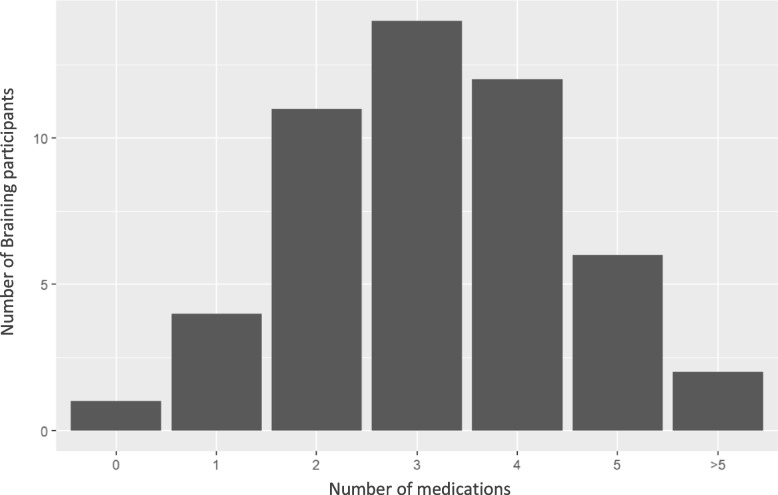
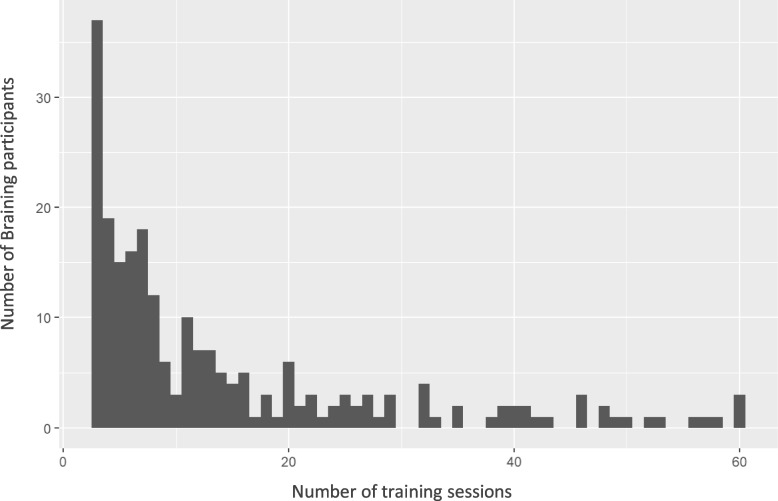
During the introduction period of Braining, 580 patients attended an information meeting about Braining, or at least one training session. 239 patients participated in ≥ 3 training sessions, considered to be participants of Braining. These Braining Participants (n = 239), ages 19 to 82, males 23.4%, attended between 3 and 308 training sessions (median 9). The main diagnoses were affective and anxiety disorders. Number of diagnoses ranged from 0 to 10 (median = 2). For the subsample, the Braining Pilot Cohort (n = 51), participants attended between 3 and 208 training sessions (median = 20). Twelve percent were working full-time, and symptom severity of depression and general anxiety was moderate. Two thirds had ≥ 3 different classes of medication. Regarding metabolic morbidity, 28 had been diagnosed with hypertension, though blood lipids, blood glucose as well as blood pressure were within the normal range. Thirty-seven percent were prescribed Physical Activity on Prescription during 2017-2020. One severe adverse event was reported.
The Braining intervention reached all age-groups and patients with a wide and representative diagnostic panorama, suggesting that Braining could be a promising and safe method for implementing physical activity in a psychiatric patient population.
患有严重精神障碍的患者比一般人群遭受更高的躯体健康不良率,预期寿命更短。身体活动可以治疗和预防多种疾病,例如心血管和代谢紊乱以及精神症状。因此,开发将身体活动融入精神卫生保健的有效方法至关重要。为了满足这一需求,开发了身体活动干预措施 Braining。本研究旨在描述 Braining,评估在试点测试的头几年中达到的患者数量,分析 2017-2020 年参加 Braining 的患者组的临床数据,并评估干预措施。
在这项描述性回顾性研究中,我们分析了所有参加 Braining 培训课程≥3 次的患者(n=239)的数据,即 Braining 参与者。常规诊所的患者作为对照组。此外,还对一个较小的队列(n=51),即 Braining 试点队列的病历进行了研究。使用卡方和 Fisher 检验分析数据。
在 Braining 的引入阶段,580 名患者参加了关于 Braining 的信息会议或至少一次培训。239 名患者参加了≥3 次培训,被认为是 Braining 的参与者。这些 Braining 参与者(n=239)年龄 19 至 82 岁,男性占 23.4%,参加了 3 至 308 次培训(中位数 9 次)。主要诊断为情感和焦虑障碍。诊断数量从 0 到 10 不等(中位数=2)。对于子样本,即 Braining 试点队列(n=51),参与者参加了 3 至 208 次培训(中位数=20 次)。12%的人全职工作,抑郁和一般焦虑的症状严重程度为中度。三分之二的人服用了≥3 种不同类别的药物。在代谢发病率方面,28 人被诊断患有高血压,尽管血脂、血糖和血压均在正常范围内。2017-2020 年,37%的人开了运动处方。报告了 1 例严重不良事件。
Braining 干预措施覆盖了所有年龄段和具有广泛代表性诊断全景的患者,这表明 Braining 可能是一种有前途且安全的方法,可将身体活动融入精神卫生保健患者群体。