KITE Research Institute, Toronto Rehabilitation Institute, University Health Network (UHN), Toronto, Ontario, Canada.
Department of Physical Therapy, University of Toronto, Toronto, Ontario, Canada.
J Spinal Cord Med. 2021;44(sup1):S173-S184. doi: 10.1080/10790268.2021.1920787. Epub 2021 May 7.
Wearable cameras have great potential for producing novel outcome measures of upper limb (UL) function and guiding care in individuals with cervical spinal cord injury (cSCI) living in the community. However, little is known about the perspectives of individuals with cSCI on the potential adoption of this technology.
To analyze feedback from individuals with cSCI regarding the use of wearable cameras to record daily activities at home, in order to define guidelines for improving the design of this technology and fostering its implementation to optimize UL rehabilitation.
Mixed-methods study.
Thirteen adults with cSCI C3-C8 AIS A-D impairment.
Interview including survey and semi-structured questions.
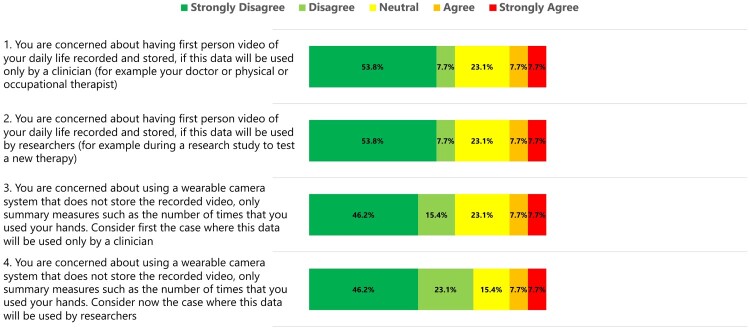
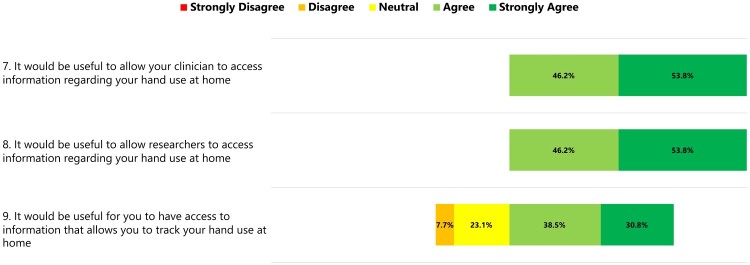
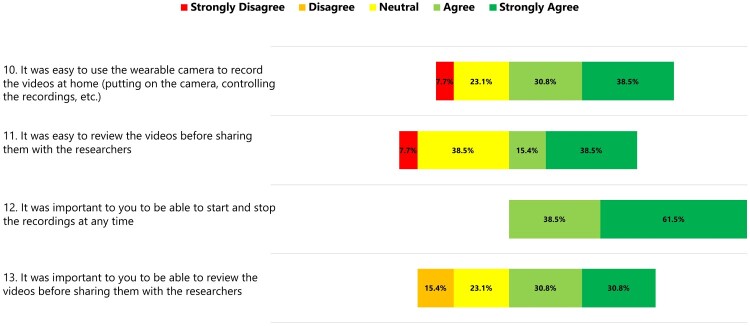
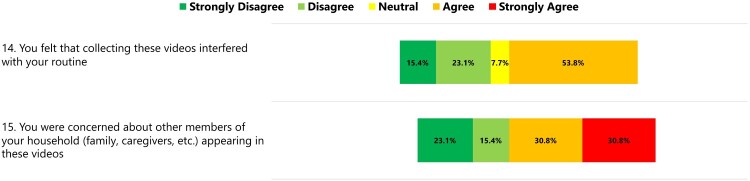
Participants felt that this technology can provide naturalistic information regarding hand use to clinicians and researchers, which in turn can lead to better assessments of UL function and optimized therapies. Participants described the technology as easy-to-use but often reported discomfort that prevented them from conducting long recordings of fully natural activities. Privacy concerns included the possibility to capture household members and personal information displayed on objects (e.g. smartphones).
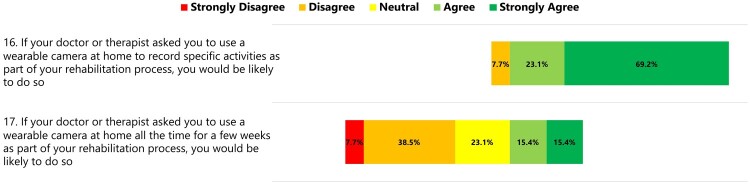
We provide the first set of guidelines to help researchers and therapists understand which steps need to be taken to translate wearable cameras into outpatient care and community-based research for UL rehabilitation. These guidelines include miniaturized and easy-to-wear cameras, as well as multiple measures for preventing privacy concerns such as avoiding public spaces and providing control over the recordings (e.g. start and stop the recordings at any time, keep or delete a recording).
可穿戴摄像机在产生新的上肢(UL)功能结果测量指标并为社区中患有颈脊髓损伤(cSCI)的个体提供指导护理方面具有巨大潜力。然而,对于 cSCI 个体对采用这种技术的潜在看法知之甚少。
分析 cSCI 个体对使用可穿戴摄像机记录家庭日常活动的反馈意见,以便为改进该技术的设计并促进其实施以优化 UL 康复提供指导原则。
混合方法研究。
13 名颈脊髓损伤 C3-C8 AIS A-D 损伤的成年人。
包括调查和半结构化问题的访谈。
参与者认为该技术可以为临床医生和研究人员提供有关手使用的自然信息,这反过来又可以更好地评估 UL 功能并优化治疗。参与者表示该技术易于使用,但经常报告因舒适度问题而无法进行长时间的完全自然活动记录。隐私问题包括可能捕获家庭成员和物品上显示的个人信息(例如智能手机)。
我们提供了一套首批指南,以帮助研究人员和治疗师了解需要采取哪些步骤将可穿戴摄像机转化为门诊护理和社区为基础的 UL 康复研究。这些指南包括小型化和易于佩戴的摄像机,以及多种防止隐私问题的措施,例如避免公共场所,并提供对录音的控制(例如随时开始和停止录音,保留或删除录音)。