PhD Programme Epidemiology, Hannover Biomedical Research School, Hannover Medical School, Hannover, Germany.
Hannover Medical School, Hannover, Germany.
JMIR Mhealth Uhealth. 2021 May 7;9(5):e26289. doi: 10.2196/26289.
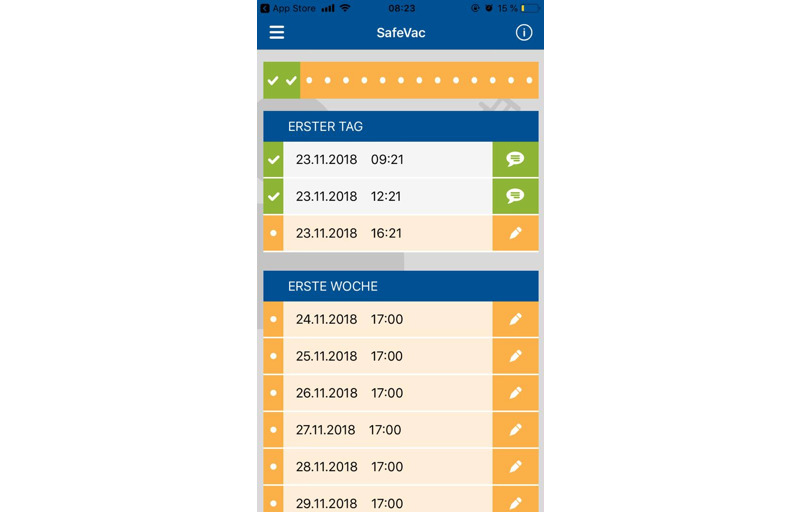
For the safety monitoring of vaccinations postlicensure, reports of adverse events after immunization (AEFIs) are crucial. New technologies such as digital mobile apps can be used as an active approach to capture these events. We therefore conducted a feasibility study among recipients of the influenza vaccination using an app for assessment of the reporting of AEFIs.
The goal of the research was to determine factors influencing adherence to and correct use of a newly developed app for individuals to report AEFI for 3 months using regular reminder functions, to identify determinants of AEFI occurrence and define reported AEFI types.
We developed the app (SafeVac) and offered it to recipients of the influenza vaccination in 3 occupational settings in fall 2018. In this prospective longitudinal feasibility study, data on AEFIs were generated through SafeVac for 3 months. Using logistic and Cox regression, we assessed associations between app adherence, correct app entry, AEFIs, and sociodemographic parameters.
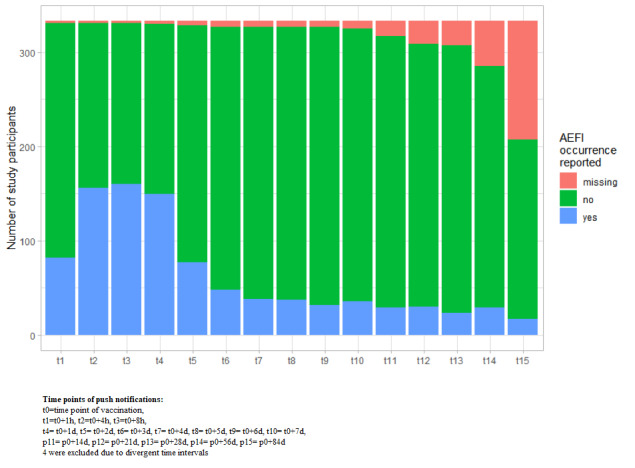
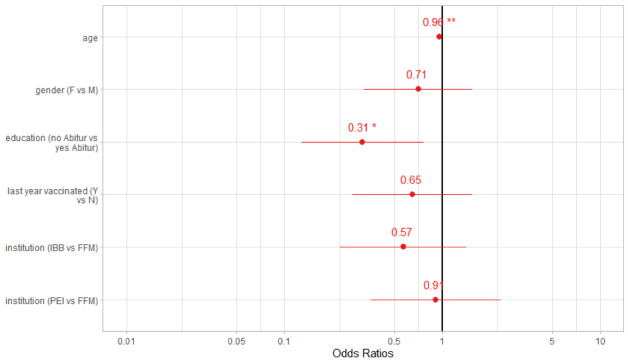
Of the individuals who logged into SafeVac, 61.4% (207/337) used the app throughout a 3-month period. App use adherence was negatively associated with female sex (odds ratio [OR] 0.47; CI 0.25-0.91) and correct app entry was negatively associated with older age (OR 0.96; CI 0.93-0.99) and lower education (OR 0.31; CI 0.13-0.76). AEFI occurrence was associated with female sex (hazard ratio 1.41; CI 1.01-1.96) and negatively with older age (hazard ratio 0.98; CI 0.97-0.99). The most common AEFIs reported were injection site pain (106/337), pain in extremity (103/337), and fatigue/asthenia (73/337).
Digital AEFI reporting was feasible with SafeVac and generated plausible results for this observation period and setting. Studies directly comparing SafeVac with conventional passive reporting schemes could determine whether such digital approaches improve completeness, timeliness, and sensitivity of vaccine vigilance. Further studies should evaluate if these results are transferable to other vaccinations and populations and if introduction of such a tool has an influence on vaccination readiness and therefore vaccine safety.
为了疫苗上市后的安全性监测,接种后不良反应(AEFI)报告至关重要。新的技术,如数字移动应用程序,可以作为一种主动的方法来捕捉这些事件。因此,我们使用一款应用程序评估流感疫苗接种者的 AEFI 报告情况,对其进行了一项可行性研究。
该研究的目的是确定影响 3 个月内使用定期提醒功能,对新开发的应用程序报告 AEFI 的依从性和正确使用的因素,确定 AEFI 发生的决定因素并定义报告的 AEFI 类型。
我们开发了一款应用程序(SafeVac),并在 2018 年秋季的 3 个职业环境中提供给流感疫苗接种者。在这项前瞻性纵向可行性研究中,通过 SafeVac 在 3 个月内生成 AEFI 数据。使用逻辑回归和 Cox 回归分析,我们评估了应用程序依从性、正确的应用程序输入、AEFI 和社会人口学参数之间的关联。
在登录到 SafeVac 的人群中,61.4%(207/337)在 3 个月内使用了该应用程序。女性(比值比[OR]0.47;95%CI 0.25-0.91)和年龄较大(OR 0.96;95%CI 0.93-0.99)以及较低的教育程度(OR 0.31;95%CI 0.13-0.76)与正确的应用程序输入呈负相关。AEFI 发生与女性(危险比 1.41;95%CI 1.01-1.96)相关,与年龄较大(危险比 0.98;95%CI 0.97-0.99)呈负相关。报告的最常见 AEFI 是注射部位疼痛(106/337)、四肢疼痛(103/337)和疲劳/乏力(73/337)。
使用 SafeVac 进行数字 AEFI 报告是可行的,在观察期和设定条件下产生了合理的结果。直接比较 SafeVac 与传统被动报告方案的研究可以确定此类数字方法是否可以提高疫苗警戒的完整性、及时性和敏感性。进一步的研究应评估这些结果是否可推广到其他疫苗和人群,以及引入此类工具是否会对疫苗接种准备情况产生影响,从而影响疫苗安全性。