• 文献检索
  • 文档翻译
  • 深度研究
  • 学术资讯
  • Suppr Zotero 插件Zotero 插件
  • 邀请有礼
  • 套餐&价格
  • 历史记录
应用&插件
Suppr Zotero 插件Zotero 插件浏览器插件Mac 客户端Windows 客户端微信小程序
定价
高级版会员购买积分包购买API积分包
服务
文献检索文档翻译深度研究API 文档MCP 服务
关于我们
关于 Suppr公司介绍联系我们用户协议隐私条款
关注我们

Suppr 超能文献

核心技术专利:CN118964589B侵权必究
粤ICP备2023148730 号-1Suppr @ 2026

文献检索

告别复杂PubMed语法,用中文像聊天一样搜索,搜遍4000万医学文献。AI智能推荐,让科研检索更轻松。

立即免费搜索

文件翻译

保留排版,准确专业,支持PDF/Word/PPT等文件格式,支持 12+语言互译。

免费翻译文档

深度研究

AI帮你快速写综述,25分钟生成高质量综述,智能提取关键信息,辅助科研写作。

立即免费体验

中文应用商店中用于药物-药物相互作用检查的移动应用程序:系统评价和内容分析。

Mobile Apps for Drug-Drug Interaction Checks in Chinese App Stores: Systematic Review and Content Analysis.

机构信息

Department of Pharmacy, Minhang Hospital, Fudan University, Shanghai, China.

Department of Pharmacy Administration & Clinical Pharmacy, School of Pharmaceutical Sciences, Peking University, Beijing, China.

出版信息

JMIR Mhealth Uhealth. 2021 Jun 15;9(6):e26262. doi: 10.2196/26262.

DOI:10.2196/26262
PMID:33962910
原文链接:https://pmc.ncbi.nlm.nih.gov/articles/PMC8277361/
Abstract

BACKGROUND

As a computerized drug-drug interaction (DDI) alert system has not been widely implemented in China, health care providers are relying on mobile health (mHealth) apps as references for checking drug information, including DDIs.

OBJECTIVE

The main objective of this study was to evaluate the quality and content of mHealth apps supporting DDI checking in Chinese app stores.

METHODS

A systematic review was carried out in November 2020 to identify mHealth apps providing DDI checking in both Chinese iOS and Android platforms. We extracted the apps' general information (including the developer, operating system, costs, release date, size, number of downloads, and average rating), scientific or clinical basis, and accountability, based on a multidimensional framework for evaluation of apps. The quality of mHealth apps was evaluated by using the Mobile App Rating Scale (MARS). Descriptive statistics, including numbers and percentages, were calculated to describe the characteristics of the apps. For each app selected for evaluation, the section-specific MARS scores were calculated by taking the arithmetic mean, while the overall MARS score was described as the arithmetic mean of the section scores. In addition, the Cohen kappa (κ) statistic was used to evaluate the interrater agreement.

RESULTS

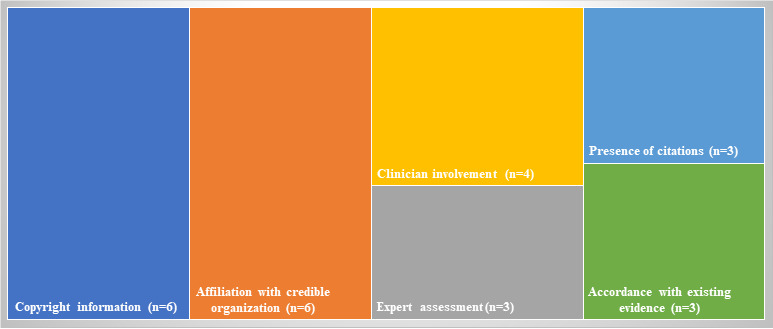
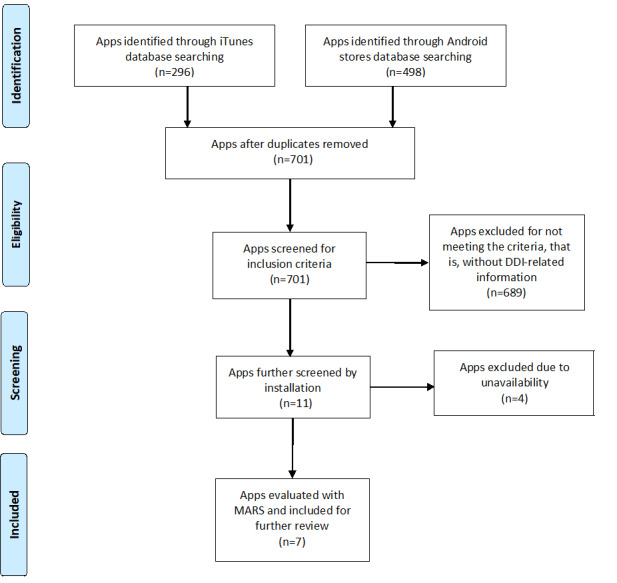
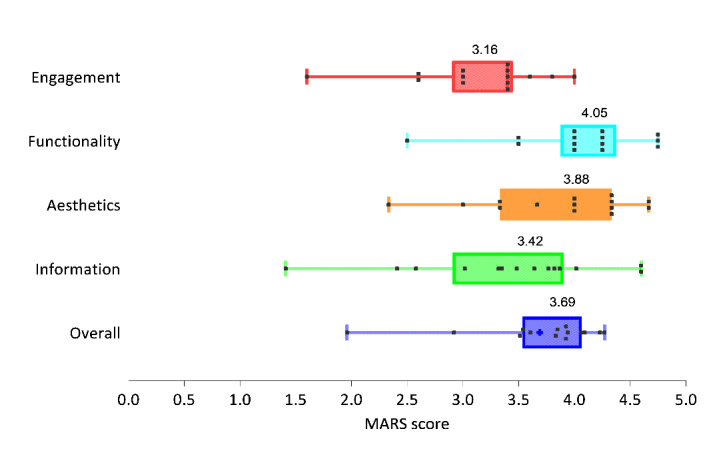
A total of 7 apps met the selection criteria, and only 3 included citations. The average rating score for Android apps was 3.5, with a minimum of 1.0 and a maximum of 4.9, while the average rating score for iOS apps was 4.7, with a minimum of 4.2 and a maximum of 4.9. The mean MARS score was 3.69 out of 5 (95% CI 3.34-4.04), with the lowest score of 1.96 for Medication Guidelines and the highest score of 4.27 for MCDEX mobile. The greatest variation was observed in the information section, which ranged from 1.41 to 4.60. The functionality section showed the highest mean score of 4.05 (95% CI 3.71-4.40), whereas the engagement section resulted in the lowest average score of 3.16 (95% CI 2.81-3.51). For the information quality section, which was the focus of this analysis, the average score was 3.42, with the MCDEX mobile app having the highest score of 4.6 and the Medication Guidelines app having the lowest score of 1.9. For the overall MARS score, the Cohen interrater κ was 0.354 (95% CI 0.236-0.473), the Fleiss κ was 0.353 (95% CI, 0.234-0.472), and the Krippendorff α was 0.356 (95% CI 0.237-0.475).

CONCLUSIONS

This study systematically reviewed the mHealth apps in China with a DDI check feature. The majority of investigated apps demonstrated high quality with accurate and comprehensive information on DDIs. However, a few of the apps that had a massive number of downloads in the Chinese market provided incorrect information. Given these apps might be used by health care providers for checking potential DDIs, this creates a substantial threat to patient safety.
https://cdn.ncbi.nlm.nih.gov/pmc/blobs/bf4c/8277361/f9dbfe9890c4/mhealth_v9i6e26262_fig3.jpg
https://cdn.ncbi.nlm.nih.gov/pmc/blobs/bf4c/8277361/8f7aec186824/mhealth_v9i6e26262_fig1.jpg
https://cdn.ncbi.nlm.nih.gov/pmc/blobs/bf4c/8277361/d0c5d23996f3/mhealth_v9i6e26262_fig2.jpg
https://cdn.ncbi.nlm.nih.gov/pmc/blobs/bf4c/8277361/f9dbfe9890c4/mhealth_v9i6e26262_fig3.jpg
https://cdn.ncbi.nlm.nih.gov/pmc/blobs/bf4c/8277361/8f7aec186824/mhealth_v9i6e26262_fig1.jpg
https://cdn.ncbi.nlm.nih.gov/pmc/blobs/bf4c/8277361/d0c5d23996f3/mhealth_v9i6e26262_fig2.jpg
https://cdn.ncbi.nlm.nih.gov/pmc/blobs/bf4c/8277361/f9dbfe9890c4/mhealth_v9i6e26262_fig3.jpg
摘要

背景

由于计算机化药物相互作用(DDI)警报系统尚未在中国广泛实施,医疗保健提供者依赖移动健康(mHealth)应用程序作为检查药物信息(包括 DDI)的参考。

目的

本研究的主要目的是评估中国应用商店中支持 DDI 检查的 mHealth 应用程序的质量和内容。

方法

2020 年 11 月进行了系统评价,以确定在中 iOS 和 Android 平台上提供 DDI 检查的 mHealth 应用程序。我们根据多维评估应用程序的框架,提取了应用程序的一般信息(包括开发者、操作系统、成本、发布日期、大小、下载量和平均评分)、科学或临床依据以及问责制。使用移动应用程序评分量表(MARS)评估 mHealth 应用程序的质量。使用数字和百分比描述性统计来描述应用程序的特征。对于每个选择进行评估的应用程序,通过取算术平均值来计算特定于节目的 MARS 得分,而整体 MARS 得分则描述为节目的算术平均值。此外,使用 Cohen kappa(κ)统计来评估评分者间的一致性。

结果

共有 7 个应用程序符合选择标准,其中只有 3 个包含引文。Android 应用程序的平均评分为 3.5,最低为 1.0,最高为 4.9,而 iOS 应用程序的平均评分为 4.7,最低为 4.2,最高为 4.9。MARS 得分为 5 分中的 3.69(95%CI 3.34-4.04),最低得分为 1.96 的《用药指南》和最高得分为 4.27 的 MCDEX mobile。信息部分的变化最大,范围为 1.41 至 4.60。功能部分的平均得分最高,为 4.05(95%CI 3.71-4.40),而参与部分的平均得分最低,为 3.16(95%CI 2.81-3.51)。在信息质量部分,这是本分析的重点,平均得分为 3.42,其中 MCDEX mobile 应用程序的得分为 4.6,而《用药指南》应用程序的得分为 1.9。对于整体 MARS 评分,Cohen 评分者间 κ 为 0.354(95%CI 0.236-0.473),Fleiss κ 为 0.353(95%CI,0.234-0.472),Krippendorff α 为 0.356(95%CI 0.237-0.475)。

结论

本研究系统地回顾了中国具有 DDI 检查功能的 mHealth 应用程序。大多数调查应用程序的质量都很高,具有准确且全面的 DDI 信息。然而,一些在中国市场拥有大量下载量的应用程序提供了不正确的信息。鉴于这些应用程序可能被医疗保健提供者用于检查潜在的 DDI,这对患者安全构成了重大威胁。

相似文献

1
Mobile Apps for Drug-Drug Interaction Checks in Chinese App Stores: Systematic Review and Content Analysis.中文应用商店中用于药物-药物相互作用检查的移动应用程序:系统评价和内容分析。
JMIR Mhealth Uhealth. 2021 Jun 15;9(6):e26262. doi: 10.2196/26262.
2
Consumer Mobile Apps for Potential Drug-Drug Interaction Check: Systematic Review and Content Analysis Using the Mobile App Rating Scale (MARS).用于潜在药物相互作用检查的消费者移动应用程序:使用移动应用程序评分量表(MARS)的系统评价和内容分析
JMIR Mhealth Uhealth. 2018 Mar 28;6(3):e74. doi: 10.2196/mhealth.8613.
3
Mobile Apps for Hematological Conditions: Review and Content Analysis Using the Mobile App Rating Scale.移动应用程序在血液学疾病中的应用:使用移动应用程序评级量表进行的评价和内容分析。
JMIR Mhealth Uhealth. 2022 Feb 16;10(2):e32826. doi: 10.2196/32826.
4
Mobile Phone Apps for Food Allergies or Intolerances in App Stores: Systematic Search and Quality Assessment Using the Mobile App Rating Scale (MARS).应用商店中针对食物过敏或不耐受的手机应用程序:使用移动应用评级量表(MARS)进行系统搜索和质量评估。
JMIR Mhealth Uhealth. 2020 Sep 16;8(9):e18339. doi: 10.2196/18339.
5
Assessing Apps for Patients with Genitourinary Tumors Using the Mobile Application Rating Scale (MARS): Systematic Search in App Stores and Content Analysis.使用移动应用程序评级量表(MARS)评估泌尿生殖系统肿瘤患者的应用程序:应用程序商店中的系统搜索和内容分析。
JMIR Mhealth Uhealth. 2020 Jul 23;8(7):e17609. doi: 10.2196/17609.
6
Mobile Apps for the Care Management of Chronic Kidney and End-Stage Renal Diseases: Systematic Search in App Stores and Evaluation.移动应用程序在慢性肾脏病和终末期肾病的护理管理中的应用:应用商店中的系统检索和评估。
JMIR Mhealth Uhealth. 2019 Sep 4;7(9):e12604. doi: 10.2196/12604.
7
Comparing Smartphone Apps for Traditional Chinese Medicine and Modern Medicine in China: Systematic Search and Content Analysis.比较中国传统医学和现代医学的智能手机应用程序:系统搜索和内容分析。
JMIR Mhealth Uhealth. 2021 Mar 24;9(3):e27406. doi: 10.2196/27406.
8
Analysis of Apps With a Medication List Functionality for Older Adults With Heart Failure Using the Mobile App Rating Scale and the IMS Institute for Healthcare Informatics Functionality Score: Evaluation Study.使用移动应用程序评级量表和 IMS 研究所医疗保健信息学功能评分对心力衰竭老年患者的带药物清单功能的应用程序进行分析:评估研究。
JMIR Mhealth Uhealth. 2021 Nov 2;9(11):e30674. doi: 10.2196/30674.
9
German Mobile Apps in Rheumatology: Review and Analysis Using the Mobile Application Rating Scale (MARS).德国风湿病学移动应用程序:使用移动应用程序评级量表(MARS)进行的评估与分析。
JMIR Mhealth Uhealth. 2019 Aug 5;7(8):e14991. doi: 10.2196/14991.
10
Evaluating Chinese Mobile Health Apps for Ankylosing Spondylitis Management: Systematic App Search.评估用于强直性脊柱炎管理的中文移动医疗应用程序:系统应用搜索。
JMIR Mhealth Uhealth. 2021 Jul 14;9(7):e27234. doi: 10.2196/27234.

引用本文的文献

1
Quality and Privacy Policy Compliance of Mental Health Care Apps in China: Cross-Sectional Evaluation Study.中国心理健康护理应用程序的质量与隐私政策合规性:横断面评估研究
J Med Internet Res. 2025 Jul 3;27:e66762. doi: 10.2196/66762.
2
Comparing the Effectiveness of a Clinical Decision Support Tool in Reducing Pediatric Opioid Dose Calculation Errors: PediPain App vs. Traditional Calculators - A Simulation-Based Randomised Controlled Study.比较临床决策支持工具在减少儿科阿片类药物剂量计算错误方面的有效性:PediPain 应用程序与传统计算器——基于模拟的随机对照研究。
J Med Syst. 2024 Apr 17;48(1):43. doi: 10.1007/s10916-024-02060-4.
3

本文引用的文献

1
A Quantitative and Narrative Evaluation of Goodman and Gilman's Pharmacological Basis of Therapeutics.《 Goodman 和 Gilman 治疗学的药理学基础》的定量与叙述性评价
Pharmacy (Basel). 2019 Dec 20;8(1):1. doi: 10.3390/pharmacy8010001.
2
A Comparison of Functional Features in Chinese and US Mobile Apps for Diabetes Self-Management: A Systematic Search in App Stores and Content Analysis.中、美两国糖尿病自我管理手机应用程序功能特征比较:应用商店系统检索与内容分析。
JMIR Mhealth Uhealth. 2019 Aug 28;7(8):e13971. doi: 10.2196/13971.
3
German Mobile Apps in Rheumatology: Review and Analysis Using the Mobile Application Rating Scale (MARS).
Performance evaluation of Hipee S2 point-of-care testing urine dipstick analyser: a cross-sectional study.
Hipee S2 即时检测尿液干化学试纸条分析仪性能评估:一项横断面研究。
BMJ Open. 2022 Oct 27;12(10):e063781. doi: 10.1136/bmjopen-2022-063781.
4
Shared Decision-Making for Drug-Drug Interactions: Formative Evaluation of an Anticoagulant Drug Interaction.药物相互作用的共同决策:抗凝药物相互作用的形成性评估
JMIR Form Res. 2022 Oct 19;6(10):e40018. doi: 10.2196/40018.
5
Mobile Health Apps Providing Information on Drugs for Adult Emergency Care: Systematic Search on App Stores and Content Analysis.移动医疗应用程序提供成人急救药物信息:应用商店的系统检索和内容分析。
JMIR Mhealth Uhealth. 2022 Apr 20;10(4):e29985. doi: 10.2196/29985.
6
Multipurpose Mobile Apps for Mental Health in Chinese App Stores: Content Analysis and Quality Evaluation.中文应用商店中用于心理健康的多用途移动应用程序:内容分析和质量评估。
JMIR Mhealth Uhealth. 2022 Jan 4;10(1):e34054. doi: 10.2196/34054.
德国风湿病学移动应用程序:使用移动应用程序评级量表(MARS)进行的评估与分析。
JMIR Mhealth Uhealth. 2019 Aug 5;7(8):e14991. doi: 10.2196/14991.
4
Nutrition-Related Mobile Apps in the China App Store: Assessment of Functionality and Quality.中国应用商店中与营养相关的移动应用程序:功能和质量评估。
JMIR Mhealth Uhealth. 2019 Jul 30;7(7):e13261. doi: 10.2196/13261.
5
Evaluation of community pharmacists' knowledge about drug-drug interaction in Central Saudi Arabia.沙特阿拉伯中部地区社区药剂师对药物相互作用知识的评估。
Saudi Pharm J. 2019 May;27(4):463-466. doi: 10.1016/j.jsps.2019.01.008. Epub 2019 Jan 7.
6
Mobile Health Applications for Pediatric Care: Review and Comparison.用于儿科护理的移动健康应用程序:综述与比较
Ther Innov Regul Sci. 2018 May;52(3):383-391. doi: 10.1177/2168479017725557. Epub 2017 Sep 12.
7
Consumer Mobile Apps for Potential Drug-Drug Interaction Check: Systematic Review and Content Analysis Using the Mobile App Rating Scale (MARS).用于潜在药物相互作用检查的消费者移动应用程序:使用移动应用程序评分量表(MARS)的系统评价和内容分析
JMIR Mhealth Uhealth. 2018 Mar 28;6(3):e74. doi: 10.2196/mhealth.8613.
8
Challenges in Assessing Mobile Health App Quality: A Systematic Review of Prevalent and Innovative Methods.评估移动健康应用程序质量的挑战:对流行和创新方法的系统评价。
Am J Prev Med. 2016 Dec;51(6):1051-1059. doi: 10.1016/j.amepre.2016.07.009. Epub 2016 Sep 19.
9
Review and Analysis of Existing Mobile Phone Apps to Support Heart Failure Symptom Monitoring and Self-Care Management Using the Mobile Application Rating Scale (MARS).使用移动应用程序评分量表(MARS)对支持心力衰竭症状监测和自我护理管理的现有手机应用程序进行回顾与分析。
JMIR Mhealth Uhealth. 2016 Jun 14;4(2):e74. doi: 10.2196/mhealth.5882.
10
A review and content analysis of engagement, functionality, aesthetics, information quality, and change techniques in the most popular commercial apps for weight management.对最受欢迎的商业体重管理应用程序中的参与度、功能、美学、信息质量和改变技巧进行综述与内容分析。
Int J Behav Nutr Phys Act. 2016 Mar 10;13:35. doi: 10.1186/s12966-016-0359-9.