Department of Soils and Agricultural Chemistry, Biosystem Engineering, Faculty of Agriculture, (Saba Basha), Alexandria University, P.O. Box 21531, Alexandria, Egypt.
Department of Chemistry, College of Science, Taif University, P.O. Box 11099, Taif, 21944, Saudi Arabia.
Sci Rep. 2021 May 7;11(1):9811. doi: 10.1038/s41598-021-89287-0.
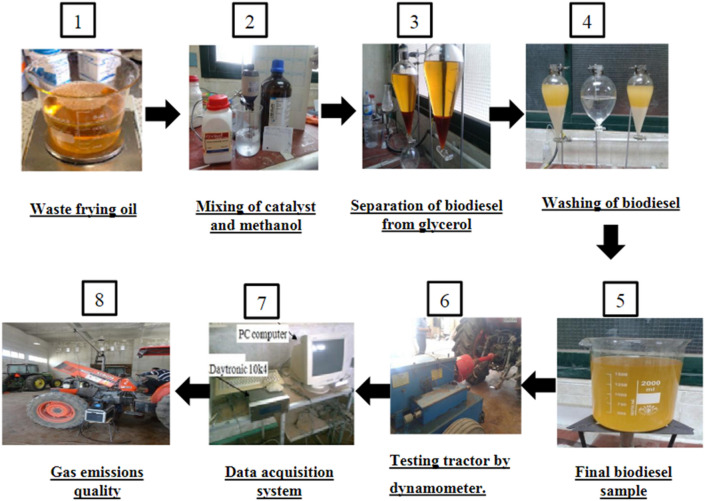
Fossil fuels are the main energy sources responsible for harmful emissions and global warming. Using biodiesel made from waste deep-frying oil as an alternative fuel source in diesel engines has drawn great attention. This biodiesel is produced using the transesterification process and blends with mineral diesel at Faculty of Agriculture Saba Basha, Alexandria University, Egypt. The turbocharged diesel engine of a Kubota M-90 tractor was tested. The objectives of this work are to test tractor as a source of power in the farm using waste deep-frying oil biodiesel to utilize waste frying oils (WFO) in clean energy production on the farm and determine the best engine loading stages to maximize engine efficiencies for different fuel blends and reduce the environmental impact of gas emissions from tractor diesel engines in the farms. The experiment design was factorial, with two factors, where the first was the engine load (0%, 25%, 50%, 75%, and 100%) and the second was fuel blend (0%, 5%, 20%, and 100% biodiesel), and the effects of loading stages and biodiesel percentage on engine performance indicators of engine speed, power take off torque, power take off power, brake power, brake mean effective pressure, brake thermal efficiency, brake specific fuel consumption, and gas emissions were studied. The experimental results indicated that engine load percentage and fuel blend percentage significantly affected all studied characters, and the best engine loading stages were between 25 and 75% to maximize engine efficiency and minimize the specific fuel consumption and gas emissions. Increasing the biodiesel percentage at all loading stages resulted decreasing in Engine brake power (BP), brake thermal efficiency, Power take-off (PTO) torque, and brake mean effective pressure and increases in brake specific fuel consumption. Increasing the engine load resulted in decreases in O emissions and increases in CO, CO, NO, and SO emissions. Increasing the biodiesel percentage in the blended fuel samples resulted in increases in O and NO emissions and decreases in CO, CO, and SO emissions. The use of biodiesel with diesel fuel reduces the environmental impact of gas emissions and decreases engine efficiency.
化石燃料是造成有害排放和全球变暖的主要能源。在柴油机中使用由废食用油制成的生物柴油作为替代燃料来源引起了极大的关注。这种生物柴油是通过酯交换过程生产的,并与埃及亚历山大大学萨巴巴沙农业学院的矿物柴油混合。测试了库塔 M-90 拖拉机的涡轮增压柴油机。这项工作的目的是测试拖拉机作为农场动力源,使用废食用油生物柴油利用农场废食用油(WFO)生产清洁能源,并确定最佳发动机加载阶段,以最大限度地提高不同燃料混合物的发动机效率,并减少农场拖拉机柴油机废气的环境影响。实验设计为两因素析因设计,第一个因素是发动机负荷(0%、25%、50%、75%和 100%),第二个因素是燃料混合物(0%、5%、20%和 100%生物柴油),研究了加载阶段和生物柴油百分比对发动机性能指标(发动机转速、动力输出扭矩、动力输出功率、制动功率、制动平均有效压力、制动热效率、制动比油耗和气体排放)的影响。实验结果表明,发动机负荷百分比和燃料混合百分比对所有研究的特性都有显著影响,最佳的发动机加载阶段在 25%至 75%之间,以最大限度地提高发动机效率,最小化比油耗和气体排放。在所有加载阶段增加生物柴油百分比会降低发动机制动功率(BP)、制动热效率、动力输出(PTO)扭矩和制动平均有效压力,增加制动比油耗。增加发动机负荷会降低 O 排放,增加 CO、CO、NO 和 SO 排放。在混合燃料样品中增加生物柴油百分比会增加 O 和 NO 排放,降低 CO、CO 和 SO 排放。使用生物柴油与柴油燃料相结合可以减少气体排放对环境的影响,并降低发动机效率。