Department of Laboratory Medicine (Microbiology), JPN Apex Trauma Center, All India Institute of Medical Sciences, New Delhi, India.
Department of Infectious Diseases, All India Institute of Medical Sciences, New Delhi, India.
Indian J Med Microbiol. 2021 Apr;39(2):147-153. doi: 10.1016/j.ijmmb.2020.10.014. Epub 2020 Nov 2.
The COVID-19 pandemic has raised concerns over secondary infections because it has limited treatment options and empiric antimicrobial treatment poses serious risks of aggravating antimicrobial resistance (AMR). Studies have shown that COVID-19 patients are predisposed to develop secondary infections. This study was conducted to ascertain the prevalence and profiles of co- & secondary infections in patients at the COVID-19 facility in North India.
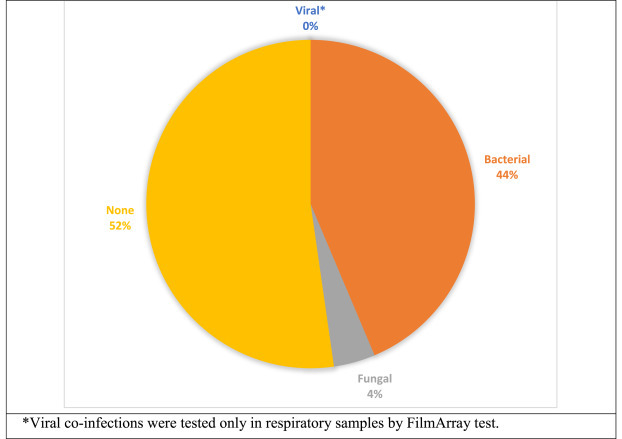
We studied the profile of pathogens isolated from 290 clinical samples. Bacterial and fungal pathogens were identified, and antimicrobial susceptibility was determined by the Vitek2® system. Additionally, respiratory samples were tested for any viral/atypical bacterial co-infections and the presence of AMR genes by FilmArray test. The clinical and outcome data of these patients were also recorded for demographic and outcome measures analyses.
A total of 151 (13%) patients had secondary infections, and most got infected within the first 14 days of hospital admission. Patients aged >50 years developed severe symptoms (p = 0.0004) and/or had a fatal outcome (p = 0.0005). In-hospital mortality was 33%.K.pneumoniae (33.3%) was the predominant pathogen, followed by A. baumannii (27.1%). The overall resistance was up to 84%.Majority of the organisms were multidrug-resistant (MDR) harbouring MDR genes.
A high rate of secondary infections with resistant pathogens in COVID-19 patients highlights the importance of antimicrobial stewardship programs focussing on supporting the optimal selection of empiric treatment and rapid-de-escalation, based on culture reports.
COVID-19 大流行引发了人们对二次感染的担忧,因为它的治疗选择有限,经验性抗菌治疗会严重加剧抗菌药物耐药性(AMR)。研究表明,COVID-19 患者易发生继发感染。本研究旨在确定印度北部 COVID-19 病房患者继发感染和合并感染的流行率和特征。
我们研究了从 290 份临床样本中分离出的病原体的特征。通过 Vitek2®系统鉴定细菌和真菌病原体,并确定其药敏性。此外,通过 FilmArray 试验检测呼吸道样本是否存在任何病毒/非典型细菌合并感染和 AMR 基因。还记录了这些患者的临床和结局数据,以进行人口统计学和结局措施分析。
共有 151 名(13%)患者发生继发感染,大多数患者在入院后 14 天内感染。年龄>50 岁的患者出现严重症状(p=0.0004)和/或发生致命结局(p=0.0005)。住院死亡率为 33%。肺炎克雷伯菌(33.3%)是主要病原体,其次是鲍曼不动杆菌(27.1%)。总体耐药率高达 84%。大多数病原体为多药耐药(MDR),携带 MDR 基因。
COVID-19 患者继发感染的发生率高,且病原体耐药性强,这凸显了实施抗菌药物管理计划的重要性,该计划侧重于根据培养报告支持经验性治疗的优化选择和快速降级。