Laifenfeld Daphna, Yanover Chen, Ozery-Flato Michal, Shaham Oded, Rosen-Zvi Michal, Lev Nirit, Goldschmidt Yaara, Grossman Iris
Formerly Global Research and Development, Teva Pharmaceutical Industries, Netanya, Israel.
Formerly IBM Research - Haifa, Israel.
Front Pharmacol. 2021 Apr 22;12:631584. doi: 10.3389/fphar.2021.631584. eCollection 2021.
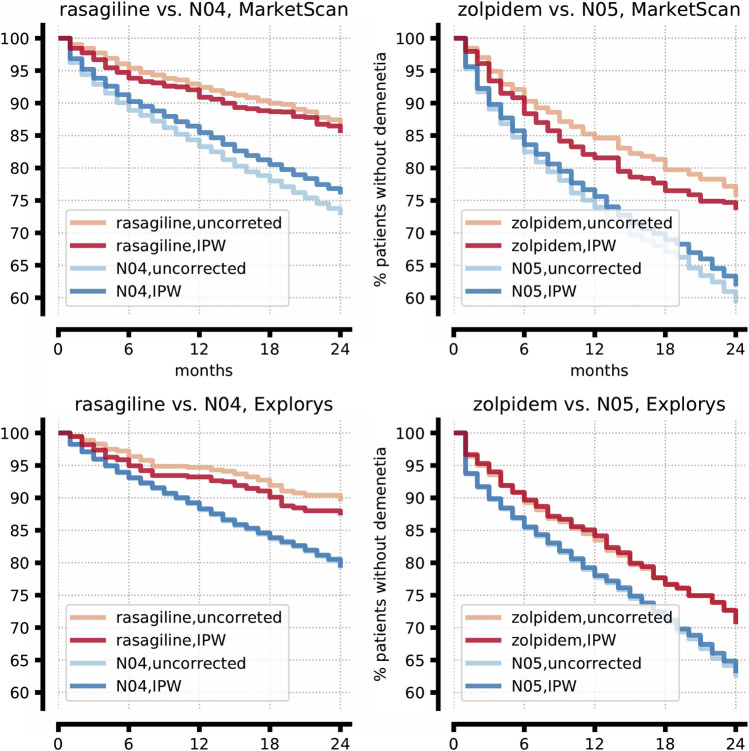
Real-world healthcare data hold the potential to identify therapeutic solutions for progressive diseases by efficiently pinpointing safe and efficacious repurposing drug candidates. This approach circumvents key early clinical development challenges, particularly relevant for neurological diseases, concordant with the vision of the 21st Century Cures Act. However, to-date, these data have been utilized mainly for confirmatory purposes rather than as drug discovery engines. Here, we demonstrate the usefulness of real-world data in identifying drug repurposing candidates for disease-modifying effects, specifically candidate marketed drugs that exhibit beneficial effects on Parkinson's disease (PD) progression. We performed an observational study in cohorts of ascertained PD patients extracted from two large medical databases, Explorys SuperMart (N = 88,867) and IBM MarketScan Research Databases (N = 106,395); and applied two conceptually different, well-established causal inference methods to estimate the effect of hundreds of drugs on delaying dementia onset as a proxy for slowing PD progression. Using this approach, we identified two drugs that manifested significant beneficial effects on PD progression in both datasets: rasagiline, narrowly indicated for PD motor symptoms; and zolpidem, a psycholeptic. Each confers its effects through distinct mechanisms, which we explored via a comparison of estimated effects within the drug classification ontology. We conclude that analysis of observational healthcare data, emulating otherwise costly, large, and lengthy clinical trials, can highlight promising repurposing candidates, to be validated in prospective registration trials, beneficial against common, late-onset progressive diseases for which disease-modifying therapeutic solutions are scarce.
真实世界的医疗数据有潜力通过高效地精准确定安全有效的药物再利用候选药物,来识别针对进展性疾病的治疗方案。这种方法规避了关键的早期临床开发挑战,这对于神经疾病尤为重要,与《21世纪治愈法案》的愿景相一致。然而,迄今为止,这些数据主要用于验证目的,而非作为药物发现的引擎。在此,我们证明了真实世界数据在识别具有疾病修饰作用的药物再利用候选药物方面的有用性,特别是对帕金森病(PD)进展具有有益作用的上市候选药物。我们对从两个大型医学数据库Explorys SuperMart(N = 88,867)和IBM MarketScan研究数据库(N = 106,395)中提取的确诊PD患者队列进行了一项观察性研究;并应用了两种概念上不同但成熟的因果推断方法,以估计数百种药物对延缓痴呆症发作的影响,以此作为减缓PD进展的替代指标。使用这种方法,我们在两个数据集中都发现了两种对PD进展具有显著有益作用的药物:雷沙吉兰,其适应症狭窄,用于PD运动症状;以及唑吡坦,一种精神安定药。每种药物都通过不同的机制发挥作用,我们通过在药物分类本体中比较估计的效果来探究这些机制。我们得出结论,对观察性医疗数据的分析,模拟了原本成本高昂、规模庞大且耗时长久的临床试验,可以突出有前景的再利用候选药物,这些药物有待在前瞻性注册试验中得到验证,对缺乏疾病修饰治疗方案的常见晚发性进展性疾病有益。