Immunologie, hématologie et rhumatologie pédiatrique, hôpital Necker-Enfants malades, AP-HP- Centre - Université de Paris, Paris, France.
Laboratoire de microbiologie clinique, hôpital Necker-Enfants malades, AP-HP-Centre - Université de Paris, Paris, France.
Front Immunol. 2021 Apr 22;12:662894. doi: 10.3389/fimmu.2021.662894. eCollection 2021.
The early initiation of antiretroviral therapy (ART) in HIV-1-infected infants reduces mortality and prevents early CD4 T-cell loss. However, the impact of early ART on the immune system has not been thoroughly investigated in children over five years of age or adolescents. Here, we describe the levels of naive CD4 and CD8 T lymphocytes (CD4/CD8T), reflecting the quality of immune reconstitution, as a function of the timing of ART initiation (early (<6 months) versus late (≥24 months of age)).
The ANRS-EP59-CLEAC study enrolled 27 children (5-12 years of age) and nine adolescents (13-17 years of age) in the early-treatment group, and 19 children (L-Ch) and 21 adolescents (L-Ado) in the late-treatment group. T lymphocytes were analyzed by flow cytometry and plasma markers were analyzed by ELISA. Linear regression analysis was performed with univariate and multivariate models.
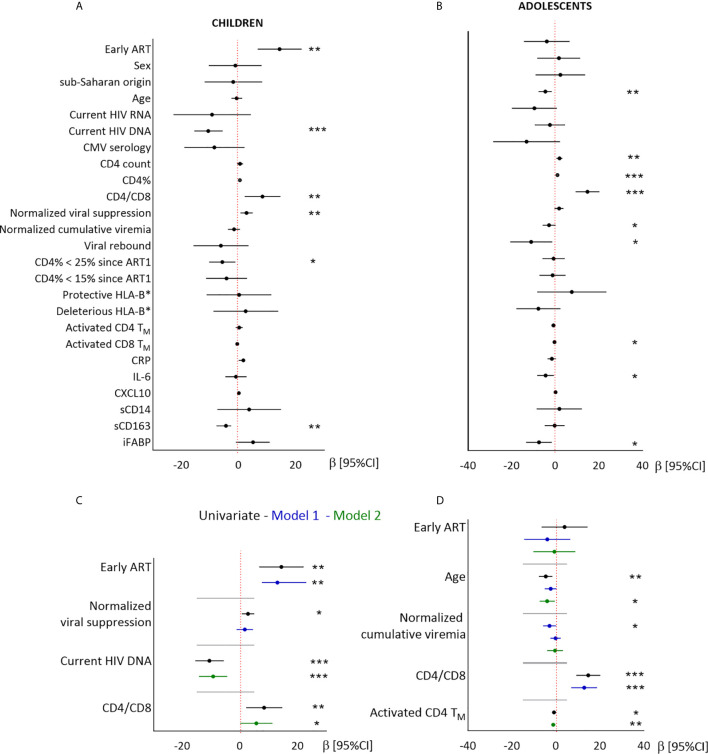
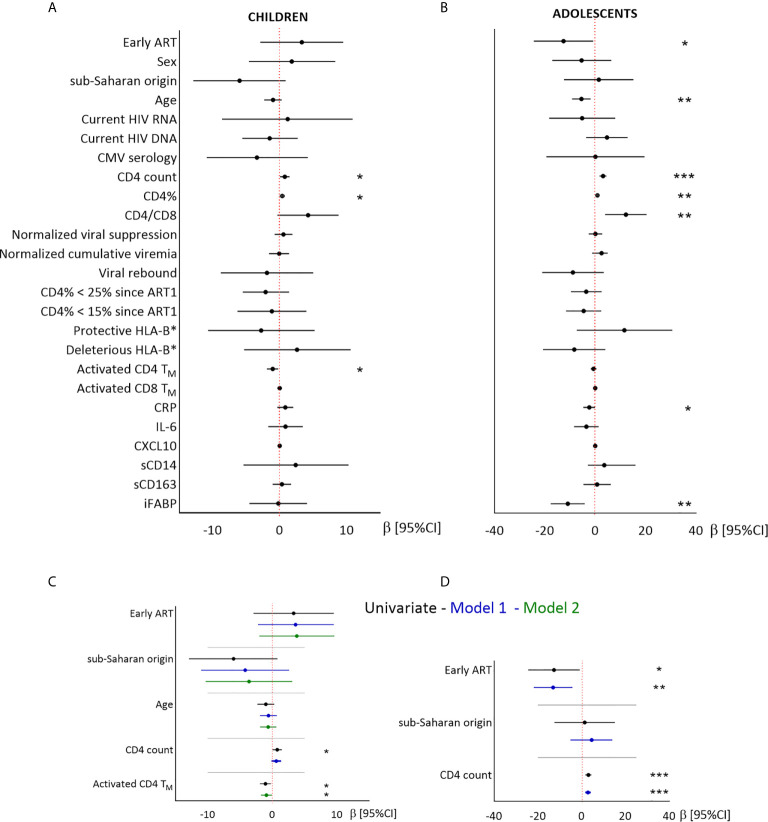
At the time of evaluation, all patients were on ART and had a good immunovirological status: 83% had HIV RNA loads below 50 copies/mL and the median CD4 T-cell count was 856 cells/µL (interquartile range: 685-1236 cells/µL). In children, early ART was associated with higher CD8T percentages (medians: 48.7% vs. 31.0%, = 0.001), and a marginally higher CD4T (61.2% vs. 53.1%, = 0.33). In adolescents, early ART was associated with low CD4T percentages and less differentiated memory CD8 T cells. CD4T and CD8T levels were inversely related to cellular activation and gut permeability.
In children and adolescents, the benefits of early ART for CD8T were clear after long-term ART. The impact of early ART on CD4T appears to be modest, because pediatric patients treated late respond to HIV-driven CD4 T-lymphocyte loss by the production of T cells in the thymus. Our data also suggest that current immune activation and/or gut permeability has a negative impact on T levels.
ClinicalTrials.gov, identifier NCT02674867.
在 HIV-1 感染的婴儿中早期启动抗逆转录病毒治疗(ART)可降低死亡率并防止早期 CD4 T 细胞的丢失。然而,在五岁以上的儿童和青少年中,早期 ART 对免疫系统的影响尚未得到彻底研究。在这里,我们描述了反映免疫重建质量的幼稚 CD4 和 CD8 T 淋巴细胞(CD4/CD8T)的水平,其取决于 ART 启动的时间(早期(<6 个月)与晚期(≥24 个月))。
ANRS-EP59-CLEAC 研究纳入了 27 名年龄在 5-12 岁的儿童(早期治疗组)和 9 名年龄在 13-17 岁的青少年(早期治疗组),以及 19 名儿童(L-Ch)和 21 名青少年(L-Ado)。通过流式细胞术分析 T 淋巴细胞,通过 ELISA 分析血浆标志物。采用单变量和多变量模型进行线性回归分析。
在评估时,所有患者均接受 ART 治疗,免疫病毒学状况良好:83%的患者 HIV RNA 载量低于 50 拷贝/mL,中位 CD4 T 细胞计数为 856 个/µL(四分位距:685-1236 个/µL)。在儿童中,早期 ART 与较高的 CD8T 百分比相关(中位数:48.7%比 31.0%, = 0.001),而 CD4T 略有升高(61.2%比 53.1%, = 0.33)。在青少年中,早期 ART 与低 CD4T 百分比和分化较差的记忆 CD8 T 细胞有关。CD4T 和 CD8T 水平与细胞活化和肠道通透性呈负相关。
在儿童和青少年中,长期 ART 后,早期 ART 对 CD8T 的益处是明确的。早期 ART 对 CD4T 的影响似乎较小,因为晚期接受治疗的儿科患者通过在胸腺中产生 T 细胞来应对 HIV 驱动的 CD4 T 淋巴细胞丢失。我们的数据还表明,目前的免疫激活和/或肠道通透性对 T 水平有负面影响。
ClinicalTrials.gov,标识符 NCT02674867。