Engel Sinha, Schumacher Sarah, Niemeyer Helen, Kuester Annika, Burchert Sebastian, Klusmann Hannah, Rau Heinrich, Willmund Gerd-Dieter, Knaevelsrud Christine
Division of Clinical Psychological Intervention, Freie Universität Berlin, Berlin, Germany.
Department for Military Mental Health, German Armed Forces, Military Hospital Berlin, Berlin, Germany.
Eur J Psychotraumatol. 2021 Mar 25;12(1):1886499. doi: 10.1080/20008198.2021.1886499.
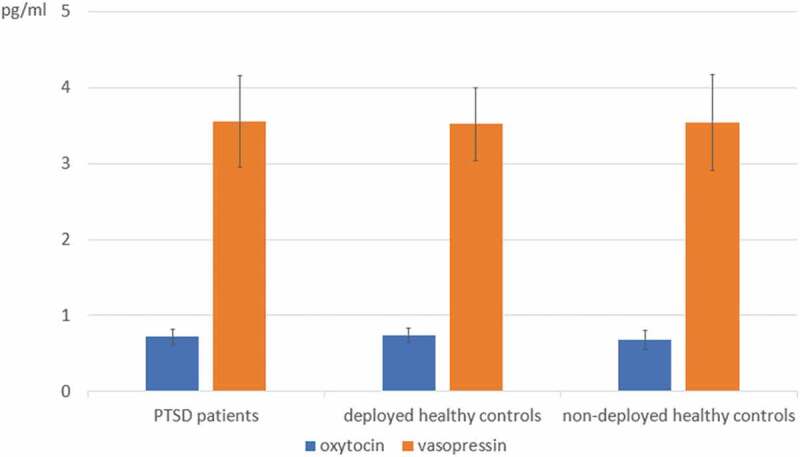
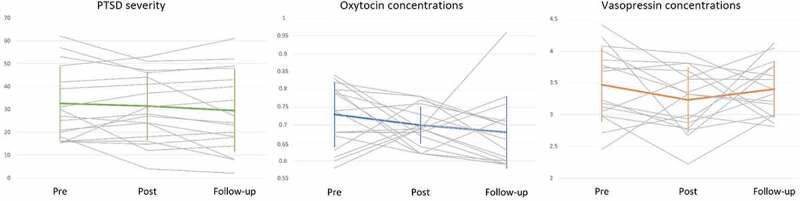
: Posttraumatic stress disorder (PTSD) is characterized by impairments in extinction learning and social behaviour, which are targeted by trauma-focused cognitive behavioural treatment (TF-CBT). The biological underpinnings of TF-CBT can be better understood by adding biomarkers to the clinical evaluation of interventions. Due to their involvement in social functioning and fear processing, oxytocin and arginine vasopressin might be informative biomarkers for TF-CBT, but to date, this has never been tested. : To differentiate the impact of traumatic event exposure and PTSD symptoms on blood oxytocin and vasopressin concentrations. Further, to describe courses of PTSD symptoms, oxytocin and vasopressin during an internet-based TF-CBT and explore interactions between these parameters. : We compared oxytocin and vasopressin between three groups of active and former male service members of the German Armed Forces ( = 100): PTSD patients ( = 39), deployed healthy controls who experienced a deployment-related traumatic event ( = 33) and non-deployed healthy controls who never experienced a traumatic event ( = 28). PTSD patients underwent a 5-week internet-based TF-CBT. We correlated PTSD symptoms with oxytocin and vasopressin before treatment onset. Further, we analysed courses of PTSD symptoms, oxytocin and vasopressin from pre- to post-treatment and 3 months follow-up, as well as interactions between the three parameters. : Oxytocin and vasopressin did not differ between the groups and were unrelated to PTSD symptoms. PTSD symptoms were highly stable over time, whereas the endocrine parameters were not, and they also did not change in mean. Oxytocin and vasopressin were not associated with PTSD symptoms longitudinally. : Mainly due to their insufficient intraindividual stability, single measurements of endogenous oxytocin and vasopressin concentrations are not informative biomarkers for TF-CBT. We discuss how the stability of these biomarkers might be increased and how they could be better related to the specific impairments targeted by TF-CBT.
创伤后应激障碍(PTSD)的特征是消退学习和社交行为受损,而创伤聚焦认知行为疗法(TF-CBT)针对这些方面进行治疗。通过在干预措施的临床评估中加入生物标志物,可以更好地理解TF-CBT的生物学基础。由于催产素和精氨酸加压素参与社交功能和恐惧处理,它们可能是TF-CBT的有用生物标志物,但迄今为止,尚未对此进行过测试。:区分创伤事件暴露和PTSD症状对血液中催产素和加压素浓度的影响。此外,描述基于互联网的TF-CBT过程中PTSD症状、催产素和加压素的变化过程,并探讨这些参数之间的相互作用。:我们比较了德国武装部队三组现役和退役军人(n = 100)的催产素和加压素水平:PTSD患者(n = 39)、经历与部署相关创伤事件的已部署健康对照组(n = 33)和从未经历过创伤事件的未部署健康对照组(n = 28)。PTSD患者接受了为期5周的基于互联网的TF-CBT。我们在治疗开始前将PTSD症状与催产素和加压素进行了相关性分析。此外,我们分析了治疗前至治疗后以及3个月随访期间PTSD症状、催产素和加压素的变化过程,以及这三个参数之间的相互作用。:各组之间的催产素和加压素没有差异,且与PTSD症状无关。PTSD症状随时间高度稳定,而内分泌参数并非如此,且其平均值也没有变化。催产素和加压素与PTSD症状在纵向方面没有关联。:主要由于内源性催产素和加压素浓度的个体内稳定性不足,单次测量这些浓度并不是TF-CBT的有用生物标志物。我们讨论了如何提高这些生物标志物的稳定性,以及如何使其更好地与TF-CBT所针对的特定损伤相关联。