Division of Clinical Psychological Intervention, Department of Education and Psychology, Freie Universität Berlin, Freie Universität Berlin, Schwendenerstr. 27, 14195, Berlin, Germany.
Department of Clinical Psychology, Psychotherapy and Diagnostics, Institute of Psychology, Technische Universität Braunschweig, Braunschweig, Germany.
BMC Psychiatry. 2020 May 6;20(1):205. doi: 10.1186/s12888-020-02595-z.
The present study was designed to evaluate the efficacy of a therapist-guided internet-based cognitive-behavioral therapy (iCBT) intervention for service members of the German Armed Forces with posttraumatic stress disorder (PTSD). The iCBT was adapted from Interapy, a trauma-focused evidence-based treatment based on prolonged exposure and cognitive restructuring. It lasted for 5 weeks and included 10 writing assignments (twice a week). The program included a reminder function if assignments were overdue, but no multimedia elements. Therapeutic written feedback was provided asynchronously within one working day.
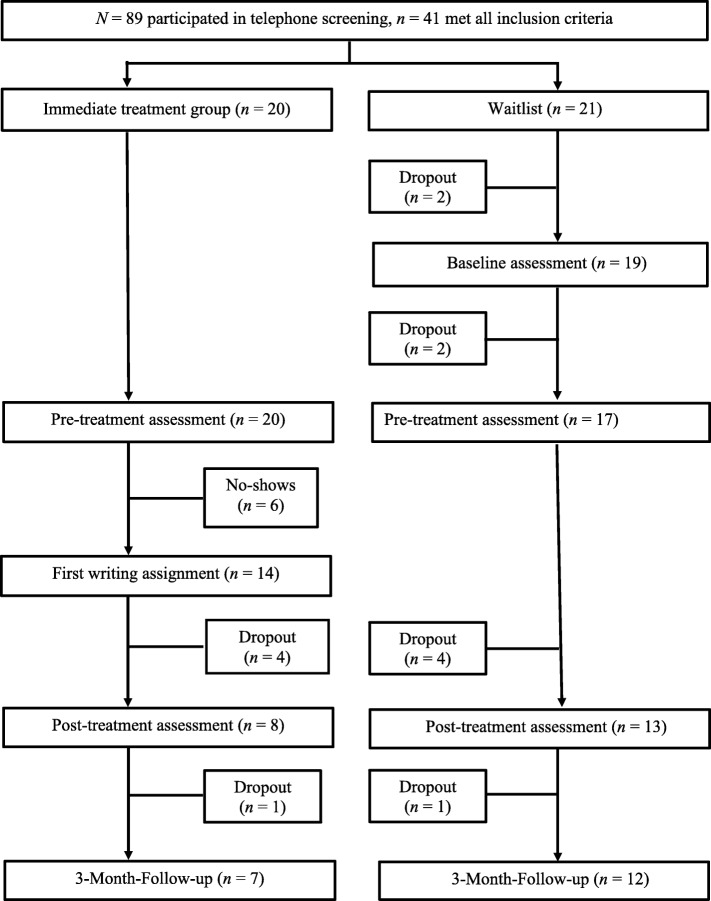
Male active and former military service members were recruited from the German Armed Forces. Diagnoses were assessed with the Clinician-Administered PTSD Scale for DSM-5 (CAPS-5) and the Mini-International Neuropsychiatric Interview. Psychopathology was assessed at pre-treatment, post-treatment, and 3-month follow-up. Severity of PTSD was the primary outcome and anxiety was the secondary outcome. Participants were randomly allocated to a treatment group that received iCBT immediately or to a waitlist group that received iCBT after 6 weeks. Due to the overall small sample size (n = 37), the two groups were collapsed for the statistical analyses. Change during the intervention period was investigated using latent-change score models.
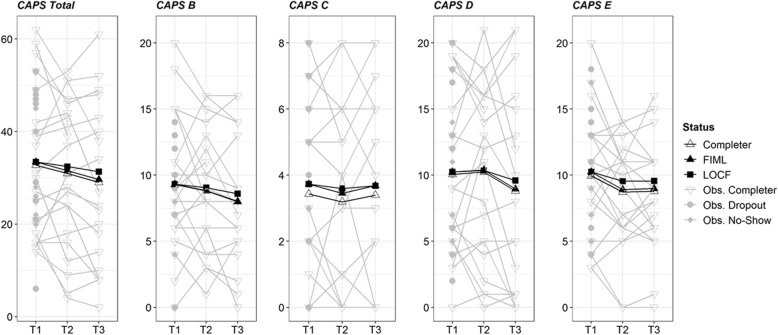
Improvements in the CAPS-5 were small and not statistically significant. For anxiety, small significant improvements were observed from pre- to follow-up assessment. The dropout rate was 32.3%.
The low treatment utilization and the high dropout rate are in line with previous findings on treatment of service members. The interpretation of the current null results for the efficacy of iCBT is limited due to the small sample size, however for military samples effect estimates were also smaller in other recent studies. Our results demonstrate the need to identify factors influencing treatment engagement and efficacy in veterans.
Australian Clinical Trials Registry ACTRN12616000956404.
本研究旨在评估一种基于互联网的认知行为疗法(iCBT)干预对德国武装部队创伤后应激障碍(PTSD)患者的疗效。该 iCBT 改编自 Interapy,一种基于延长暴露和认知重构的创伤为中心的循证治疗方法。它持续 5 周,包括 10 次写作作业(每周两次)。该方案包括逾期提醒功能,但没有多媒体元素。治疗性书面反馈在一个工作日内异步提供。
从德国武装部队招募现役和退役军人男性。使用 DSM-5 临床医生管理 PTSD 量表(CAPS-5)和 Mini-国际神经精神访谈(MINI)进行诊断评估。在治疗前、治疗后和 3 个月随访时评估精神病理学。PTSD 的严重程度是主要结局,焦虑是次要结局。参与者被随机分配到立即接受 iCBT 的治疗组或接受 6 周后接受 iCBT 的等待组。由于总体样本量较小(n=37),对两组进行了合并统计分析。使用潜在变化评分模型研究干预期间的变化。
CAPS-5 的改善较小,且无统计学意义。焦虑方面,治疗前到随访评估的改善较小,但有统计学意义。脱落率为 32.3%。
低治疗利用率和高脱落率与之前关于军人治疗的研究结果一致。由于样本量小,目前 iCBT 疗效的阴性结果的解释有限,但在其他最近的研究中,军事样本的效应估计也较小。我们的结果表明,有必要确定影响退伍军人治疗参与和疗效的因素。
澳大利亚临床试验注册中心 ACTRN12616000956404。