de Sousa Herdson Renney, de Frazão Stefânia, de Oliveira Júnior Getúlio Pereira, Albuquerque Patrícia, Nicola André Moraes
Microbiology, Immunology and Biotechnology Laboratory, Faculty of Medicine, University of Brasília, Brasília, Brazil.
Laboratory of Molecular Biology of Pathogenic Fungi, Department of Cell Biology, Institute of Biological Sciences, University of Brasília, Brasília, Brazil.
Front Cell Infect Microbiol. 2021 Apr 21;11:657502. doi: 10.3389/fcimb.2021.657502. eCollection 2021.
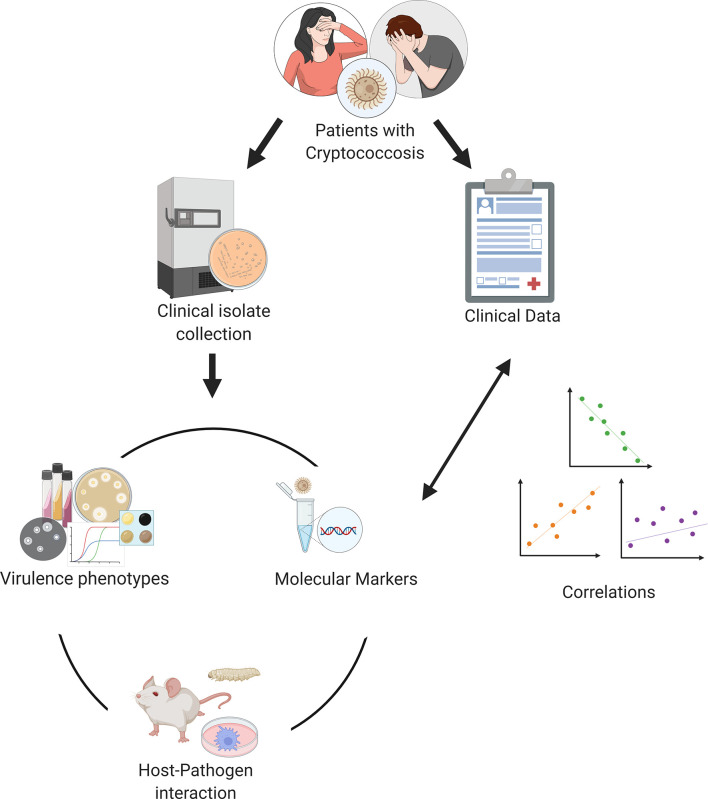
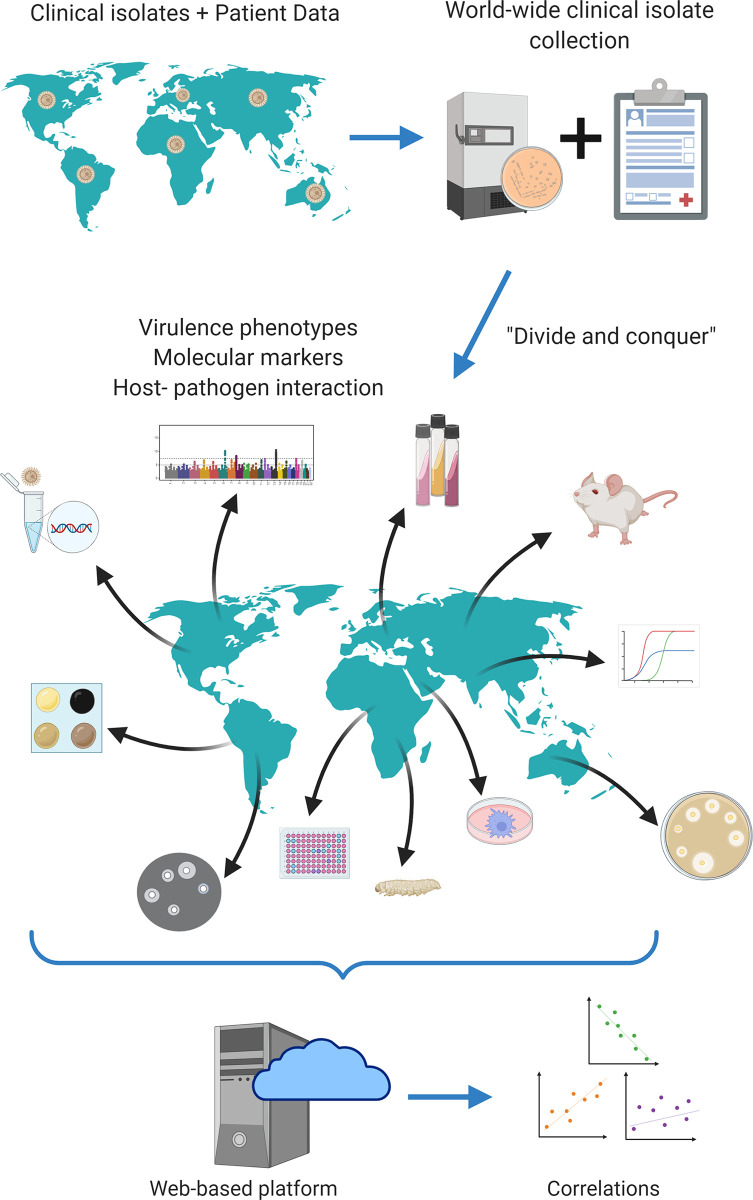
Cryptococcosis, an invasive mycosis caused by spp, kills between 20% and 70% of the patients who develop it. There are no vaccines for prevention, and treatment is based on a limited number of antifungals. Studying fungal virulence and how the host responds to infection could lead to new therapies, improving outcomes for patients. The biggest challenge, however, is that experimental cryptococcosis models do not completely recapitulate human disease, while human experiments are limited due to ethical reasons. To overcome this challenge, one of the approaches used by researchers and clinicians is to: 1) collect cryptococcal clinical isolates and associated patient data; 2) study the set of isolates in the laboratory (virulence and host-pathogen interaction variables, molecular markers); 3) correlate the laboratory and patient data to understand the roles fungal attributes play in the human disease. Here we review studies that have shed light on the cryptococcosis pathophysiology using these approaches, with a special focus on human disease. Isolates that more effectively evade macrophage responses, that secrete more laccase, melanize faster and have larger capsules in the cerebrospinal fluid are associated with poorer patient outcomes. Additionally, molecular studies have also shown that cryptococcal clades vary in virulence, with clinical impact. Limitations of those studies include the use of a small number of isolates or retrospectively collected clinical data. The fact that they resulted in very important information is a reflection of the impact this strategy has in understanding cryptococcosis and calls for international collaboration that could boost our knowledge.
隐球菌病是由隐球菌属物种引起的一种侵袭性真菌病,在发病患者中导致20%至70%的患者死亡。目前尚无预防疫苗,治疗主要基于有限的几种抗真菌药物。研究真菌毒力以及宿主对感染的反应可能会带来新的治疗方法,改善患者的治疗效果。然而,最大的挑战在于实验性隐球菌病模型并不能完全重现人类疾病,而由于伦理原因,人体实验受到限制。为了克服这一挑战,研究人员和临床医生采用的方法之一是:1)收集隐球菌临床分离株及相关患者数据;2)在实验室研究这些分离株(毒力和宿主-病原体相互作用变量、分子标记);3)将实验室数据与患者数据相关联,以了解真菌特性在人类疾病中所起的作用。在此,我们综述了利用这些方法揭示隐球菌病病理生理学的研究,特别关注人类疾病。在脑脊液中更有效地逃避巨噬细胞反应、分泌更多漆酶、更快黑化且具有更大荚膜的分离株与患者预后较差相关。此外,分子研究还表明,隐球菌的进化分支在毒力方面存在差异,并具有临床影响。这些研究的局限性包括使用的分离株数量较少或临床数据为回顾性收集。它们得出了非常重要的信息,这反映了该策略在理解隐球菌病方面的影响力,并呼吁开展国际合作以增进我们的知识。