Alam Athar, Bröms Jeanette E, Kumar Rajender, Sjöstedt Anders
Laboratory for Molecular Infection Medicine Sweden (MIMS), Department of Clinical Microbiology, Umeå University, Umeå, Sweden.
Front Mol Biosci. 2021 Apr 22;8:668910. doi: 10.3389/fmolb.2021.668910. eCollection 2021.
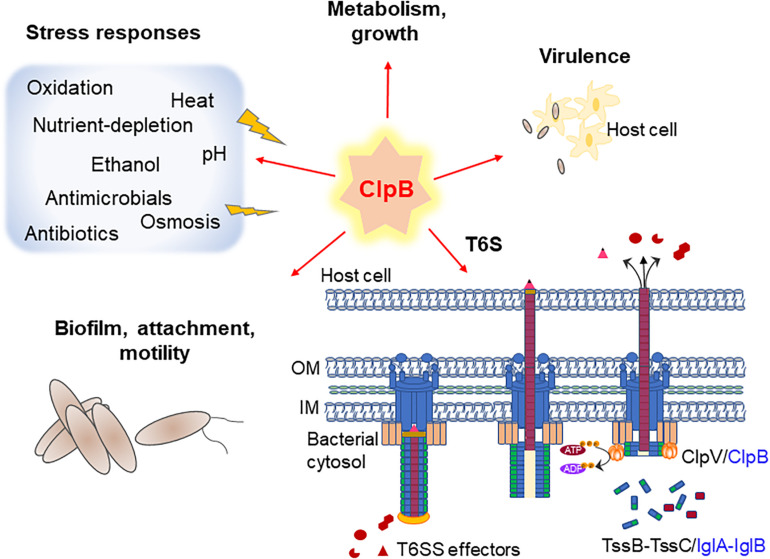
Bacterial survival within a mammalian host is contingent upon sensing environmental perturbations and initiating an appropriate counter-response. To achieve this, sophisticated molecular machineries are used, where bacterial chaperone systems play key roles. The chaperones are a prerequisite for bacterial survival during normal physiological conditions as well as under stressful situations, e.g., infection or inflammation. Specific stress factors include, but are not limited to, high temperature, osmolarity, pH, reactive oxidative species, or bactericidal molecules. ClpB, a member of class 1 AAA proteins, is a key chaperone that via its disaggregase activity plays a crucial role for bacterial survival under various forms of stress, in particular heat shock. Recently, it has been reported that ClpB also regulates secretion of bacterial effector molecules related to type VI secretion systems. In this review, the roles of ClpB in stress responses and the mechanisms by which it promotes survival of pathogenic bacteria are discussed.
细菌在哺乳动物宿主体内的存活取决于感知环境扰动并启动适当的应对反应。为此,细菌会利用复杂的分子机制,其中细菌伴侣系统发挥着关键作用。伴侣蛋白是细菌在正常生理条件下以及在应激情况下(如感染或炎症)存活的先决条件。特定的应激因素包括但不限于高温、渗透压、pH值、活性氧物质或杀菌分子。ClpB是1类AAA蛋白的成员,是一种关键的伴侣蛋白,它通过其解聚酶活性在各种形式的应激(特别是热休克)下对细菌存活起着至关重要的作用。最近,有报道称ClpB还调节与VI型分泌系统相关的细菌效应分子的分泌。在这篇综述中,讨论了ClpB在应激反应中的作用及其促进病原菌存活的机制。