Rieke Lorena, Spindler Birgit, Zylka Isabel, Kemper Nicole, Giersberg Mona Franziska
Institute for Animal Hygiene, Animal Welfare and Farm Animal Behavior, University of Veterinary Medicine Hannover, Foundation, Hanover, Germany.
Animals in Science and Society, Department Population Health Sciences, Faculty of Veterinary Medicine, Utrecht University, Utrecht, Netherlands.
Front Vet Sci. 2021 Apr 23;8:660400. doi: 10.3389/fvets.2021.660400. eCollection 2021.
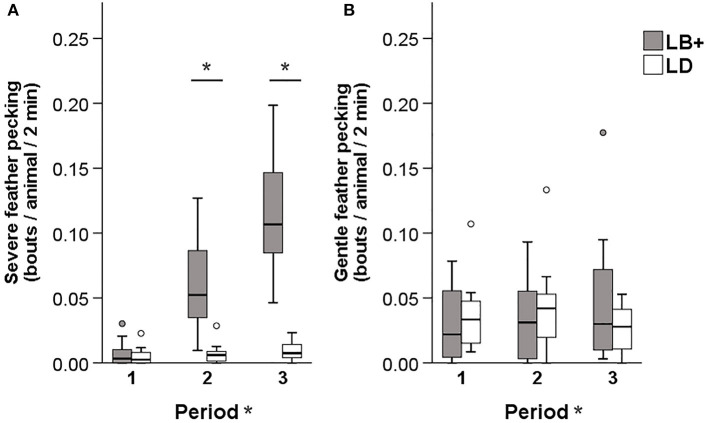
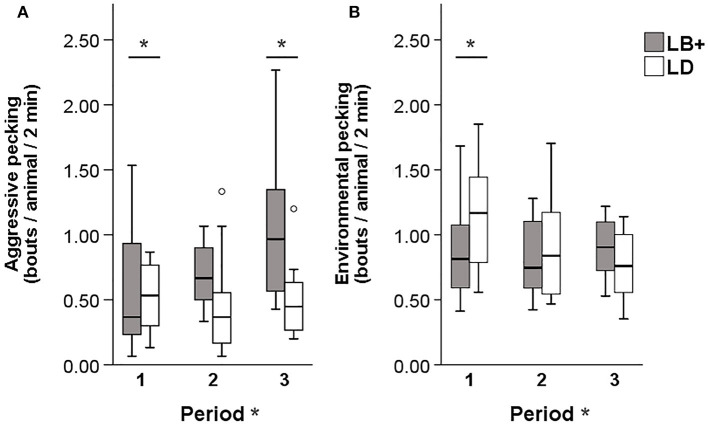
To avoid the killing of surplus male layer chickens, dual-purpose hybrids are suggested as an alternative approach. These strains may offer additional advantages compared to conventional laying hens, for instance, a lower tendency to develop injurious pecking behavior. The aim of this study was to assess the behavior, with focus on pecking behavior, of conventional layers (Lohmann Brown plus, LB+) and dual-purpose hens (Lohmann Dual, LD). About 1,845 hens per strain with intact beaks were housed in four stable compartments in aviary systems. Video-based scan sampling of general behaviors and continuous observations of pecking behavior were carried out between 25 and 69 weeks of life. With the exception of "dustbathing" and "scratching," hybrid × time during the laying period affected all of the observed general behaviors [ = 3.92-10.81, < 0.001-0.05]. With increasing age, the LB+ hens performed more general pecking, more locomotion and less comfort and sitting behavior. General pecking and comfort behavior did not change over time in the LD hens, whereas inactive behaviors increased with age. During continuous observations, a significant hybrid x period interaction was found for all forms of pecking behavior [ = 4.55-14.80, < 0.001-0.05]. The LB+ hens showed particularly more severe feather pecking (SFP), which increased with age. In contrast, SFP remained exceptionally low in the LD hens throughout production. Therefore, dual-purpose hybrids should be considered as an alternative to both avoid the killing of surplus male chickens and the development of SFP in laying hen production.
为避免宰杀多余的雄性蛋鸡,建议采用兼用型杂交鸡作为替代方法。与传统蛋鸡相比,这些品系可能具有其他优势,例如,发生有害啄癖行为的倾向较低。本研究的目的是评估传统蛋鸡(罗曼褐plus,LB+)和兼用型母鸡(罗曼兼用型,LD)的行为,重点是啄癖行为。每个品系约1845只喙完整的母鸡饲养在禽舍系统的四个稳定隔间中。在25至69周龄期间,对一般行为进行基于视频的扫描取样,并对啄癖行为进行连续观察。除“沙浴”和“抓挠”外,产蛋期的杂交×时间影响了所有观察到的一般行为[F = 3.92 - 10.81,P < 0.001 - 0.05]。随着年龄的增长,LB+母鸡表现出更多的一般啄癖、更多的运动以及更少的舒适和坐卧行为。LD母鸡的一般啄癖和舒适行为随时间没有变化,而不活动行为随年龄增加。在连续观察期间,发现所有形式的啄癖行为均存在显著的杂交×时期交互作用[F = 4.55 - 14.80,P < 0.001 - 0.05]。LB+母鸡表现出特别严重的拔羽癖(SFP),且随年龄增加。相比之下,LD母鸡在整个生产过程中SFP一直极低。因此,兼用型杂交鸡应被视为一种替代选择,既能避免宰杀多余的雄性鸡,又能避免蛋鸡生产中SFP的发生。