Yoon Jai Hoon, Jung Ye-Ji, Moon Sung-Hoon
Department of Internal Medicine, Hanyang University College of Medicine, Seoul 04763, South Korea.
Department of Internal Medicine, Hallym University, Anyang 14068, South Korea.
World J Clin Cases. 2021 May 6;9(13):2969-2982. doi: 10.12998/wjcc.v9.i13.2969.
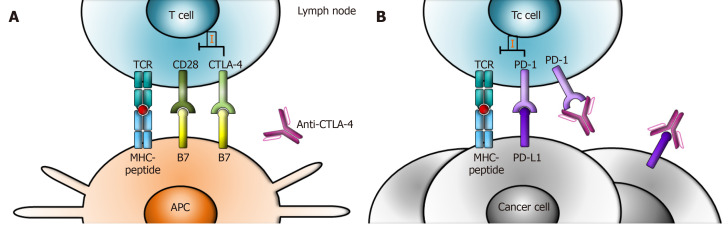
Pancreatic cancer, a highly lethal cancer, has the lowest 5-year survival rate for several reasons, including its tendency for the late diagnosis, a lack of serologic markers for screening, aggressive local invasion, its early metastatic dissemination, and its resistance to chemotherapy/radiotherapy. Pancreatic cancer evades immunologic elimination by a variety of mechanisms, including induction of an immunosuppressive microenvironment. Cancer-associated fibroblasts interact with inhibitory immune cells, such as tumor-associated macrophages and regulatory T cells, to form an inflammatory shell-like desmoplastic stroma around tumor cells. Immunotherapy has the potential to mobilize the immune system to eliminate cancer cells. Nevertheless, although immunotherapy has shown brilliant results across a wide range of malignancies, only anti-programmed cell death 1 antibodies have been approved for use in patients with pancreatic cancer who test positive for microsatellite instability or mismatch repair deficiency. Some patients treated with immunotherapy who show progression based on conventional response criteria may prove to have a durable response later. Continuation of immune-based treatment beyond disease progression can be chosen if the patient is clinically stable. Immunotherapeutic approaches for pancreatic cancer treatment deserve further exploration, given the plethora of combination trials with other immunotherapeutic agents, targeted therapy, stroma-modulating agents, chemotherapy, and multi-way combination therapies.
胰腺癌是一种高度致命的癌症,其5年生存率极低,原因包括诊断往往较晚、缺乏用于筛查的血清学标志物、局部侵袭性强、早期发生转移扩散以及对化疗/放疗具有抗性。胰腺癌通过多种机制逃避免疫清除,包括诱导免疫抑制微环境。癌症相关成纤维细胞与抑制性免疫细胞相互作用,如肿瘤相关巨噬细胞和调节性T细胞,在肿瘤细胞周围形成炎性壳状促纤维增生性基质。免疫疗法有潜力调动免疫系统来清除癌细胞。然而,尽管免疫疗法在多种恶性肿瘤中都取得了显著成效,但只有抗程序性细胞死亡1抗体被批准用于微卫星不稳定或错配修复缺陷检测呈阳性的胰腺癌患者。一些接受免疫疗法治疗的患者,根据传统反应标准显示病情进展,但后来可能会有持久反应。如果患者临床状况稳定,可以选择在疾病进展后继续进行基于免疫的治疗。鉴于有大量与其他免疫治疗药物、靶向治疗、基质调节药物、化疗和多途径联合疗法的联合试验,胰腺癌治疗的免疫治疗方法值得进一步探索。