Cox-Witton Keren, Baker Michelle L, Edson Dan, Peel Alison J, Welbergen Justin A, Field Hume
Wildlife Health Australia, Mosman, NSW 2088, Australia.
CSIRO, Health and Biosecurity Business Unit, Australian Centre for Disease Preparedness, Geelong, VIC 3220, Australia.
One Health. 2021 Dec;13:100247. doi: 10.1016/j.onehlt.2021.100247. Epub 2021 May 3.
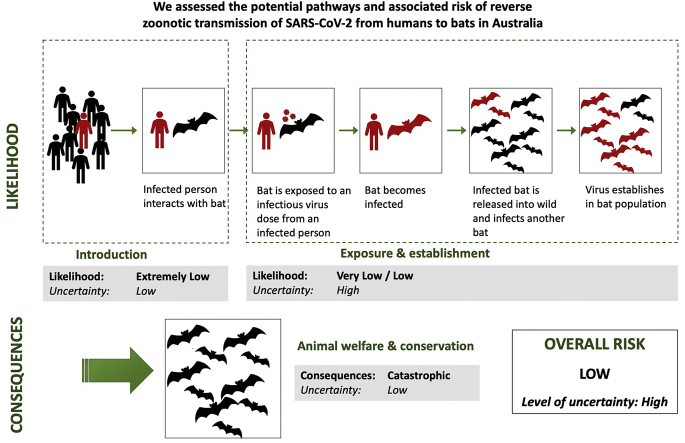
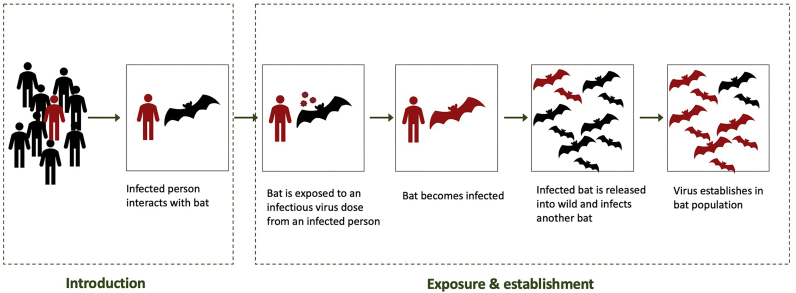
SARS-CoV-2, the cause of COVID-19, infected over 100 million people globally by February 2021. Reverse zoonotic transmission of SARS-CoV-2 from humans to other species has been documented in pet cats and dogs, big cats and gorillas in zoos, and farmed mink. As SARS-CoV-2 is closely related to known bat viruses, assessment of the potential risk of transmission of the virus from humans to bats, and its subsequent impacts on conservation and public health, is warranted. A qualitative risk assessment was conducted by a multi-disciplinary group to assess this risk in bats in the Australian context, with the aim of informing risk management strategies for human activities involving interactions with bats. The overall risk of SARS-CoV-2 establishing in an Australian bat population was assessed to be , however with a level of uncertainty. The outcome of the assessment indicates that, for the Australian situation where the prevalence of COVID-19 in humans is very low, it is reasonable for research and rehabilitation of bats to continue, provided additional biosecurity measures are applied. Risk assessment is challenging for an emerging disease where information is lacking and the situation is changing rapidly; assessments should be revised if human prevalence or other important factors change significantly. The framework developed here, based on established animal disease risk assessment approaches adapted to assess reverse zoonotic transmission, has potential application to a range of wildlife species and situations.
严重急性呼吸综合征冠状病毒2(SARS-CoV-2)是导致新冠肺炎的病原体,截至2021年2月,已在全球感染了超过1亿人。SARS-CoV-2从人类反向人畜共患病传播至其他物种的情况已在宠物猫和狗、动物园中的大型猫科动物和大猩猩以及养殖水貂中得到记录。由于SARS-CoV-2与已知的蝙蝠病毒密切相关,因此有必要评估该病毒从人类传播至蝙蝠的潜在风险及其对保护和公共卫生的后续影响。一个多学科小组进行了定性风险评估,以评估澳大利亚境内蝙蝠面临的这种风险,目的是为涉及与蝙蝠互动的人类活动提供风险管理策略。评估得出SARS-CoV-2在澳大利亚蝙蝠种群中定殖的总体风险为 ,但存在一定程度的不确定性。评估结果表明,对于澳大利亚新冠肺炎在人类中患病率极低的情况,只要采取额外的生物安全措施,继续进行蝙蝠研究和康复工作是合理的。对于一种信息匮乏且情况迅速变化的新兴疾病而言,风险评估具有挑战性;如果人类患病率或其他重要因素发生显著变化,评估应予以修订。此处基于既定动物疾病风险评估方法开发的框架,经过调整以评估反向人畜共患病传播,具有应用于一系列野生动物物种和情况的潜力。