Division of Allergy and Immunology and Center for Pediatric Eosinophilic Disorders, Children's Hospital of Philadelphia, Philadelphia, Pennsylvania.
Division of Allergy and Immunology and Center for Pediatric Eosinophilic Disorders, Children's Hospital of Philadelphia, Philadelphia, Pennsylvania; Institute for Immunology and Department of Pediatrics, Perelman School of Medicine, Philadelphia, Pennsylvania.
Ann Allergy Asthma Immunol. 2021 Sep;127(3):293-300. doi: 10.1016/j.anai.2021.04.036. Epub 2021 May 7.
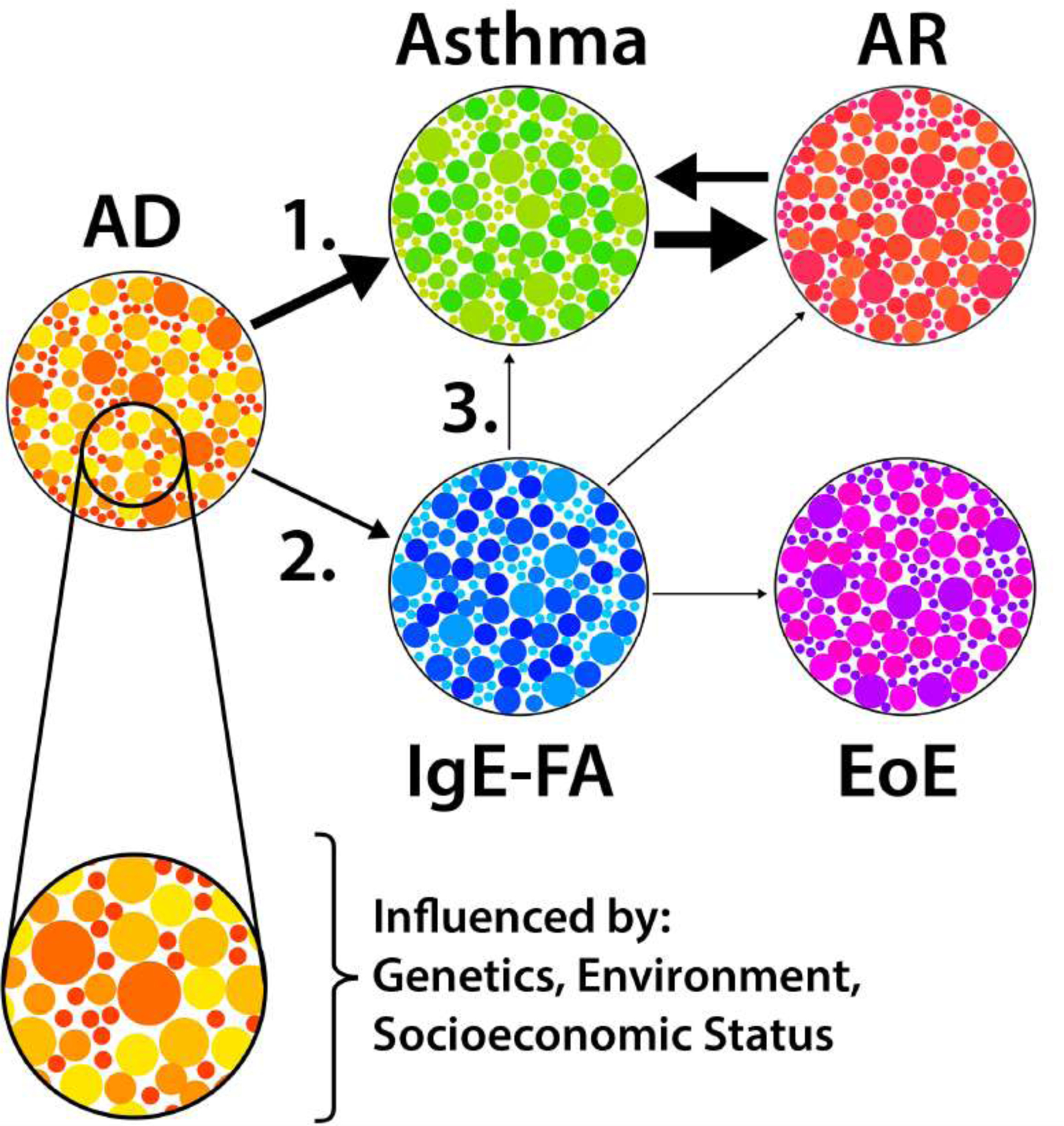
The classical allergic march model posits that atopy begins in infancy with atopic dermatitis and progresses to asthma and allergic rhinitis in a subset of individuals. The growing prevalence and severity of allergic diseases have prompted renewed interest in refining this model. This review outlines epidemiologic evidence for the existence of allergic march trajectories (distinct paths of atopy development in individuals); reviews the roles that genetics, environment, and disease endotypes play in determining trajectory outcomes; and discusses the clinical utility of the trajectory model.
PubMed search of English-language articles and reviews without date limits pertaining to the epidemiology, genetics, and immunologic mechanisms of allergic march trajectories and disease endotypes.
Studies and reviews were selected based on their high quality and direct relevance to the review topic.
Recent work in the field has revealed that immunoglobulin E-mediated food allergy and eosinophilic esophagitis are components of the allergic march. Furthermore, the field is acknowledging that variability exists in the number and sequence of allergic manifestations that individuals develop. These allergic march pathways, or trajectories, are influenced by genetic, environmental, and psychosocial factors that are incompletely understood.
Continued elucidation of the landscape and origins of allergic march trajectories will inform efforts to personalize allergic disease prevention, diagnosis, and treatment.
经典的过敏进展模型提出,特应性始于婴儿期的特应性皮炎,并在一部分人群中进展为哮喘和过敏性鼻炎。过敏疾病的患病率和严重程度不断增加,促使人们重新关注对该模型的完善。本综述概述了过敏进展轨迹(个体中特应性发展的不同路径)存在的流行病学证据;综述了遗传、环境和疾病表型在决定轨迹结果中的作用;并讨论了轨迹模型的临床实用性。
在没有时间限制的情况下,通过 PubMed 搜索有关过敏进展轨迹和疾病表型的流行病学、遗传学和免疫学机制的英文文章和综述。
根据与综述主题的直接相关性和高质量选择研究和综述。
该领域的最新研究表明,免疫球蛋白 E 介导的食物过敏和嗜酸性食管炎是过敏进展的组成部分。此外,该领域还承认,个体发生的过敏表现的数量和顺序存在差异。这些过敏进展途径或轨迹受到遗传、环境和社会心理因素的影响,这些因素尚未完全了解。
对过敏进展轨迹的特征和起源的进一步阐明将有助于实现过敏疾病预防、诊断和治疗的个体化。