Interdisciplinary Consortium on Advanced Motion Performance (iCAMP), Michael E. DeBakey Department of Surgery, Baylor College of Medicine, Houston, Texas, USA.
BioSensics LLC, Newton, Massachusetts, USA.
Gerontology. 2022;68(2):224-233. doi: 10.1159/000515939. Epub 2021 May 10.
Cognitive frailty (CF), defined as the simultaneous presence of cognitive impairment and physical frailty, is a clinical symptom in early-stage dementia with promise in assessing the risk of dementia. The purpose of this study was to use wearables to determine the most sensitive digital gait biomarkers to identify CF.
Of 121 older adults (age = 78.9 ± 8.2 years, body mass index = 26.6 ± 5.5 kg/m2) who were evaluated with a comprehensive neurological exam and the Fried frailty criteria, 41 participants (34%) were identified with CF and 80 participants (66%) were identified without CF. Gait performance of participants was assessed under single task (walking without cognitive distraction) and dual task (walking while counting backward from a random number) using a validated wearable platform. Participants walked at habitual speed over a distance of 10 m. A validated algorithm was used to determine steady-state walking. Gait parameters of interest include steady-state gait speed, stride length, gait cycle time, double support, and gait unsteadiness. In addition, speed and stride length were normalized by height.
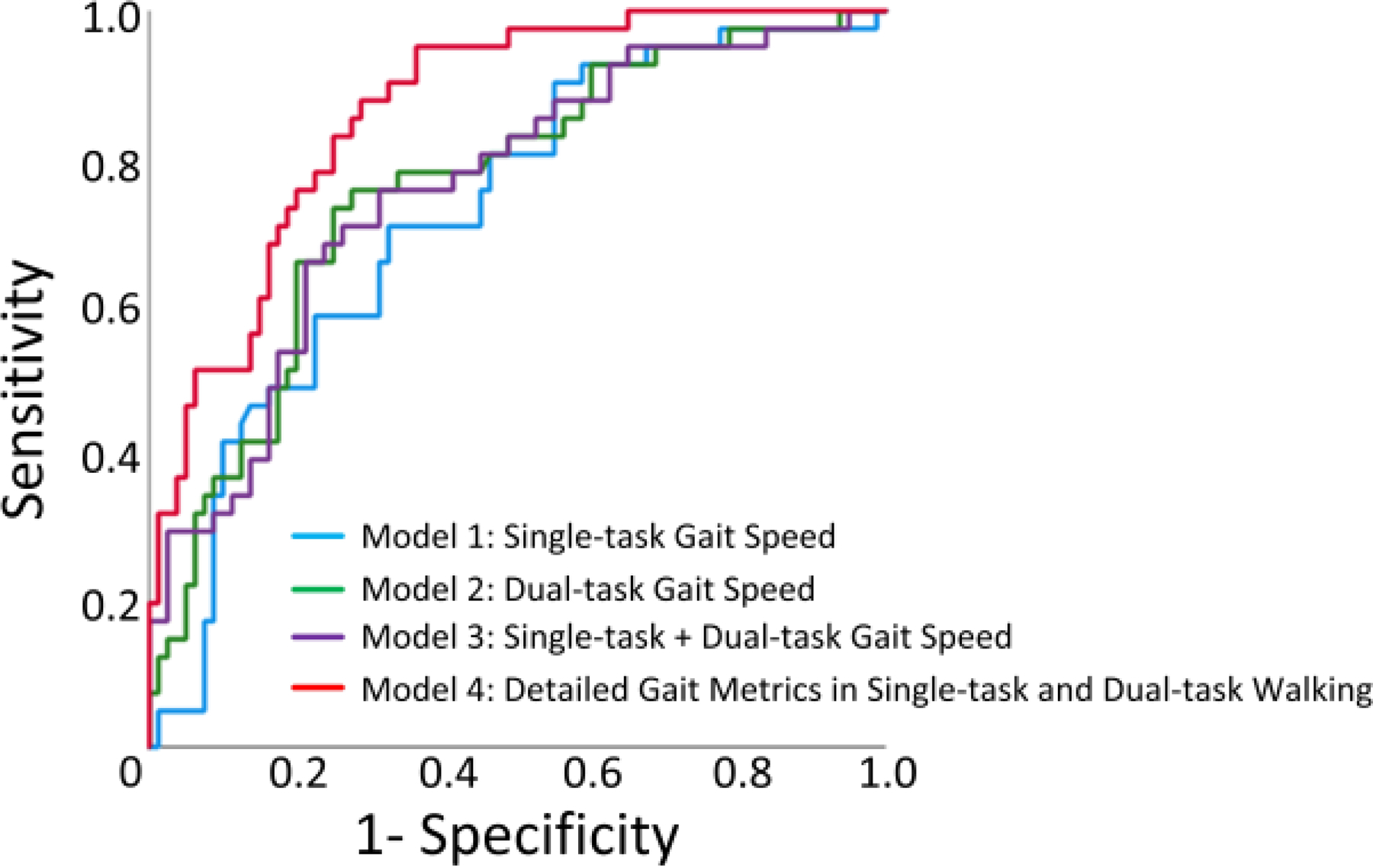
Our results suggest that compared to the group without CF, the CF group had deteriorated gait performances in both single-task and dual-task walking (Cohen's effect size d = 0.42-0.97, p < 0.050). The largest effect size was observed in normalized dual-task gait speed (d = 0.97, p < 0.001). The use of dual-task gait speed improved the area under the curve (AUC) to distinguish CF cases to 0.76 from 0.73 observed for the single-task gait speed. Adding both single-task and dual-task gait speeds did not noticeably change AUC. However, when additional gait parameters such as gait unsteadiness, stride length, and double support were included in the model, AUC was improved to 0.87.
This study suggests that gait performances measured by wearable sensors are potential digital biomarkers of CF among older adults. Dual-task gait and other detailed gait metrics provide value for identifying CF above gait speed alone. Future studies need to examine the potential benefits of gait performances for early diagnosis of CF and/or tracking its severity over time.
认知脆弱(CF)被定义为认知障碍和身体脆弱的同时存在,是痴呆症早期阶段的一种临床症状,在评估痴呆症风险方面具有很大的潜力。本研究旨在使用可穿戴设备来确定最敏感的数字步态生物标志物以识别 CF。
在对 121 名年龄为 78.9 ± 8.2 岁、体重指数为 26.6 ± 5.5kg/m2 的老年人进行全面的神经检查和 Fried 脆弱标准评估后,确定了 41 名参与者(34%)患有 CF,80 名参与者(66%)无 CF。使用经过验证的可穿戴平台,在单任务(无认知干扰的行走)和双任务(从随机数倒计数行走)下评估参与者的步态表现。参与者以习惯速度在 10m 距离内行走。使用经过验证的算法来确定稳态行走。感兴趣的步态参数包括稳态行走速度、步长、步态周期时间、双支撑和步态不稳定。此外,速度和步长通过身高进行归一化。
与无 CF 组相比,CF 组在单任务和双任务行走中的步态表现均恶化(Cohen 效应大小 d = 0.42-0.97,p < 0.050)。在归一化双任务行走速度中观察到最大的效应量(d = 0.97,p < 0.001)。使用双任务行走速度可将区分 CF 病例的曲线下面积(AUC)从单任务行走速度的 0.73 提高到 0.76。添加单任务和双任务行走速度不会明显改变 AUC。然而,当将步态不稳定性、步长和双支撑等其他步态参数添加到模型中时,AUC 提高到 0.87。
本研究表明,可穿戴传感器测量的步态表现可能是老年人 CF 的潜在数字生物标志物。与仅行走速度相比,双任务步态和其他详细的步态指标为识别 CF 提供了更多价值。未来的研究需要检查步态表现对 CF 的早期诊断和/或随时间跟踪其严重程度的潜在益处。