Lund University, Sweden.
Brief Bioinform. 2021 Nov 5;22(6). doi: 10.1093/bib/bbab154.
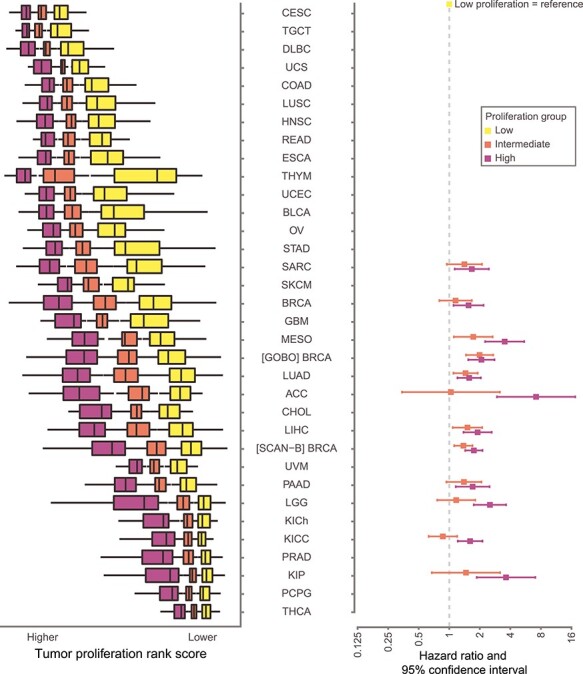
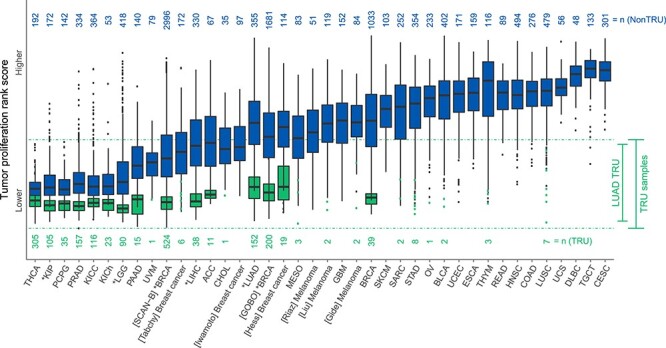
Gene-expression profiling can be used to classify human tumors into molecular subtypes or risk groups, representing potential future clinical tools for treatment prediction and prognostication. However, it is less well-known how prognostic gene signatures derived in one malignancy perform in a pan-cancer context. In this study, a gene-rule-based single sample predictor (SSP) called classifier for lung adenocarcinoma molecular subtypes (CLAMS) associated with proliferation was tested in almost 15 000 samples from 32 cancer types to classify samples into better or worse prognosis. Of the 14 malignancies that presented both CLAMS classes in sufficient numbers, survival outcomes were significantly different for breast, brain, kidney and liver cancer. Patients with samples classified as better prognosis by CLAMS were generally of lower tumor grade and disease stage, and had improved prognosis according to other type-specific classifications (e.g. PAM50 for breast cancer). In all, 99.1% of non-lung cancer cases classified as better outcome by CLAMS were comprised within the range of proliferation scores of lung adenocarcinoma cases with a predicted better prognosis by CLAMS. This finding demonstrates the potential of tuning SSPs to identify specific levels of for instance tumor proliferation or other transcriptional programs through predictor training. Together, pan-cancer studies such as this may take us one step closer to understanding how gene-expression-based SSPs act, which gene-expression programs might be important in different malignancies, and how to derive tools useful for prognostication that are efficient across organs.
基因表达谱分析可用于将人类肿瘤分为分子亚型或风险组,这代表了治疗预测和预后的潜在未来临床工具。然而,在泛癌背景下,从一种恶性肿瘤中得出的预后基因特征如何表现,这一点还不太为人所知。在这项研究中,一种基于基因规则的单样本预测器(SSP),称为与增殖相关的肺腺癌分子亚型分类器(CLAMS),在来自 32 种癌症类型的近 15000 个样本中进行了测试,以将样本分类为预后较好或较差。在有足够数量的 CLAMS 两类的 14 种恶性肿瘤中,乳腺癌、脑癌、肾癌和肝癌的生存结果有显著差异。CLAMS 分类为预后较好的患者的肿瘤分级和疾病分期通常较低,根据其他特定类型的分类(如乳腺癌的 PAM50)预后也有所改善。总的来说,CLAMS 分类为预后较好的非肺癌病例中,99.1%的病例在 CLAMS 预测为预后较好的肺腺癌病例的增殖评分范围内。这一发现表明,通过预测器训练,调整 SSP 以识别特定水平的肿瘤增殖或其他转录程序的潜力。总的来说,像这样的泛癌研究可能使我们更接近于理解基于基因表达的 SSP 如何作用,哪些基因表达程序在不同的恶性肿瘤中可能很重要,以及如何得出在不同器官中有效的预后预测工具。