Department of Integrated Oncology, CIO Bonn, Center for Integrated Oncology ABCD, University Hospital Bonn, Venusberg-Campus 1, 53127, Bonn, Germany.
Institute of Psychosomatic Medicine and Psychotherapy, University Hospital Bonn, Bonn, Germany.
BMC Cancer. 2021 May 10;21(1):526. doi: 10.1186/s12885-021-08141-8.
Immigration has taken the central stage in world politics, especially in the developed countries like Germany, where the continuous flow of immigrants has been well documented since 1960s. Strikingly, emerging data suggest that migrant patients have a poorer response to the treatment and lower survival rates in their new host country, raising concerns about health disparities. Herein, we present our investigation on the treatment response rate and cancer survival in German patients with and without an immigrant background that were treated at our comprehensive cancer center in Germany.
Initially, we considered 8162 cancer patients treated at the Center for Integrated Oncology (CIO), University Hospital Bonn, Germany (April 2002-December 2015) for matched-pair analysis. Subsequently, the German patients with a migration background and those from the native German population were manually identified and catalogued using a highly specific name-based algorithm. The clinical parameters such as demographic characteristics, tumor characteristics, defined staging criteria, and primary therapy were further adjusted. Using these stringent criteria, a total of 422 patients (n = 211, Germans with migration background; n = 211, native German population) were screened to compare for the treatment response and survival rates (i.e., 5-year overall survival, progression-free survival, and time to progression).
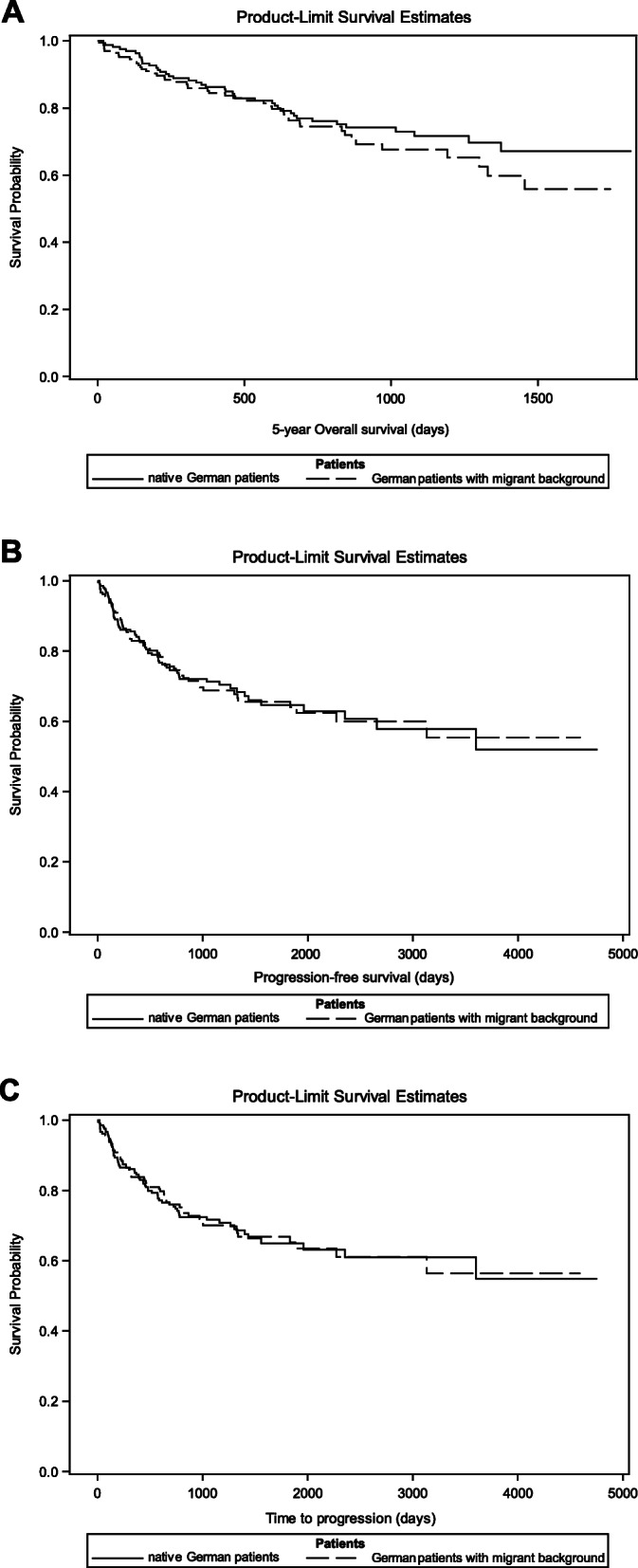
Compared to the cohort with migration background, the cohort without migration background was slightly older (54.9 vs. 57.9 years) while having the same sex distribution (54.5% vs. 55.0% female) and longer follow-up time (36.9 vs. 42.6 months). We did not find significant differences in cancer survival (5-year overall survival, P = 0.771) and the response rates (Overall Remission Rate; McNemar's test, P = 0.346) between both collectives.
Contrary to prior reports, we found no significant differences in cancer survival between German patients with immigrant background and native German patients. Nevertheless, the advanced treatment protocols implemented at our comprehensive cancer center may possibly account for the low variance in outcome. To conduct similar studies with a broader perspective, we propose that certain risk factors (country-of-origin-specific infections, dietary habits, epigenetics for chronic diseases etc.) should be considered, specially in the future studies that will recruit new arrivals from the 2015 German refugee crisis.
移民已成为世界政治的核心议题,尤其是在德国等发达国家,自 20 世纪 60 年代以来,移民的持续涌入有案可查。引人注目的是,新出现的数据表明,移民患者在新的宿主国家对治疗的反应较差,生存率较低,这引发了人们对健康差距的担忧。在此,我们报告了我们在德国综合癌症中心对有和没有移民背景的德国患者的治疗反应率和癌症生存率的调查。
最初,我们考虑了在德国波恩大学综合肿瘤中心(CIO)接受治疗的 8162 名癌症患者(2002 年 4 月至 2015 年 12 月)进行配对分析。随后,使用高度特异性的基于名称的算法手动识别和编目具有移民背景的德国患者和来自德国本土的患者。进一步调整了人口统计学特征、肿瘤特征、明确的分期标准和主要治疗等临床参数。使用这些严格的标准,总共筛选了 422 名患者(n=211,具有移民背景的德国人;n=211,德国本土人口),以比较治疗反应和生存率(即 5 年总生存率、无进展生存率和进展时间)。
与具有移民背景的队列相比,无移民背景的队列年龄稍大(54.9 岁 vs. 57.9 岁),性别分布相同(54.5% vs. 55.0%女性),随访时间更长(36.9 岁 vs. 42.6 个月)。我们没有发现两组之间的癌症生存率(5 年总生存率,P=0.771)和反应率(总体缓解率;McNemar 检验,P=0.346)有显著差异。
与之前的报告相反,我们没有发现具有移民背景的德国患者和德国本土患者的癌症生存率存在显著差异。然而,我们综合癌症中心实施的先进治疗方案可能导致结果的差异较小。为了进行更广泛视角的类似研究,我们建议考虑某些风险因素(特定于原籍国的感染、饮食习惯、慢性疾病的表观遗传学等),特别是在未来将招募 2015 年德国难民危机中新来者的研究中。