Boston College Connell School of Nursing, Chestnut Hill, MA, USA.
Massachusetts General Hospital - Harvard Center for Reproductive Medicine, Boston, MA, USA.
Orphanet J Rare Dis. 2021 May 10;16(1):209. doi: 10.1186/s13023-021-01827-z.
Rare disease patients are geographically dispersed, posing challenges to research. Some researchers have partnered with patient organizations and used web-based approaches to overcome geographic recruitment barriers. Critics of such methods claim that samples are homogenous and do not represent the broader patient population-as patients recruited from patient organizations are thought to have high levels of needs. We applied latent class mixture modeling (LCMM) to define patient clusters based on underlying characteristics. We used previously collected data from a cohort of patients with congenital hypogonadotropic hypogonadism who were recruited online in collaboration with a patient organization. Patient demographics, clinical information, Revised Illness Perception Questionnaire (IPQ-R) scores and Zung self-rating depression Scale (SDS) were used as variables for LCMM analysis. Specifically, we aimed to test the classic critique that patients recruited online in collaboration with a patient organization are a homogenous group with high needs. We hypothesized that distinct classes (clinical profiles) of patients could be identified-thereby demonstrating the validity of online recruitment and supporting transferability of findings.
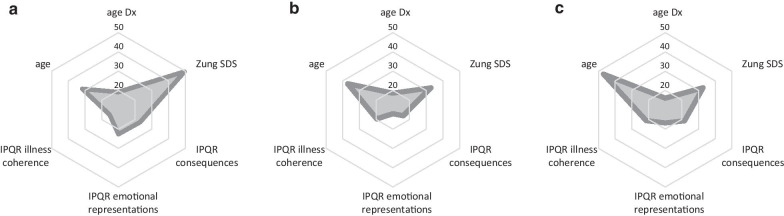
In total, 154 patients with CHH were included. The LCMM analysis identified three distinct subgroups (Class I: n = 84 [54.5%], Class II: n = 41 [26.6%], Class III: n = 29 [18.8%]) that differed significantly in terms of age, education, disease consequences, emotional consequences, illness coherence and depression symptoms (all p < 0.001) as well as age at diagnosis (p = 0.045). Classes depict a continuum of psychosocial impact ranging from severe to relatively modest. Additional analyses revealed later diagnosis (Class I: 19.2 ± 6.7 years [95% CI 17.8-20.7]) is significantly associated with worse psychological adaptation and coping as assessed by disease consequences, emotional responses, making sense of one's illness and SDS depressive symptoms (all p < 0.001).
We identify three distinct classes of patients who were recruited online in collaboration with a patient organization. Findings refute prior critiques of patient partnership and web-based recruitment for rare disease research. This is the first empirical data suggesting negative psychosocial sequelae of later diagnosis ("diagnostic odyssey") often observed in CHH.
罕见病患者分布在不同的地区,这给研究带来了挑战。一些研究人员与患者组织合作,并采用基于网络的方法来克服地理招募障碍。此类方法的批评者认为,样本具有同质性,不能代表更广泛的患者群体,因为从患者组织招募的患者被认为有较高的需求。我们应用潜在类别混合模型(LCMM)来根据潜在特征定义患者群。我们使用先前从一个与患者组织合作招募的先天性低促性腺激素性性腺功能减退症患者队列中收集的数据。患者人口统计学、临床信息、修订后的疾病感知问卷(IPQ-R)评分和 Zung 自评抑郁量表(SDS)被用作 LCMM 分析的变量。具体来说,我们旨在检验在线与患者组织合作招募的患者是一个具有高度需求的同质群体的这一经典批评。我们假设可以识别出不同的患者群体(临床特征),从而证明在线招募的有效性,并支持研究结果的可转移性。
共纳入 154 例 CHH 患者。LCMM 分析确定了三个不同的亚组(I 类:n=84[54.5%],II 类:n=41[26.6%],III 类:n=29[18.8%]),这些亚组在年龄、教育程度、疾病后果、情绪后果、疾病连贯性和抑郁症状(均 P<0.001)以及诊断年龄(P=0.045)方面存在显著差异。这些类别描绘了从严重到相对较轻的心理社会影响连续体。进一步的分析表明,较晚的诊断(I 类:19.2±6.7 岁[95%CI 17.8-20.7])与疾病后果、情绪反应、对疾病的理解和 SDS 抑郁症状评估的较差的心理适应和应对能力显著相关(均 P<0.001)。
我们确定了三个不同的患者亚组,他们是通过与患者组织合作在线招募的。研究结果驳斥了先前对患者合作和基于网络的罕见病研究招募的批评。这是首次有实证数据表明,在 CHH 中经常观察到的较晚诊断(“诊断之旅”)会带来负面的心理社会后果。