Flores Thaynã Ramos, Rodrigues Ana Paula Dos Santos, Neves Rosália Garcia, Batista Sandro Rodrigues, Teixeira Doralice Severo da Cruz, Silveira Erika Aparecida da, Malta Deborah Carvalho, Nunes Bruno Pereira
Postgraduate Program in Epidemiology, Federal University of Pelotas, Pelotas, Brazil.
Superintendence of Health Surveillance, Goiás State Health Department, Goiás, Brazil.
J Obes Metab Syndr. 2021 Jun 30;30(2):155-162. doi: 10.7570/jomes20110.
An increase in body mass index (BMI) is strongly associated with the occurrence of multimorbidity, and overweight and obesity are contributing factors for the increase in morbidities. Thus, the present study aimed to evaluate the occurrence of multimorbidity and associated factors in Brazilian adults with and without overweight or obesity.
This was a cross-sectional population-based study with data from the National Health Survey (2013) including individuals aged 18 years or older. Multimorbidity was defined as having ≥2 diseases from the list of 15 morbidities on the self-reported questionnaire (self-reported medical diagnosis in life). BMI was categorized as: ≤24.9 kg/m (low weight and eutrophy), 25.0-29.9 kg/m (overweight), and ≥30.0 kg/m (obesity). Sex, age, and schooling were the covariates. Poisson regression was used for crude and adjusted analyses for the variables representing access to health services estimating the prevalence ratio (PR) and 95% confidence interval (CI).
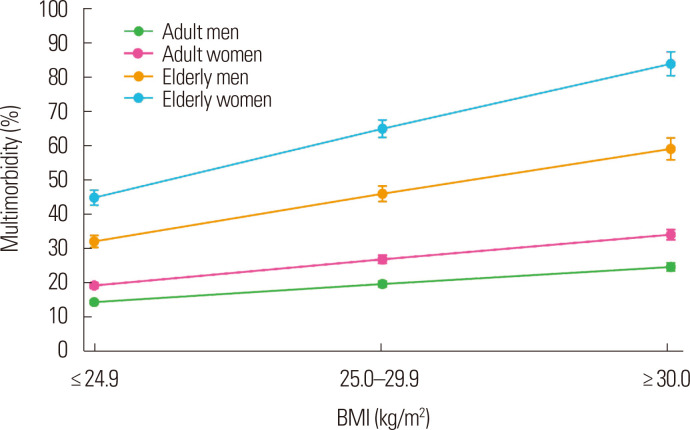
The total sample consisted of 59,402 individuals. The prevalence of multimorbidity was 25% overall and was higher among overweight (25.8%) and obese (32.5%) individuals. Obese women 60 years or older had a higher occurrence of multimorbidity (80%). In the adjusted analysis, a lower prevalence of multimorbidity was observed among those with higher educational levels in all BMI classifications: low weight/eutrophy, PR=0.66 (95% CI, 0.58-0.75); overweight, PR=0.62 (95% CI, 0.56-0.70); and obesity, PR=0.75 (95% CI, 0.67-0.85).
A higher prevalence of multimorbidity was found among obese women who were 60 years of age or older. Schooling was an associated factor regardless of BMI.
体重指数(BMI)的增加与多种疾病的发生密切相关,超重和肥胖是发病率上升的促成因素。因此,本研究旨在评估巴西有或没有超重或肥胖的成年人中多种疾病的发生情况及相关因素。
这是一项基于人群的横断面研究,数据来自全国健康调查(2013年),包括18岁及以上的个体。多种疾病被定义为在自我报告问卷(一生中自我报告的医学诊断)中的15种疾病清单中患有≥2种疾病。BMI分类为:≤24.9kg/m(低体重和正常营养)、25.0-29.9kg/m(超重)和≥30.0kg/m(肥胖)。性别、年龄和受教育程度为协变量。使用泊松回归对代表获得卫生服务情况的变量进行粗分析和调整分析,估计患病率比(PR)和95%置信区间(CI)。
总样本包括59402名个体。多种疾病的总体患病率为25%,超重(25.8%)和肥胖(32.5%)个体中的患病率更高。60岁及以上的肥胖女性多种疾病的发生率更高(80%)。在调整分析中,在所有BMI分类中,受教育程度较高者的多种疾病患病率较低:低体重/正常营养,PR=0.66(95%CI,0.58-0.75);超重,PR=0.62(95%CI,0.56-0.70);肥胖,PR=0.75(95%CI,0.67-0.85)。
在60岁及以上的肥胖女性中发现多种疾病的患病率较高。无论BMI如何,受教育程度都是一个相关因素。