Piu Chan, MD, Department of Neurobiology, Xuanwu Hospital of Capital MedicalUniversity, Beijing 100053, China.
J Nutr Health Aging. 2020;24(3):269-276. doi: 10.1007/s12603-020-1311-x.
Multimorbidity is common in older hospitalized adults. To date, however, few studies have addressed multimorbidity in the older population of Chinese inpatients. We aimed to investigate the multimorbidity rate and associated risk factors in older adult inpatients in China.
DESIGN, SETTING, PARTICIPANTS: This study was conducted in the medical wards of a tertiary-care hospital from. The patients were recruited aged between 60 to 101 (74.14±8.46) years.
Data were obtained from the China Comprehensive Geriatric Assessment Study, conducted in 2011-2012 in China. A total of 4,633 inpatients older than 60 years was recruited from 12 hospitals in 7 cities throughout China. The prevalence of comorbidity, distribution of common chronic diseases, and the associated risk factors were studied.
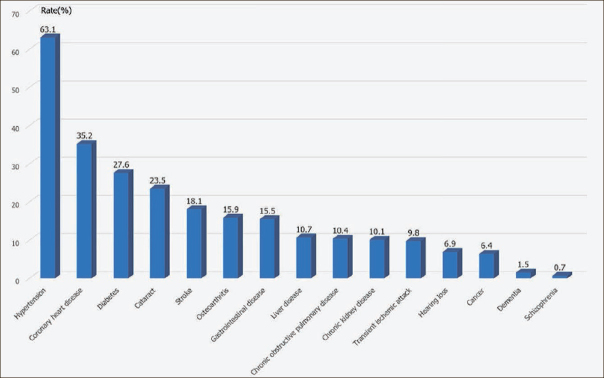
A total of 4,348 people aged 60 to 101 (74.14±8.46) years completed questionnaires. The average frequency of multimorbidity was 69.3% (95% CI, 67.9% to 70.6%). The prevalence of multimorbidity increased with age and was higher in men (71.6%; 95% CI, 69.9% to 73.3%) than in women (65.3%, 95% CI 63.0% to 67.6%), and higher in the northern region (71.7%, 95% CI 69.9% to 73.5%) than in the southern region (66.0%; 95% CI, 63.8% to 68.1%). The most frequent chronic diseases were hypertension, coronary heart disease, diabetes, cataract, and stroke. Area (OR=0.556; 95% CI, 0.465 to 0.666), region (OR=0.834; 95% CI, 0.723 to 0.962), body mass index (BMI) (OR=1.124; 95% CI, 1.017 to 1.242), and impairment of activities of daily living (OR=0.911; 95% CI, 0.855 to 0.970) were independent factors associated with multimorbidity.
Multimorbidity is common in older Chinese inpatients with a national prevalence of 69.3% that increases in line with age. Age, region, area, BMI, and daily activities were independent factors significantly associated with multimorbidity in older inpatients. Clinicians should therefore focus more attention on multimorbidity.
老年人住院患者中多病共存较为常见。然而,迄今为止,针对中国老年住院患者多病共存的研究较少。本研究旨在调查中国老年住院患者的多病共存发生率及其相关危险因素。
设计、地点和参与者:本研究于 2011-2012 年在中国一家三级医院的内科病房进行。患者年龄在 60 至 101 岁之间(74.14±8.46 岁)。
数据来自于 2011-2012 年在中国开展的中国综合老年评估研究。从中国 7 个城市的 12 家医院共招募了 4633 名 60 岁以上的住院患者。研究了共病的患病率、常见慢性疾病的分布以及相关的危险因素。
共有 4348 名年龄在 60 至 101 岁之间(74.14±8.46 岁)的患者完成了问卷调查。多病共存的平均发生率为 69.3%(95%可信区间,67.9%至 70.6%)。多病共存的患病率随年龄增长而增加,男性(71.6%;95%可信区间,69.9%至 73.3%)高于女性(65.3%,95%可信区间 63.0%至 67.6%),北方地区(71.7%,95%可信区间 69.9%至 73.5%)高于南方地区(66.0%;95%可信区间,63.8%至 68.1%)。最常见的慢性疾病包括高血压、冠心病、糖尿病、白内障和中风。地区(OR=0.556;95%可信区间,0.465 至 0.666)、区域(OR=0.834;95%可信区间,0.723 至 0.962)、体质指数(BMI)(OR=1.124;95%可信区间,1.017 至 1.242)和日常生活活动受损(OR=0.911;95%可信区间,0.855 至 0.970)是与多病共存相关的独立因素。
多病共存在中国老年住院患者中较为常见,全国患病率为 69.3%,并随年龄增长而增加。年龄、地区、地区、BMI 和日常活动是与老年住院患者多病共存显著相关的独立因素。临床医生应更加关注多病共存。