Huo Xi, Sun Xiaodan, Bragazzi Nicola, Wu Jianhong
Department of Mathematics, University of Miami, Coral Gables, FL 33146, USA.
School of Mathematics and Statistics, Xi'an Jiaotong University, Xi'an 710049, Shaanxi, People's Republic of China.
R Soc Open Sci. 2021 Feb 10;8(2):202248. doi: 10.1098/rsos.202248.
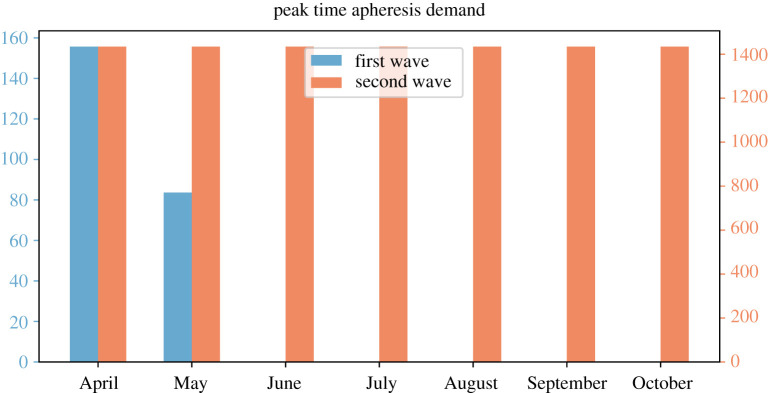
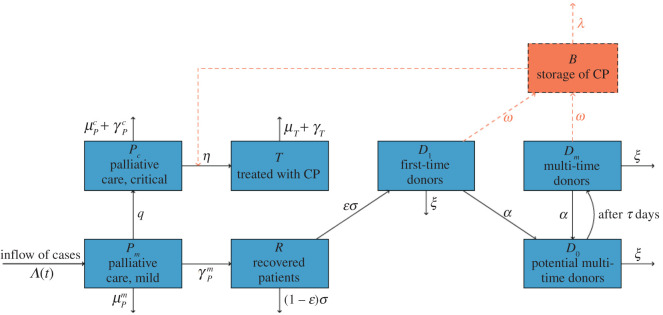
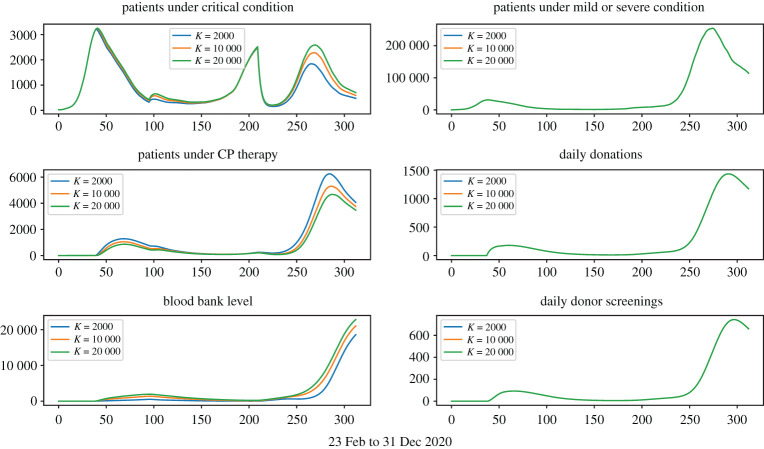
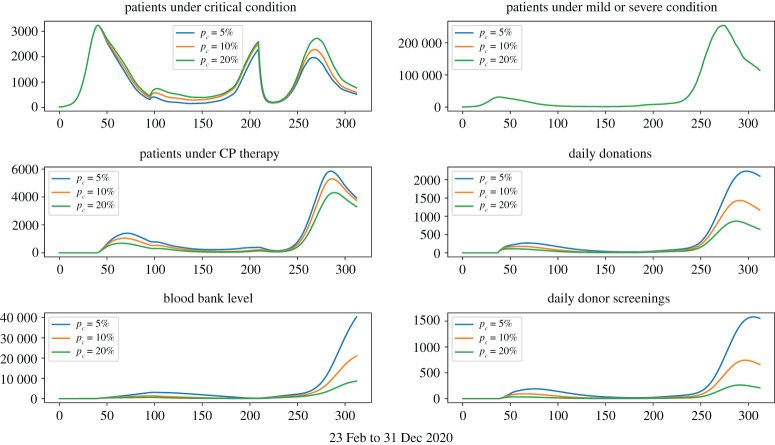
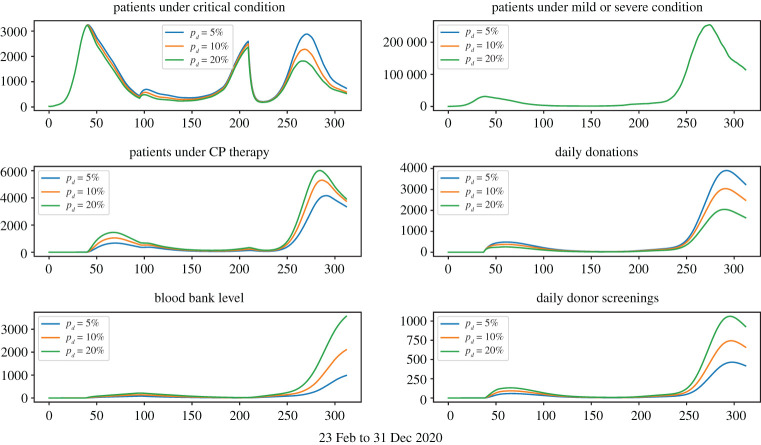
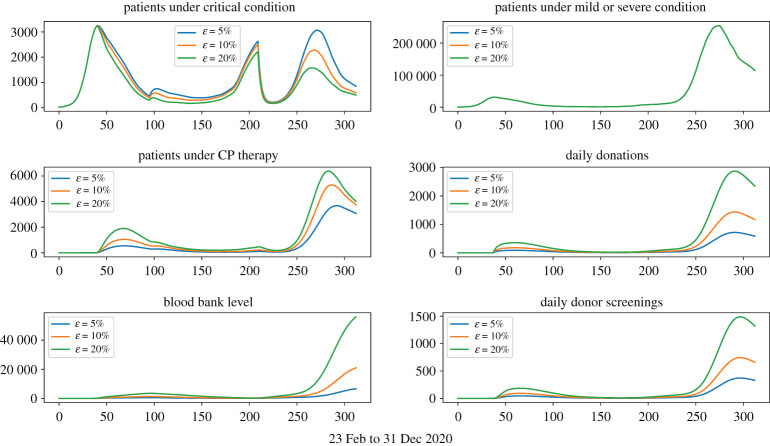
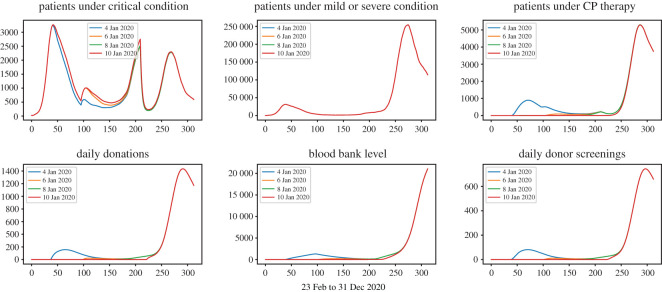
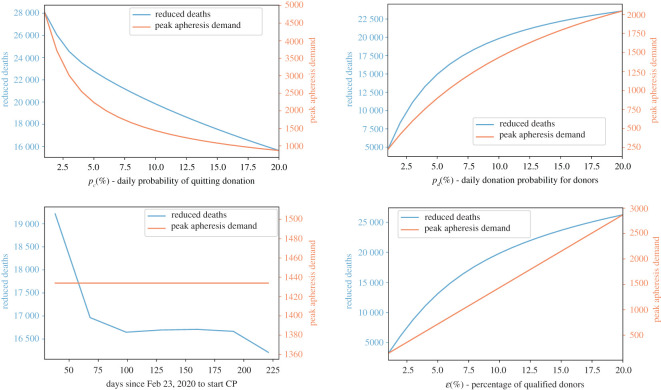
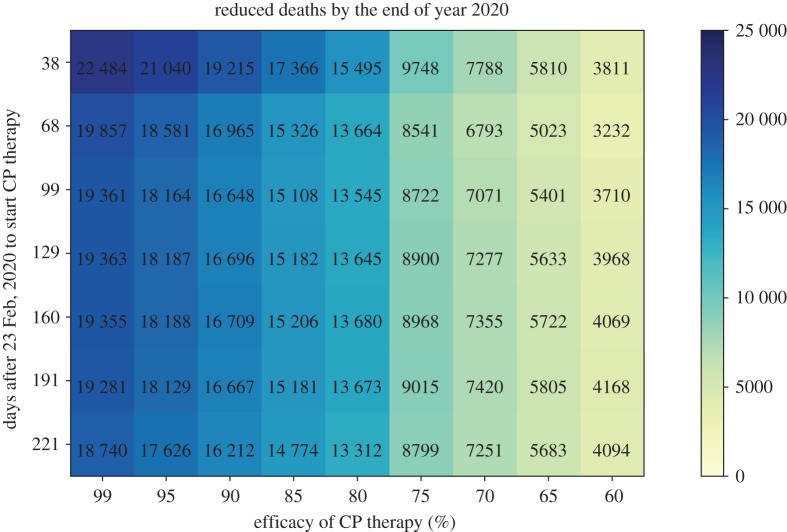
As of December 2020, COVID-19 has spread all over the world with more than 81 million cases and more than 1.8 million deaths. The rapidly increasing number of patients mandates the consideration of potential treatments for patients under severe and critical conditions. Convalescent plasma (CP) treatment refers to the approach of infusing patients with plasma from recently recovered patients. CP appears to be a possible therapeutic option to manage patients suffering from severe or even lethal infectious disorders, in which 'traditional therapies' have failed to obtain any result. In the present study, we develop a mathematical model on the treatment-donation-stockpile dynamics for an optimal implementation of CP therapy to examine potential benefits and complications in the logistic realization of this therapy in a large-scale population. We parametrize the model with COVID-19 epidemics in Italy, and conduct scenario analyses to estimate outcomes of population-wide CP therapy and to examine the maximum number of CP donation processions per day. Under the assumption that the efficacy of CP is 90%, we show that by the end of year 2020, initiating the population-wide CP therapy from April 2020 can save as many as 19 215 lives (ranging from 5000 to 28 000 depending on donor availability), while the demand for apheresis use is manageable in all scenarios: the maximum daily demand is 156 (ranging from 27 to 519 depending on donor availability) for the first outbreak wave and 1434 (ranging from 224 to 4817 depending on donor availability) for the second wave. Given that Italy has 61 centres with apheresis this maximum demand level corresponds to a daily average of 2.5 and 23.5 processions of CP donation being performed by each centre with respect to each outbreak wave. Our analyses show that population-wide CP therapy can contribute to curbing COVID-19-related deaths, and the logistic implementation is feasible for developed countries. The reduction of deaths can be very significant if the CP therapy is started earlier in the outbreak, and remains significant even if it is implemented during the outbreak peak time.
截至2020年12月,新冠病毒病已在全球蔓延,病例超过8100万例,死亡超过180万例。患者数量的迅速增加使得必须考虑针对重症和危重症患者的潜在治疗方法。恢复期血浆(CP)治疗是指向患者输注近期康复患者的血浆的方法。CP似乎是治疗患有严重甚至致命性感染性疾病且“传统疗法”未能取得任何效果的患者的一种可能的治疗选择。在本研究中,我们建立了一个关于治疗 - 捐赠 - 储备动态的数学模型,以优化CP治疗的实施,从而在大规模人群中检验这种治疗在后勤实现过程中的潜在益处和并发症。我们用意大利的新冠病毒病疫情对模型进行参数化,并进行情景分析,以估计全人群CP治疗的结果,并检验每天CP捐赠流程的最大数量。在CP疗效为90%的假设下,我们表明,到2020年底,从2020年4月开始实施全人群CP治疗可挽救多达19215条生命(根据献血者可及性,范围在5000至28000之间),而在所有情景下,单采需求都是可控的:第一波疫情高峰时的最大日需求为156(根据献血者可及性,范围在27至519之间),第二波疫情高峰时为1434(根据献血者可及性,范围在224至4817之间)。鉴于意大利有61个单采中心,这个最大需求水平对应于每个中心在每波疫情高峰时每天平均进行2.5次和23.5次CP捐赠流程。我们的分析表明,全人群CP治疗有助于遏制与新冠病毒病相关的死亡,并且对于发达国家来说,后勤实施是可行的。如果在疫情爆发早期就开始CP治疗,死亡人数的减少会非常显著,即使在疫情高峰时期实施,死亡人数的减少仍然显著。