Inayat Arslan, Abbas Sakina, Salman Fnu
Internal Medicine, University at Buffalo, Catholic Health System, Buffalo, USA.
Medicine, Civil Hospital Karachi, Dow University of Health Sciences, Karachi, PAK.
Cureus. 2021 Apr 7;13(4):e14344. doi: 10.7759/cureus.14344.
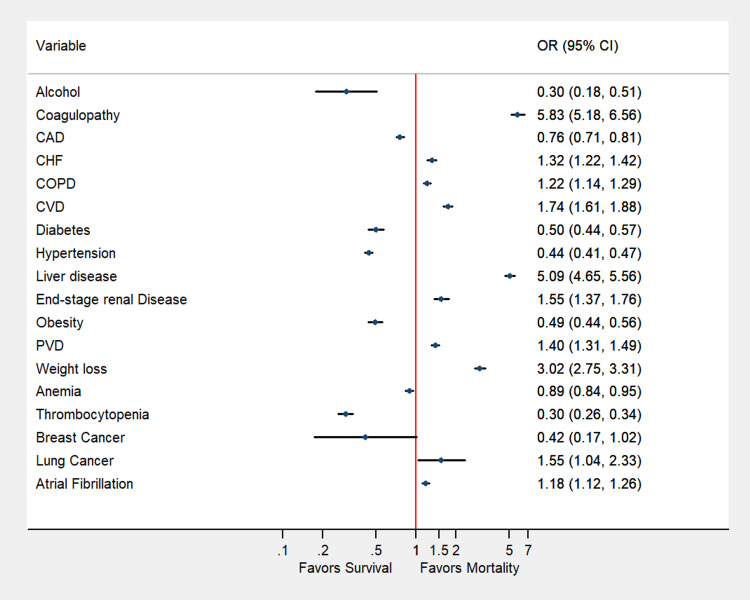
Introduction In recent decades, transcatheter aortic valve implantation (TAVI) has become a treatment of choice for aortic stenosis. The purpose of this study was to evaluate predictors of mortality in patients undergoing TAVI. Methods The National Inpatient Sample database from the year 2011 to 2018 was used to identify all patients undergoing TAVI during the study period. Results A total of 215,983 weighted hospitalizations for TAVI were included in the analysis. We report the following three main findings from our contemporary analysis of the NIS: (1) despite TAVI patients having a high comorbidity burden, mortality remains low at 2.2%, (2) in terms of baseline characteristics, end-stage renal disease, liver disease, congestive heart failure, chronic obstructive pulmonary disease, atrial fibrillation, and lung cancer remain significant predictors of mortality in patients undergoing TAVI, and (3) length of stay and cost of stay are significantly higher in patients who died during the hospitalization. Conclusion In conclusion, we report that at baseline, end-stage renal disease, liver disease, atrial fibrillation, and lung cancer are significant predictors of mortality in patients undergoing TAVI.
引言 在最近几十年中,经导管主动脉瓣植入术(TAVI)已成为主动脉瓣狭窄的首选治疗方法。本研究的目的是评估接受TAVI治疗患者的死亡预测因素。方法 使用2011年至2018年的国家住院样本数据库来识别研究期间所有接受TAVI治疗的患者。结果 分析共纳入了215,983例加权的TAVI住院病例。我们从对国家住院样本的当代分析中报告以下三个主要发现:(1)尽管TAVI患者合并症负担较高,但死亡率仍较低,为2.2%;(2)就基线特征而言,终末期肾病、肝病、充血性心力衰竭、慢性阻塞性肺疾病、心房颤动和肺癌仍然是接受TAVI治疗患者死亡的重要预测因素;(3)住院期间死亡的患者住院时间和住院费用显著更高。结论 总之,我们报告在基线时,终末期肾病、肝病、心房颤动和肺癌是接受TAVI治疗患者死亡的重要预测因素。