Zhu Lei, Ciais Philippe, Bastos Ana, Ballantyne Ashley P, Chevallier Frederic, Gasser Thomas, Kondo Masayuki, Pongratz Julia, Rödenbeck Christian, Li Wei
Ministry of Education Key Laboratory for Earth System Modeling, Department of Earth System Science, Tsinghua University, Beijing, China.
Joint Center for Global Change Studies, Beijing, China.
Carbon Balance Manag. 2021 May 10;16(1):15. doi: 10.1186/s13021-021-00178-3.
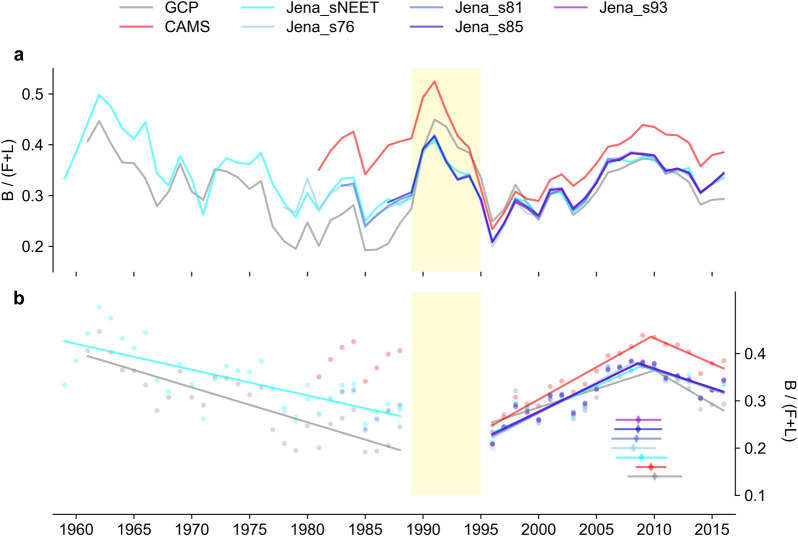
The climate mitigation target of limiting the temperature increase below 2 °C above the pre-industrial levels requires the efforts from all countries. Tracking the trajectory of the land carbon sink efficiency is thus crucial to evaluate the nationally determined contributions (NDCs). Here, we define the instantaneous land sink efficiency as the ratio of natural land carbon sinks to emissions from fossil fuel and land-use and land-cover change with a value of 1 indicating carbon neutrality to track its temporal dynamics in the past decades.
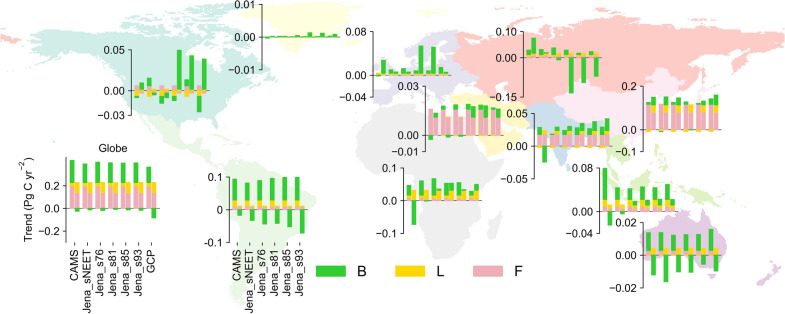
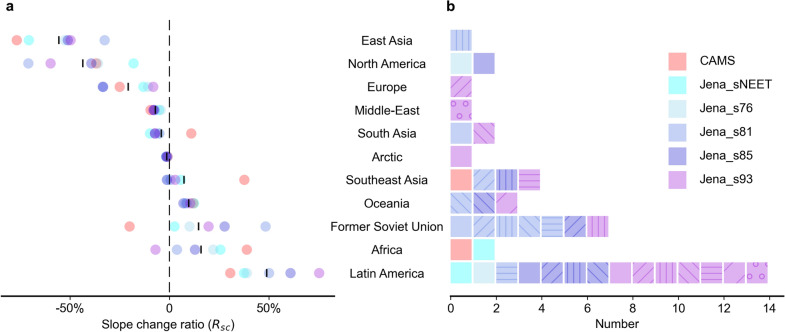
Land sink efficiency has been decreasing during 1957-1990 because of the increased emissions from fossil fuel. After the effect of the Mt. Pinatubo eruption diminished (after 1994), the land sink efficiency firstly increased before 2009 and then began to decrease again after 2009. This reversal around 2009 is mostly attributed to changes in land sinks in tropical regions in response to climate variations.
The decreasing trend of land sink efficiency in recent years reveals greater challenges in climate change mitigation, and that climate impacts on land carbon sinks must be accurately quantified to assess the effectiveness of regional scale climate mitigation policies.
将气温升幅限制在前工业化水平以上2摄氏度以内的气候缓解目标需要所有国家共同努力。因此,追踪陆地碳汇效率的轨迹对于评估国家自主贡献(NDC)至关重要。在此,我们将瞬时陆地碳汇效率定义为自然陆地碳汇与化石燃料及土地利用和土地覆盖变化排放的比值,该值为1表示碳中和,以追踪其在过去几十年的时间动态变化。
由于化石燃料排放增加,1957 - 1990年期间陆地碳汇效率一直在下降。皮纳图博火山喷发的影响减弱后(1994年之后),陆地碳汇效率在2009年之前首先上升,然后在2009年之后又开始下降。2009年左右的这种逆转主要归因于热带地区陆地碳汇因气候变化而发生的变化。
近年来陆地碳汇效率的下降趋势揭示了气候变化缓解方面面临的更大挑战,并且必须准确量化气候对陆地碳汇的影响,以评估区域尺度气候缓解政策的有效性。