• 文献检索
  • 文档翻译
  • 深度研究
  • 学术资讯
  • Suppr Zotero 插件Zotero 插件
  • 邀请有礼
  • 套餐&价格
  • 历史记录
应用&插件
Suppr Zotero 插件Zotero 插件浏览器插件Mac 客户端Windows 客户端微信小程序
定价
高级版会员购买积分包购买API积分包
服务
文献检索文档翻译深度研究API 文档MCP 服务
关于我们
关于 Suppr公司介绍联系我们用户协议隐私条款
关注我们

Suppr 超能文献

核心技术专利:CN118964589B侵权必究
粤ICP备2023148730 号-1Suppr @ 2026

文献检索

告别复杂PubMed语法,用中文像聊天一样搜索,搜遍4000万医学文献。AI智能推荐,让科研检索更轻松。

立即免费搜索

文件翻译

保留排版,准确专业,支持PDF/Word/PPT等文件格式,支持 12+语言互译。

免费翻译文档

深度研究

AI帮你快速写综述,25分钟生成高质量综述,智能提取关键信息,辅助科研写作。

立即免费体验

与数字对话代理建立的人类水平情感联系的证据:横断面回顾性观察研究。

Evidence of Human-Level Bonds Established With a Digital Conversational Agent: Cross-sectional, Retrospective Observational Study.

作者信息

Darcy Alison, Daniels Jade, Salinger David, Wicks Paul, Robinson Athena

机构信息

Woebot Health, San Francisco, CA, United States.

出版信息

JMIR Form Res. 2021 May 11;5(5):e27868. doi: 10.2196/27868.

DOI:10.2196/27868
PMID:33973854
原文链接:https://pmc.ncbi.nlm.nih.gov/articles/PMC8150389/
Abstract

BACKGROUND

There are far more patients in mental distress than there is time available for mental health professionals to support them. Although digital tools may help mitigate this issue, critics have suggested that technological solutions that lack human empathy will prevent a bond or therapeutic alliance from being formed, thereby narrowing these solutions' efficacy.

OBJECTIVE

We aimed to investigate whether users of a cognitive behavioral therapy (CBT)-based conversational agent would report therapeutic bond levels that are similar to those in literature about other CBT modalities, including face-to-face therapy, group CBT, and other digital interventions that do not use a conversational agent.

METHODS

A cross-sectional, retrospective study design was used to analyze aggregate, deidentified data from adult users who self-referred to a CBT-based, fully automated conversational agent (Woebot) between November 2019 and August 2020. Working alliance was measured with the Working Alliance Inventory-Short Revised (WAI-SR), and depression symptom status was assessed by using the 2-item Patient Health Questionnaire (PHQ-2). All measures were administered by the conversational agent in the mobile app. WAI-SR scores were compared to those in scientific literature abstracted from recent reviews.

RESULTS

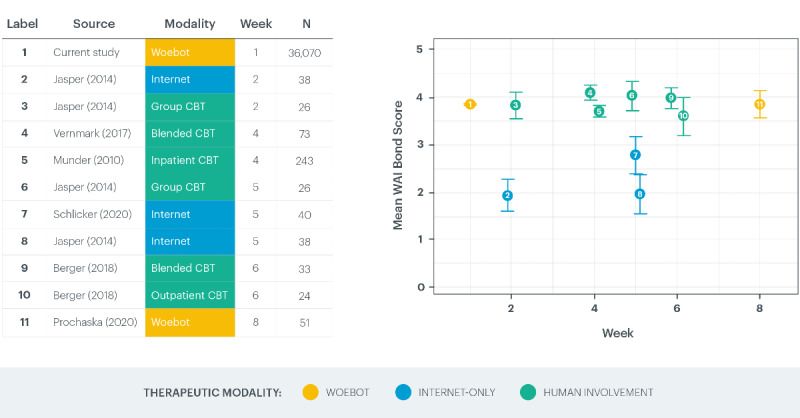
Data from 36,070 Woebot users were included in the analysis. Participants ranged in age from 18 to 78 years, and 57.48% (20,734/36,070) of participants reported that they were female. The mean PHQ-2 score was 3.03 (SD 1.79), and 54.67% (19,719/36,070) of users scored over the cutoff score of 3 for depression screening. Within 5 days of initial app use, the mean WAI-SR score was 3.36 (SD 0.8) and the mean bond subscale score was 3.8 (SD 1.0), which was comparable to those in recent studies from the literature on traditional, outpatient, individual CBT and group CBT (mean bond subscale scores of 4 and 3.8, respectively). PHQ-2 scores at baseline weakly correlated with bond scores (r=-0.04; P<.001); however, users with depression and those without depression had high bond scores of 3.45.

CONCLUSIONS

Although bonds are often presumed to be the exclusive domain of human therapeutic relationships, our findings challenge the notion that digital therapeutics are incapable of establishing a therapeutic bond with users. Future research might investigate the role of bonds as mediators of clinical outcomes, since boosting the engagement and efficacy of digital therapeutics could have major public health benefits.

摘要

背景

处于精神困扰中的患者数量远远超过心理健康专业人员能够提供支持的时间。尽管数字工具可能有助于缓解这一问题,但批评者认为,缺乏人文关怀的技术解决方案将阻碍建立联系或治疗联盟,从而限制这些解决方案的效果。

目的

我们旨在调查基于认知行为疗法(CBT)的对话代理的用户所报告的治疗联盟水平是否与关于其他CBT模式的文献中所描述的相似,这些模式包括面对面治疗、团体CBT以及其他不使用对话代理的数字干预措施。

方法

采用横断面回顾性研究设计,分析2019年11月至2020年8月期间自行求助于基于CBT的全自动对话代理(Woebot)的成年用户的汇总、去识别化数据。使用简短修订版工作联盟量表(WAI-SR)测量工作联盟,并使用2项患者健康问卷(PHQ-2)评估抑郁症状状态。所有测量均由移动应用程序中的对话代理进行。将WAI-SR分数与近期综述中提取的科学文献中的分数进行比较。

结果

分析纳入了36070名Woebot用户的数据。参与者年龄在18岁至78岁之间,57.48%(20734/36070)的参与者报告为女性。PHQ-2的平均分数为3.03(标准差1.79),54.67%(19719/36070)的用户在抑郁筛查中的得分超过了临界值3。在首次使用应用程序的5天内,WAI-SR的平均分数为3.36(标准差0.8),平均联盟子量表分数为3.8(标准差1.0),这与传统门诊个体CBT和团体CBT的近期文献研究结果相当(平均联盟子量表分数分别为4和3.8)。基线时的PHQ-2分数与联盟分数弱相关(r=-0.04;P<.001);然而,有抑郁症状的用户和无抑郁症状的用户的联盟分数均较高,为3.45。

结论

尽管通常认为建立联系是人类治疗关系的专属领域,但我们的研究结果挑战了数字疗法无法与用户建立治疗联盟的观点。未来的研究可以调查联系作为临床结果中介的作用,因为提高数字疗法的参与度和效果可能会带来重大的公共卫生益处。
https://cdn.ncbi.nlm.nih.gov/pmc/blobs/d19d/8150389/9d721441fc71/formative_v5i5e27868_fig2.jpg
https://cdn.ncbi.nlm.nih.gov/pmc/blobs/d19d/8150389/6e546a5c3c0a/formative_v5i5e27868_fig1.jpg
https://cdn.ncbi.nlm.nih.gov/pmc/blobs/d19d/8150389/9d721441fc71/formative_v5i5e27868_fig2.jpg
https://cdn.ncbi.nlm.nih.gov/pmc/blobs/d19d/8150389/6e546a5c3c0a/formative_v5i5e27868_fig1.jpg
https://cdn.ncbi.nlm.nih.gov/pmc/blobs/d19d/8150389/9d721441fc71/formative_v5i5e27868_fig2.jpg

相似文献

1
Evidence of Human-Level Bonds Established With a Digital Conversational Agent: Cross-sectional, Retrospective Observational Study.与数字对话代理建立的人类水平情感联系的证据:横断面回顾性观察研究。
JMIR Form Res. 2021 May 11;5(5):e27868. doi: 10.2196/27868.
2
Evaluating the Therapeutic Alliance With a Free-Text CBT Conversational Agent (Wysa): A Mixed-Methods Study.使用自由文本认知行为疗法对话代理(Wysa)评估治疗联盟:一项混合方法研究。
Front Digit Health. 2022 Apr 11;4:847991. doi: 10.3389/fdgth.2022.847991. eCollection 2022.
3
Delivering Cognitive Behavior Therapy to Young Adults With Symptoms of Depression and Anxiety Using a Fully Automated Conversational Agent (Woebot): A Randomized Controlled Trial.使用全自动对话代理(Woebot)为有抑郁和焦虑症状的年轻人提供认知行为疗法:一项随机对照试验。
JMIR Ment Health. 2017 Jun 6;4(2):e19. doi: 10.2196/mental.7785.
4
Engagement, Satisfaction, and Mental Health Outcomes Across Different Residential Subgroup Users of a Digital Mental Health Relational Agent: Exploratory Single-Arm Study.不同数字心理健康关系型代理住宅亚组用户的参与度、满意度和心理健康结果:探索性单臂研究。
JMIR Form Res. 2023 Sep 27;7:e46473. doi: 10.2196/46473.
5
An Empathy-Driven, Conversational Artificial Intelligence Agent (Wysa) for Digital Mental Well-Being: Real-World Data Evaluation Mixed-Methods Study.用于数字心理健康的共情驱动对话式人工智能代理(Wysa):现实世界数据评估混合方法研究
JMIR Mhealth Uhealth. 2018 Nov 23;6(11):e12106. doi: 10.2196/12106.
6
Delivery of a Mental Health Intervention for Chronic Pain Through an Artificial Intelligence-Enabled App (Wysa): Protocol for a Prospective Pilot Study.通过人工智能应用程序(Wysa)提供慢性疼痛心理健康干预:一项前瞻性试点研究方案。
JMIR Res Protoc. 2022 Mar 31;11(3):e36910. doi: 10.2196/36910.
7
Using AI chatbots to provide self-help depression interventions for university students: A randomized trial of effectiveness.使用人工智能聊天机器人为大学生提供自助式抑郁症干预措施:一项有效性随机试验。
Internet Interv. 2022 Jan 6;27:100495. doi: 10.1016/j.invent.2022.100495. eCollection 2022 Mar.
8
Mental Health Chatbot for Young Adults With Depressive Symptoms During the COVID-19 Pandemic: Single-Blind, Three-Arm Randomized Controlled Trial.新冠疫情期间抑郁症状青年使用心理健康聊天机器人:单盲、三臂随机对照试验。
J Med Internet Res. 2022 Nov 21;24(11):e40719. doi: 10.2196/40719.
9
Understanding People With Chronic Pain Who Use a Cognitive Behavioral Therapy-Based Artificial Intelligence Mental Health App (Wysa): Mixed Methods Retrospective Observational Study.了解使用基于认知行为疗法的人工智能心理健康应用程序(Wysa)的慢性疼痛患者:混合方法回顾性观察研究。
JMIR Hum Factors. 2022 Apr 27;9(2):e35671. doi: 10.2196/35671.
10
A Therapeutic Relational Agent for Reducing Problematic Substance Use (Woebot): Development and Usability Study.用于减少问题性物质使用的治疗性关系代理(Woebot):开发和可用性研究。
J Med Internet Res. 2021 Mar 23;23(3):e24850. doi: 10.2196/24850.

引用本文的文献

1
The joint estimation of uncertainty and its relationship with psychotic-like traits and psychometric schizotypy.不确定性的联合估计及其与类精神病性特质和心理测量学精神分裂症型人格的关系。
Npj Ment Health Res. 2025 Aug 31;4(1):40. doi: 10.1038/s44184-025-00146-6.
2
How do users of a mental health app conceptualise digital therapeutic alliance? A qualitative study using the framework approach.心理健康应用程序的用户如何理解数字治疗联盟?一项采用框架法的定性研究。
BMC Public Health. 2025 Jul 14;25(1):2450. doi: 10.1186/s12889-025-23603-5.
3
Crisis-line workers' perspectives on AI in suicide prevention: a qualitative exploration of risk and opportunity.

本文引用的文献

1
A Therapeutic Relational Agent for Reducing Problematic Substance Use (Woebot): Development and Usability Study.用于减少问题性物质使用的治疗性关系代理(Woebot):开发和可用性研究。
J Med Internet Res. 2021 Mar 23;23(3):e24850. doi: 10.2196/24850.
2
Prevalence of depression during the COVID-19 outbreak: A meta-analysis of community-based studies.新冠疫情期间抑郁症的患病率:基于社区研究的荟萃分析
Int J Clin Health Psychol. 2021 Jan-Apr;21(1):100196. doi: 10.1016/j.ijchp.2020.07.007. Epub 2020 Aug 31.
3
Clinical, Legal, and Ethical Aspects of Artificial Intelligence-Assisted Conversational Agents in Health Care.
危机热线工作者对人工智能在自杀预防中的看法:对风险与机遇的质性探索
BMC Public Health. 2025 Jul 2;25(1):2229. doi: 10.1186/s12889-025-23298-8.
4
Exploring user characteristics, motives, and expectations and the therapeutic alliance in the mental health conversational AI Clare®: a baseline study.探索心理健康对话式人工智能克莱尔®中的用户特征、动机、期望及治疗联盟:一项基线研究。
Front Digit Health. 2025 Jun 13;7:1576135. doi: 10.3389/fdgth.2025.1576135. eCollection 2025.
5
Designing Chatbots to Treat Depression in Youth: Qualitative Study.设计用于治疗青少年抑郁症的聊天机器人:定性研究。
JMIR Hum Factors. 2025 Jun 19;12:e66632. doi: 10.2196/66632.
6
User Engagement with A Multimodal Conversational Agent for Self-Care and Chronic Disease Management: A Retrospective Analysis.用户与用于自我护理和慢性病管理的多模态对话代理的互动:一项回顾性分析。
J Med Syst. 2025 Jun 9;49(1):76. doi: 10.1007/s10916-025-02202-2.
7
Artificial Intelligence-Based Mobile Phone Apps for Child Mental Health: Comprehensive Review and Content Analysis.基于人工智能的儿童心理健康手机应用程序:综合综述与内容分析
JMIR Mhealth Uhealth. 2025 Jun 6;13:e58597. doi: 10.2196/58597.
8
Safety and User Experience of a Generative Artificial Intelligence Digital Mental Health Intervention: Exploratory Randomized Controlled Trial.生成式人工智能数字心理健康干预的安全性与用户体验:探索性随机对照试验
J Med Internet Res. 2025 May 23;27:e67365. doi: 10.2196/67365.
9
Artificial intelligence and psychoanalysis: is it time for psychoanalyst.AI?人工智能与精神分析:精神分析人工智能的时代到了吗?
Front Psychiatry. 2025 Apr 7;16:1558513. doi: 10.3389/fpsyt.2025.1558513. eCollection 2025.
10
Impact of Conversational and Animation Features of a Mental Health App Virtual Agent on Depressive Symptoms and User Experience Among College Students: Randomized Controlled Trial.心理健康应用虚拟代理的对话和动画功能对大学生抑郁症状及用户体验的影响:随机对照试验
JMIR Ment Health. 2025 Apr 11;12:e67381. doi: 10.2196/67381.
医疗保健中人工智能辅助对话代理的临床、法律和伦理方面
JAMA. 2020 Aug 11;324(6):552-553. doi: 10.1001/jama.2020.2724.
4
A Web- and Mobile-Based Intervention for Comorbid, Recurrent Depression in Patients With Chronic Back Pain on Sick Leave (Get.Back): Pilot Randomized Controlled Trial on Feasibility, User Satisfaction, and Effectiveness.一项针对病假中的慢性背痛患者合并复发性抑郁症的基于网络和移动设备的干预措施(Get.Back):关于可行性、用户满意度和有效性的试点随机对照试验
JMIR Ment Health. 2020 Apr 15;7(4):e16398. doi: 10.2196/16398.
5
Empowering the digital therapeutic relationship: virtual clinics for digital health interventions.赋能数字治疗关系:用于数字健康干预的虚拟诊所
NPJ Digit Med. 2018 May 16;1:16. doi: 10.1038/s41746-018-0028-2. eCollection 2018.
6
Digital mental health apps and the therapeutic alliance: initial review.数字心理健康应用程序与治疗联盟:初步综述
BJPsych Open. 2019 Jan;5(1):e15. doi: 10.1192/bjo.2018.86.
7
Working alliance as a predictor of change in depression during blended cognitive behaviour therapy.工作联盟作为混合认知行为疗法中抑郁变化的预测指标。
Cogn Behav Ther. 2019 Jul;48(4):285-299. doi: 10.1080/16506073.2018.1533577. Epub 2018 Oct 29.
8
ICBT in routine care: A descriptive analysis of successful clinics in five countries.常规护理中的互联网认知行为疗法:对五个国家成功诊所的描述性分析。
Internet Interv. 2018 Jul 26;13:108-115. doi: 10.1016/j.invent.2018.07.006. eCollection 2018 Sep.
9
Identifying research priorities for digital technology in mental health care: results of the James Lind Alliance Priority Setting Partnership.确定精神卫生保健中数字技术的研究重点:詹姆斯·林德联盟优先事项设定合作项目的结果
Lancet Psychiatry. 2018 Oct;5(10):845-854. doi: 10.1016/S2215-0366(18)30296-7. Epub 2018 Aug 28.
10
The relationship between the therapeutic alliance and clinical outcomes in cognitive behaviour therapy for adults with depression: A meta-analytic review.成人抑郁症认知行为治疗中治疗联盟与临床结局的关系:一项荟萃分析综述。
Clin Psychol Psychother. 2018 May;25(3):446-456. doi: 10.1002/cpp.2180. Epub 2018 Feb 26.