Calderón-Parra Jorge, Muiño-Miguez Antonio, Bendala-Estrada Alejandro D, Ramos-Martínez Antonio, Muñez-Rubio Elena, Fernández Carracedo Eduardo, Tejada Montes Javier, Rubio-Rivas Manuel, Arnalich-Fernandez Francisco, Beato Pérez Jose Luis, García Bruñén Jose Miguel, Del Corral Beamonte Esther, Pesqueira Fontan Paula Maria, Carmona Maria Del Mar, Fernández-Madera Martínez Rosa, González García Andrés, Salazar Mosteiro Cristina, Tuñón de Almeida Carlota, González Moraleja Julio, Deodati Francesco, Martín Escalante María Dolores, Asensio Tomás María Luisa, Gómez Huelgas Ricardo, Casas Rojo José Manuel, Millán Núñez-Cortés Jesús
Infectious Diseases Unit, Internal Medicine Department, Puerta de Hierro University Hospital, Majadahonda, Madrid, Spain.
Internal Medicine Department, Gregorio Marañón University Hospital, Madrid, Spain.
PLoS One. 2021 May 11;16(5):e0251340. doi: 10.1371/journal.pone.0251340. eCollection 2021.
Most patients with COVID-19 receive antibiotics despite the fact that bacterial co-infections are rare. This can lead to increased complications, including antibacterial resistance. We aim to analyze risk factors for inappropriate antibiotic prescription in these patients and describe possible complications arising from their use.
The SEMI-COVID-19 Registry is a multicenter, retrospective patient cohort. Patients with antibiotic were divided into two groups according to appropriate or inappropriate prescription, depending on whether the patient fulfill any criteria for its use. Comparison was made by means of multilevel logistic regression analysis. Possible complications of antibiotic use were also identified.
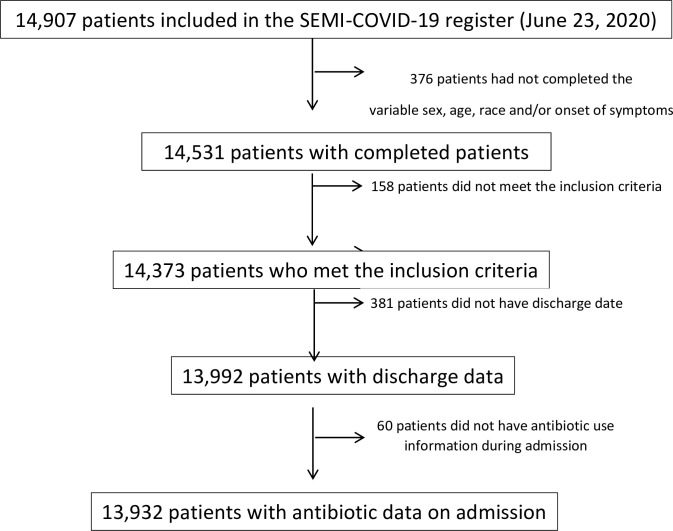
Out of 13,932 patients, 3047 (21.6%) were prescribed no antibiotics, 6116 (43.9%) were appropriately prescribed antibiotics, and 4769 (34.2%) were inappropriately prescribed antibiotics. The following were independent factors of inappropriate prescription: February-March 2020 admission (OR 1.54, 95%CI 1.18-2.00), age (OR 0.98, 95%CI 0.97-0.99), absence of comorbidity (OR 1.43, 95%CI 1.05-1.94), dry cough (OR 2.51, 95%CI 1.94-3.26), fever (OR 1.33, 95%CI 1.13-1.56), dyspnea (OR 1.31, 95%CI 1.04-1.69), flu-like symptoms (OR 2.70, 95%CI 1.75-4.17), and elevated C-reactive protein levels (OR 1.01 for each mg/L increase, 95% CI 1.00-1.01). Adverse drug reactions were more frequent in patients who received ANTIBIOTIC (4.9% vs 2.7%, p < .001).
The inappropriate use of antibiotics was very frequent in COVID-19 patients and entailed an increased risk of adverse reactions. It is crucial to define criteria for their use in these patients. Knowledge of the factors associated with inappropriate prescribing can be helpful.
尽管新冠病毒病(COVID-19)患者中细菌合并感染很少见,但大多数患者仍接受了抗生素治疗。这可能会导致包括抗菌药物耐药性在内的并发症增加。我们旨在分析这些患者不适当使用抗生素的风险因素,并描述使用抗生素可能引发的并发症。
SEMI-COVID-19注册研究是一项多中心回顾性患者队列研究。根据患者是否符合抗生素使用标准,将使用抗生素的患者分为适当用药组和不适当用药组。通过多水平逻辑回归分析进行比较。还确定了使用抗生素可能出现的并发症。
在139,32例患者中,3047例(21.6%)未使用抗生素,6116例(43.9%)抗生素使用适当,4769例(34.2%)抗生素使用不适当。以下是不适当用药的独立因素:2020年2月至3月入院(比值比[OR]1.54,95%置信区间[CI]1.18 - 2.00)、年龄(OR 0.98,95%CI 0.97 - 0.99)、无合并症(OR 1.43,95%CI 1.05 - 1.94)、干咳(OR 2.51,95%CI 1.94 - 3.26)、发热(OR 1.33,95%CI 1.13 - 1.56)、呼吸困难(OR 1.31,95%CI 1.04 - 1.69)、流感样症状(OR 2.70,95%CI 1.75 - 4.17)以及C反应蛋白水平每升高1mg/L(OR 1.01,95%CI范围1.00 - 1.01)。接受抗生素治疗的患者药物不良反应更常见(4.9%对2.7%,p < 0.001)。
COVID-19患者中抗生素使用不当的情况非常普遍,且会增加不良反应风险。为这些患者确定抗生素使用标准至关重要。了解与不适当用药相关的因素可能会有所帮助。