• 文献检索
  • 文档翻译
  • 深度研究
  • 学术资讯
  • Suppr Zotero 插件Zotero 插件
  • 邀请有礼
  • 套餐&价格
  • 历史记录
应用&插件
Suppr Zotero 插件Zotero 插件浏览器插件Mac 客户端Windows 客户端微信小程序
定价
高级版会员购买积分包购买API积分包
服务
文献检索文档翻译深度研究API 文档MCP 服务
关于我们
关于 Suppr公司介绍联系我们用户协议隐私条款
关注我们

Suppr 超能文献

核心技术专利:CN118964589B侵权必究
粤ICP备2023148730 号-1Suppr @ 2026

文献检索

告别复杂PubMed语法,用中文像聊天一样搜索,搜遍4000万医学文献。AI智能推荐,让科研检索更轻松。

立即免费搜索

文件翻译

保留排版,准确专业,支持PDF/Word/PPT等文件格式,支持 12+语言互译。

免费翻译文档

深度研究

AI帮你快速写综述,25分钟生成高质量综述,智能提取关键信息,辅助科研写作。

立即免费体验

工作人群中助听器和听力辅助技术的使用情况:荷兰听力纵向研究的纵向分析。

Uptake of Hearing Aids and Hearing Assistive Technology in a Working Population: Longitudinal Analyses of The Netherlands Longitudinal Study on Hearing.

机构信息

Amsterdam UMC, Vrije Universiteit Amsterdam, Otolaryngology-Head and Neck Surgery, Ear & Hearing, Amsterdam Public Health Research Institute, Amsterdam, The Netherlands.

Amsterdam UMC, Vrije Universiteit Amsterdam, Epidemiology and Biostatistics, Amsterdam Public Health Research Institute, Amsterdam, The Netherlands.

出版信息

Ear Hear. 2021 July/Aug;42(4):793-802. doi: 10.1097/AUD.0000000000000983.

DOI:10.1097/AUD.0000000000000983
PMID:33974788
原文链接:https://pmc.ncbi.nlm.nih.gov/articles/PMC8221723/
Abstract

OBJECTIVE

To identify predictors of the 5-year uptake of hearing aids (HAs) and hearing assistive technology (HAT) in a sample of Dutch employees eligible for HAs and/or HAT. The potential predictors included demographic factors (age, sex, marital status, and living situation), education, hearing factors (ability to recognize speech in noise and self-reported hearing disability), distress, self-efficacy, and work-related factors (job demand, job control, and need for recovery).

DESIGN

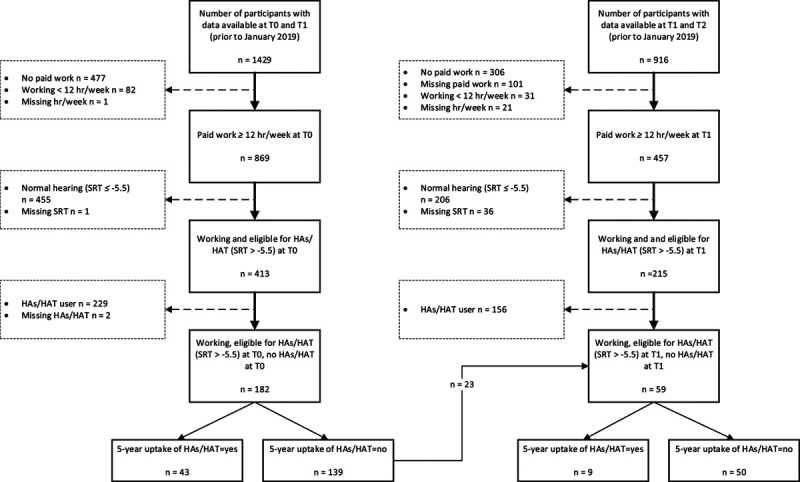
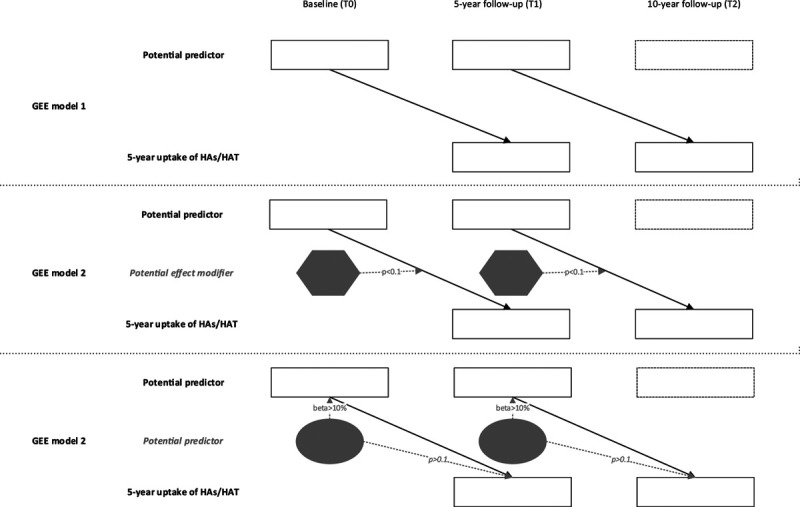
Five-year follow-up data of the Netherlands Longitudinal Study on Hearing (NL-SH) collected until January 2019 were included. An online digit-triplet in noise test, the National Hearing Test (NHT), was used to assess speech-recognition-in-noise ability. In addition, online questionnaires on demographic, socioeconomic, self-reported hearing disability, health, and work-related characteristics were administered. Adults who worked over 12 hours per week, who had not yet taken up HAs or HAT, but who would be eligible for HAs/HAT based on their NHT score (insufficient or poor hearing ability), were included in the study. The 5-year uptake of HAs/HAT was defined as a dichotomous variable of self-reported HA/HAT use reported 5 years later. Generalized Estimating Equations analyses were performed to analyze the associations between potential predicting factors and the 5-year uptake of HAs/HAT, taking into account the repeated measurements of the predicting factors and the 5-year uptake of HAs/HAT.

RESULTS

Data of 218 participants were included. The cumulative incidence of the 5-year uptake of HAs/HAT was 15 to 33%, of which 52 employees took up HAs and 11 employees took up HAT. Married participants had increased odds for 5-year uptake of HAs/HAT compared with unmarried participants (odds ratio [OR] = 2.13, 95% confidence interval [CI] = 1.05 to 4.35). Higher self-reported hearing disability (per one unit, scale range 0 to 74) was associated with increased odds for 5-year uptake of HAs/HAT (OR = 1.05, 95% CI = 1.03 to 1.07). Job demand showed a significant interaction with sex (p = 0.002), and therefore, stratified analyses were performed. In male participants, participants with higher job demand scores (per one unit, scale range 12 to 48) had increased odds for 5-year uptake of HAs/HAT (OR = 1.18, 95% CI = 1.05 to 1.35). No difference was seen in females.

CONCLUSION

This study confirms that factors predicting the uptake of HAs/HAT in the general or older populations, including marital status and self-reported hearing disability, also extend to the working population. The identification of job demand as a predictor of the uptake of HAs/HAT (in males only) was a novel finding. It demonstrates the importance of considering work-related factors in aural rehabilitation.
摘要
https://cdn.ncbi.nlm.nih.gov/pmc/blobs/d67a/8221723/49ba14f4a6e4/aud-42-0793-g002.jpg
https://cdn.ncbi.nlm.nih.gov/pmc/blobs/d67a/8221723/1558d8c2890e/aud-42-0793-g001.jpg
https://cdn.ncbi.nlm.nih.gov/pmc/blobs/d67a/8221723/49ba14f4a6e4/aud-42-0793-g002.jpg
https://cdn.ncbi.nlm.nih.gov/pmc/blobs/d67a/8221723/1558d8c2890e/aud-42-0793-g001.jpg
https://cdn.ncbi.nlm.nih.gov/pmc/blobs/d67a/8221723/49ba14f4a6e4/aud-42-0793-g002.jpg

目的

在荷兰有资格获得助听器 (HA) 和听力辅助技术 (HAT) 的员工样本中,确定 5 年内使用 HA 和/或 HAT 的预测因素。潜在的预测因素包括人口统计学因素(年龄、性别、婚姻状况和生活状况)、教育程度、听力因素(在噪声中识别言语的能力和自我报告的听力障碍)、困扰、自我效能和与工作相关的因素(工作需求、工作控制和恢复需求)。

设计

纳入了截至 2019 年 1 月的荷兰听力纵向研究 (NL-SH) 的 5 年随访数据。使用在线数字三重在噪声测试(NHT)评估言语识别噪声能力。此外,还在线问卷调查了人口统计学、社会经济、自我报告的听力障碍、健康和与工作相关的特征。每周工作超过 12 小时、尚未使用 HA 或 HAT、但根据其 NHT 评分(听力能力不足或差)有资格获得 HA/HAT 的成年人被纳入研究。HA/HAT 的 5 年使用率定义为 5 年后自我报告的 HA/HAT 使用的二项变量。考虑到预测因素的重复测量和 HA/HAT 的 5 年使用率,使用广义估计方程分析来分析潜在预测因素与 HA/HAT 5 年使用率之间的关联。

结果

共纳入 218 名参与者。HA/HAT 的 5 年累积发病率为 15%至 33%,其中 52 名员工使用了 HA,11 名员工使用了 HAT。与未婚参与者相比,已婚参与者 HA/HAT 使用率的优势比(OR)为 2.13(95%置信区间 [CI] = 1.05 至 4.35)。自我报告的听力障碍每增加一个单位(量表范围为 0 至 74),HA/HAT 的使用率就会增加(OR = 1.05,95%CI = 1.03 至 1.07)。工作需求与性别呈显著交互作用(p = 0.002),因此进行了分层分析。在男性参与者中,工作需求评分较高(每单位,量表范围 12 至 48)的参与者 HA/HAT 的使用率更高(OR = 1.18,95%CI = 1.05 至 1.35)。女性则没有差异。

结论

本研究证实,预测普通人群或老年人群中 HA/HAT 使用的因素,包括婚姻状况和自我报告的听力障碍,也适用于工作人群。工作需求被确定为 HA/HAT 使用的预测因素(仅在男性中)是一个新发现。它证明了在听觉康复中考虑与工作相关因素的重要性。

相似文献

1
Uptake of Hearing Aids and Hearing Assistive Technology in a Working Population: Longitudinal Analyses of The Netherlands Longitudinal Study on Hearing.工作人群中助听器和听力辅助技术的使用情况:荷兰听力纵向研究的纵向分析。
Ear Hear. 2021 July/Aug;42(4):793-802. doi: 10.1097/AUD.0000000000000983.
2
The Longitudinal Relationship Between Speech Recognition in Noise, Need for Recovery After Work, Job Demand, and Job Control Over a Period of 5 Years.5年期间噪声环境下言语识别、工作后恢复需求、工作要求和工作控制之间的纵向关系。
Ear Hear. 2022 Mar/Apr;43(2):659-668. doi: 10.1097/AUD.0000000000001127.
3
10-Year Follow-Up Results of The Netherlands Longitudinal Study on Hearing: Trends of Longitudinal Change in Speech Recognition in Noise.荷兰听力纵向研究 10 年随访结果:噪声中言语识别的纵向变化趋势。
Ear Hear. 2020 May/Jun;41(3):491-499. doi: 10.1097/AUD.0000000000000780.
4
Change in Psychosocial Health Status Over 5 Years in Relation to Adults' Hearing Ability in Noise.5年间心理社会健康状况的变化与成年人在噪声环境中的听力能力的关系
Ear Hear. 2016 Nov/Dec;37(6):680-689. doi: 10.1097/AUD.0000000000000332.
5
Speech reception thresholds in noise and self-reported hearing disability in a general adult population.普通成年人群在噪声环境中的言语接受阈值与自我报告的听力残疾情况
Ear Hear. 2006 Oct;27(5):538-49. doi: 10.1097/01.aud.0000233917.72551.cf.
6
The Effects of Tinnitus and Tinnitus Annoyance on Need for Recovery After Work: Results of the Netherlands Longitudinal Study on Hearing.耳鸣和耳鸣烦恼对工作后恢复需求的影响:荷兰听力纵向研究结果。
Ear Hear. 2023;44(4):768-775. doi: 10.1097/AUD.0000000000001323. Epub 2022 Dec 27.
7
Factors Associated With the Development of Tinnitus and With the Degree of Annoyance Caused by Newly Developed Tinnitus.与耳鸣发展及新发性耳鸣引起的烦恼程度相关的因素。
Ear Hear. 2022;43(6):1807-1815. doi: 10.1097/AUD.0000000000001250. Epub 2022 Oct 18.
8
Explaining Discrepancies Between the Digit Triplet Speech-in-Noise Test Score and Self-Reported Hearing Problems in Older Adults.解释老年人数字三联噪声中言语测试分数与自我报告听力问题之间的差异。
J Speech Lang Hear Res. 2018 Apr 17;61(4):986-999. doi: 10.1044/2018_JSLHR-H-17-0124.
9
Ten-year association between change in speech-in-noise recognition and falls due to balance problems: a longitudinal cohort study.十年间言语识别噪声比变化与因平衡问题导致的跌倒之间的关联:一项纵向队列研究。
BMC Public Health. 2024 Mar 7;24(1):732. doi: 10.1186/s12889-024-18187-5.
10
Deterioration of Speech Recognition Ability Over a Period of 5 Years in Adults Ages 18 to 70 Years: Results of the Dutch Online Speech-in-Noise Test.18至70岁成年人5年期间言语识别能力的衰退:荷兰在线噪声环境下言语测试的结果
Ear Hear. 2015 May-Jun;36(3):e129-37. doi: 10.1097/AUD.0000000000000134.

引用本文的文献

1
Hearing Screening in Older Adults in Primary Care Clinics: How the Effects of Setting and Provider Encouragement Differ by Patient Sex and Race.基层医疗诊所中老年患者的听力筛查:环境及医护人员鼓励措施的效果如何因患者性别和种族而异。
Ear Hear. 2025;46(2):512-522. doi: 10.1097/AUD.0000000000001604. Epub 2025 Feb 17.
2
Ten-year association between change in speech-in-noise recognition and falls due to balance problems: a longitudinal cohort study.十年间言语识别噪声比变化与因平衡问题导致的跌倒之间的关联:一项纵向队列研究。
BMC Public Health. 2024 Mar 7;24(1):732. doi: 10.1186/s12889-024-18187-5.
3
Cohort profile: Netherlands Longitudinal Study on Hearing (NL-SH).

本文引用的文献

1
10-Year Follow-Up Results of The Netherlands Longitudinal Study on Hearing: Trends of Longitudinal Change in Speech Recognition in Noise.荷兰听力纵向研究 10 年随访结果:噪声中言语识别的纵向变化趋势。
Ear Hear. 2020 May/Jun;41(3):491-499. doi: 10.1097/AUD.0000000000000780.
2
Studies on stigma regarding hearing impairment and hearing aid use among adults of working age: a scoping review.成人工作年龄段听力障碍和助听器使用相关污名的研究:范围综述。
Disabil Rehabil. 2021 Feb;43(3):436-446. doi: 10.1080/09638288.2019.1622798. Epub 2019 Jun 8.
3
Working life trajectories with hearing impairment.
队列研究简介:荷兰听力纵向研究(NL-SH)。
BMJ Open. 2023 Apr 17;13(4):e070180. doi: 10.1136/bmjopen-2022-070180.
4
Factors Influencing Hearing Help-Seeking and Hearing Aid Uptake in Adults: A Systematic Review of the Past Decade.影响成年人寻求听力帮助和使用助听器的因素:过去十年的系统回顾。
Trends Hear. 2023 Jan-Dec;27:23312165231157255. doi: 10.1177/23312165231157255.
5
A proposed artificial intelligence-based real-time speech-to-text to sign language translator for South African official languages for the COVID-19 era and beyond: In pursuit of solutions for the hearing impaired.一种基于人工智能的实时语音到南非官方语言手语翻译器的建议,用于 COVID-19 时代及以后:为听力障碍者寻求解决方案。
S Afr J Commun Disord. 2022 Aug 19;69(2):e1-e11. doi: 10.4102/sajcd.v69i2.915.
听力障碍者的工作生活轨迹。
Disabil Rehabil. 2020 Jan;42(2):190-200. doi: 10.1080/09638288.2018.1495273. Epub 2018 Oct 9.
4
Time From Hearing Aid Candidacy to Hearing Aid Adoption: A Longitudinal Cohort Study.从助听候选到助听采用:一项纵向队列研究。
Ear Hear. 2019 May/Jun;40(3):468-476. doi: 10.1097/AUD.0000000000000641.
5
The Effectiveness of a Vocational Enablement Protocol for Employees With Hearing Difficulties: Results of a Randomized Controlled Trial.《职业能力提升方案对听力困难员工的有效性:一项随机对照试验的结果》
Trends Hear. 2017 Jan-Dec;21:2331216517692304. doi: 10.1177/2331216517692304.
6
Predictors of Entering a Hearing Aid Evaluation Period: A Prospective Study in Older Hearing-Help Seekers.进入助听器评估期的预测因素:老年助听寻求者的前瞻性研究。
Trends Hear. 2017 Jan-Dec;21:2331216517744915. doi: 10.1177/2331216517744915.
7
Social Context and Hearing Aid Adoption.社会环境与助听器的使用
Trends Hear. 2016 Oct 12;20:2331216516673833. doi: 10.1177/2331216516673833.
8
The Four-Dimensional Symptom Questionnaire (4DSQ) in the general population: scale structure, reliability, measurement invariance and normative data: a cross-sectional survey.一般人群中的四维症状问卷(4DSQ):量表结构、信度、测量不变性及常模数据:一项横断面调查
Health Qual Life Outcomes. 2016 Sep 15;14(1):130. doi: 10.1186/s12955-016-0533-4.
9
Health behavior theories as predictors of hearing-aid uptake and outcomes.作为助听器使用及效果预测因素的健康行为理论
Int J Audiol. 2016 Jul;55 Suppl 3:S59-68. doi: 10.3109/14992027.2016.1144240. Epub 2016 May 5.
10
Reevaluation of the Amsterdam Inventory for Auditory Disability and Handicap Using Item Response Theory.使用项目反应理论对阿姆斯特丹听觉残疾和障碍量表进行重新评估。
J Speech Lang Hear Res. 2016 Apr 1;59(2):373-83. doi: 10.1044/2015_JSLHR-H-15-0156.