Laura Schwarz-Kipp Research of Autoimmune Diseases, Sackler School of Medicine Tel-Aviv University, Neuroimmunology Laboratory at the Multiple Sclerosis Centre, Blood Bank, Sheba Medical Centre, Ramat-Gann, Israel.
Laura Schwarz-Kipp Research of Autoimmune Diseases, Sackler School of Medicine Tel-Aviv University, Neuroimmunology Laboratory at the Multiple Sclerosis Centre, Blood Bank, Sheba Medical Centre, Ramat-Gann, Israel.
Clin Microbiol Infect. 2021 Sep;27(9):1349.e1-1349.e6. doi: 10.1016/j.cmi.2021.05.008. Epub 2021 May 8.
The worldwide spread of coronavirus disease 2019 (COVID-19) highlights the need for assessment of long-term humoral immunity in convalescent subjects. Our objectives were to evaluate long-term IgG antibody response to severe acute respiratory syndrome coronavirus 2 (SARS-CoV-2) and B-cell memory response in COVID-19 convalescent subjects.
Blood samples were collected from a cohort of subjects recovering from COVID-19 and from healthy subjects who donated blood. SARS-CoV-2 IgG antibodies were quantitatively detected by ELISA using anti-S1 spike IgG. SARS-CoV-2 spike-specific IgG memory B cells were evaluated by reversed B-cell FluroSpot based on human IgG SARS-CoV-2 receptor-binding domain in a randomly selected group of subjects recovering from COVID-19. Statistical analysis was performed with clinical variables and time post COVID-19 infection.
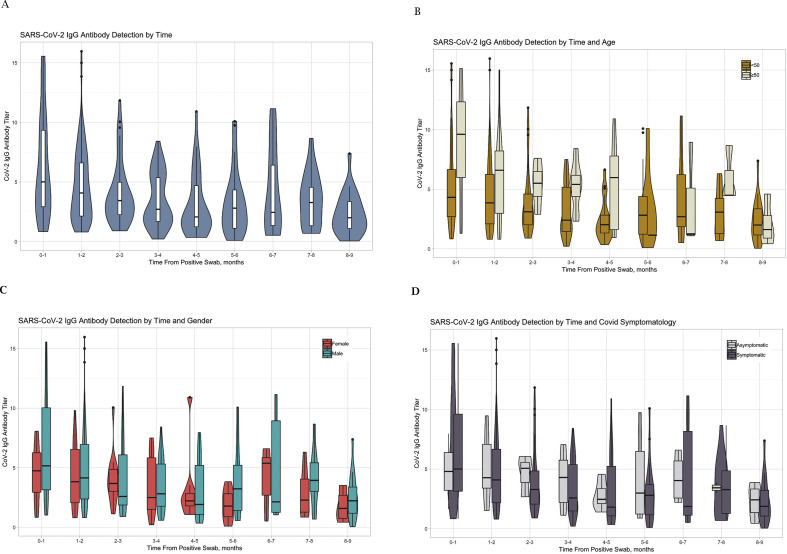
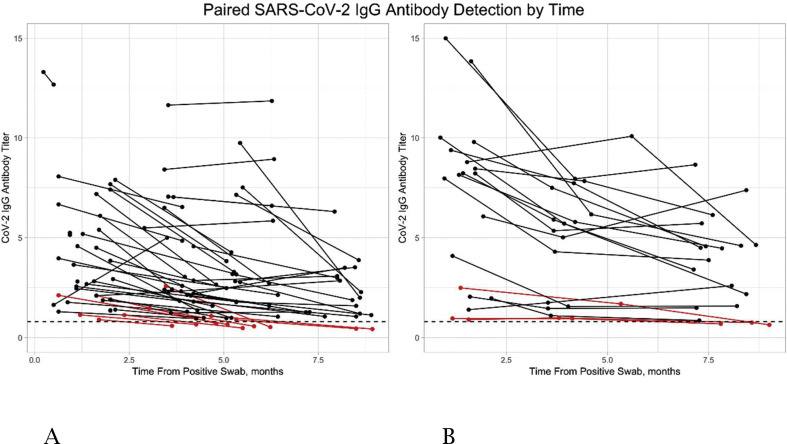
Antibody response was not detected in 26 of 392 COVID-19 convalescent subjects (6.6%). Over a period of 9 months, the level of antibodies decreased by 50% but stabilized at 6 months, and a protective level prevailed for up to 9 months. No differences were found regarding IgG SARS-CoV-2 antibody levels for age, gender, and major blood types over time. Over time, asymptomatic COVID-19 subjects did not differ in antibody level from subjects with mild to severe disease. Repeated paired IgG SARS-CoV-2 antibody level analyses disclosed that, over 6 and 9 months, 15.3% (nine of 59) and 15.8% (three of 19) of subjects became SARS-CoV-2 IgG-seronegative, respectively, all with a low antibody level at 3 months. Rate of antibody decline was not affected by age, gender, or clinical symptomatology. In a subgroup of recovering subjects, memory B-cell response up to 9 months post-COVID-19 infection was undetectable in 31.8% of subjects (14/44), and there was no correlation with age, SARS-CoV-2 antibody level, or time post infection.
The majority of convalescent COVID-19 subjects develop an IgG SARS-CoV-2 antibody response and a protective level prevails over a period of up to 9 months, regardless of age, gender, major blood types or clinical symptomatology.
2019 年冠状病毒病(COVID-19)在全球范围内的传播凸显了评估恢复期患者体液免疫的必要性。我们的目的是评估 COVID-19 恢复期患者对严重急性呼吸综合征冠状病毒 2(SARS-CoV-2)的长期 IgG 抗体反应和 B 细胞记忆反应。
从 COVID-19 恢复期患者和献血的健康供体中采集血样。通过 ELISA 用抗 S1 刺突 IgG 定量检测 SARS-CoV-2 IgG 抗体。在 COVID-19 恢复期患者的随机选择组中,通过基于人 IgG SARS-CoV-2 受体结合域的反向 B 细胞 FluroSpot 评估 SARS-CoV-2 刺突特异性 IgG 记忆 B 细胞。用临床变量和 COVID-19 感染后时间进行统计分析。
在 392 名 COVID-19 恢复期患者中,有 26 名(6.6%)未检测到抗体反应。在 9 个月的时间里,抗体水平下降了 50%,但在 6 个月时稳定下来,保护水平持续了 9 个月。随着时间的推移,年龄、性别和主要血型对 IgG SARS-CoV-2 抗体水平没有差异。随着时间的推移,无症状 COVID-19 患者与轻度至重度疾病患者的抗体水平没有差异。重复配对的 IgG SARS-CoV-2 抗体水平分析显示,在 6 个月和 9 个月时,分别有 15.3%(9/59)和 15.8%(3/19)的患者成为 SARS-CoV-2 IgG 阴性,且所有患者在 3 个月时抗体水平较低。抗体下降率不受年龄、性别或临床症状的影响。在恢复期患者的亚组中,在 COVID-19 感染后 9 个月时,有 31.8%(14/44)的患者无法检测到记忆 B 细胞反应,且与年龄、SARS-CoV-2 抗体水平或感染后时间均无相关性。
大多数 COVID-19 恢复期患者会产生针对 SARS-CoV-2 的 IgG 抗体反应,保护水平可持续长达 9 个月,无论年龄、性别、主要血型或临床症状如何。