IST Austria, Am Campus 1, 3400 Klosterneuburg, Austria.
School of Biological Sciences, University of Manchester, Manchester M13 9PT, UK.
Biol Lett. 2021 May;17(5):20200913. doi: 10.1098/rsbl.2020.0913. Epub 2021 May 12.
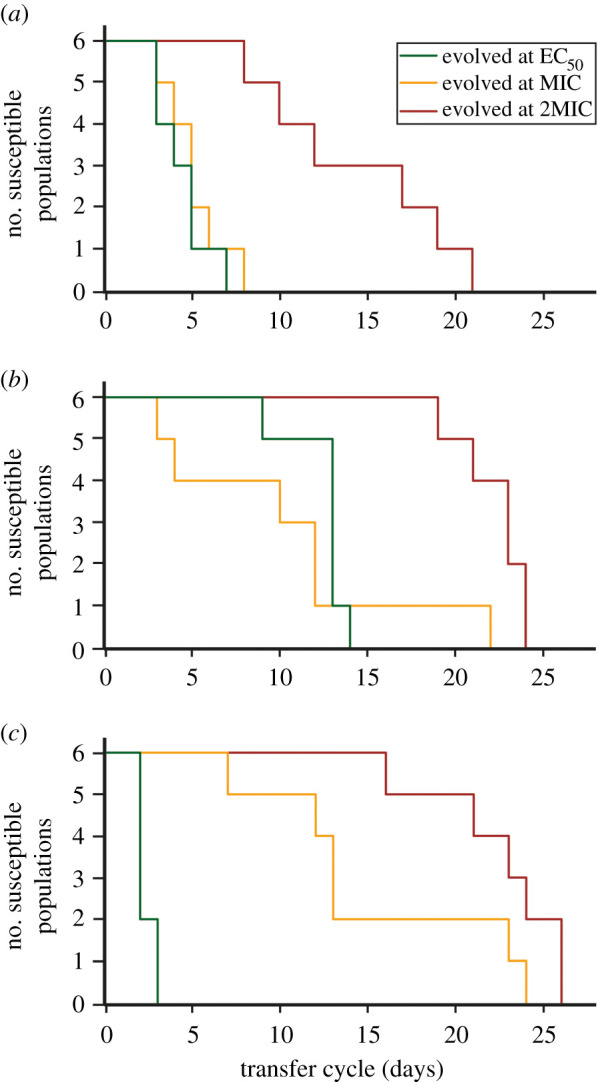
Antibiotic concentrations vary dramatically in the body and the environment. Hence, understanding the dynamics of resistance evolution along antibiotic concentration gradients is critical for predicting and slowing the emergence and spread of resistance. While it has been shown that increasing the concentration of an antibiotic slows resistance evolution, how adaptation to one antibiotic concentration correlates with fitness at other points along the gradient has not received much attention. Here, we selected populations of at several points along a concentration gradient for three different antibiotics, asking how rapidly resistance evolved and whether populations became specialized to the antibiotic concentration they were selected on. Populations selected at higher concentrations evolved resistance more slowly but exhibited equal or higher fitness across the whole gradient. Populations selected at lower concentrations evolved resistance rapidly, but overall fitness in the presence of antibiotics was lower. However, these populations readily adapted to higher concentrations upon subsequent selection. Our results indicate that resistance management strategies must account not only for the rates of resistance evolution but also for the fitness of evolved strains.
抗生素在体内和环境中的浓度差异很大。因此,了解抗生素浓度梯度下耐药性进化的动态对于预测和减缓耐药性的出现和传播至关重要。虽然已经表明增加抗生素浓度可以减缓耐药性的进化,但对于在一个抗生素浓度下的适应性如何与梯度上其他点的适应性相关,还没有得到太多关注。在这里,我们在抗生素浓度梯度的几个点选择了 的种群,研究了耐药性进化的速度以及种群是否对其被选择的抗生素浓度产生了专门性。在较高浓度下选择的种群进化出耐药性的速度较慢,但在整个梯度上表现出相同或更高的适应性。在较低浓度下选择的种群进化出耐药性的速度较快,但在抗生素存在的情况下整体适应性较低。然而,这些种群在随后的选择中很容易适应更高的浓度。我们的结果表明,耐药性管理策略不仅要考虑耐药性进化的速度,还要考虑进化菌株的适应性。