Peking University First Hospital, 8 Xishiku Road, Xicheng District, Beijing, China.
Institute of Health Yangtze River Delta, Shanghai Jiao Tong University, 1954 Huashan Road, Xuhui District, Shanghai, China.
BMC Psychiatry. 2021 May 11;21(1):245. doi: 10.1186/s12888-021-03251-w.
Understanding the long-term inpatient service cost and utilization of psychiatric patients may provide insight into service demand for these patients and guide the design of targeted mental health programs. This study assesses 3-year hospitalization patterns and quantifies service utilization intensity of psychiatric patients in Beijing, China.
We identified patients admitted for one of three major psychiatric disorders (schizophrenia, bipolar and depressive disorders) between January 1 and December 31, 2013 in Beijing, China. Inpatient admissions during the following 3 years were extracted and analyzed using sequence analysis. Clinical characteristics, psychiatric and non-psychiatric service use of included patients were analyzed.
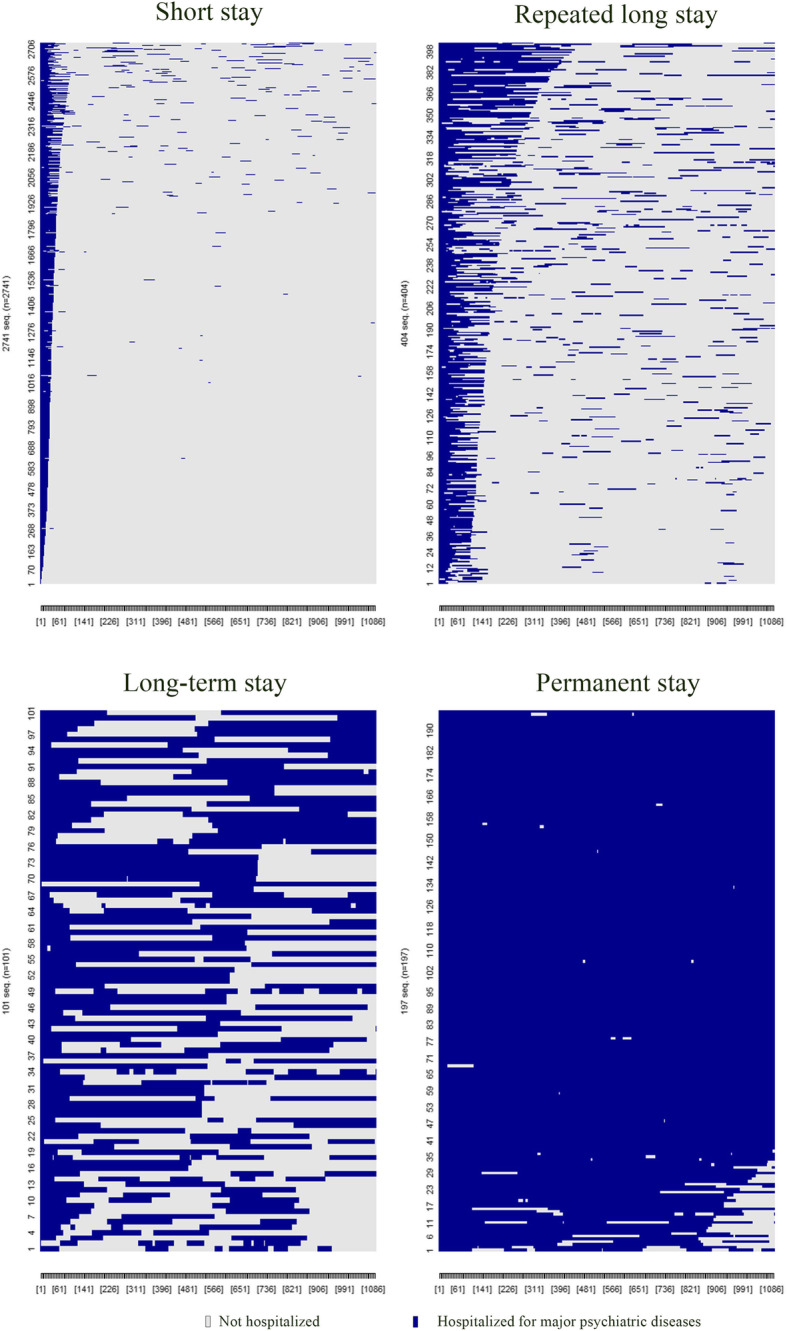
The study included 3443 patients (7657 hospitalizations). The patient hospitalization sequences were grouped into 4 clusters: short stay (N = 2741 (79.61% of patients), who had 126,911 or 26.82% of the hospital days within the sample), repeated long stay (N = 404 (11.73%), 76,915 (16.26%) days), long-term stay (N = 101 (2.93%), 59,909 (12.66%) days) and permanent stay (N = 197 (5.72%), 209,402 (44.26%) days). Length and frequency of hospitalization, as well as readmission rates were significantly different across the 4 clusters. Over the 3-year period, hospitalization days per year decreased for patients in the short stay and repeated long stay clusters. Patients with schizophrenia (1705 (49.52%)) had 78.4% of cumulative psychiatric stays, with 11.14% of them in the permanent stay cluster. Among patients with depression, 23.11% had non-psychiatric hospitalizations, and on average 46.65% of their total inpatient expenses were for non-psychiatric care, the highest among three diagnostic groups.
Hospitalization patterns varied significantly among psychiatric patients and across diagnostic categories. The high psychiatric care service use of the long-term and permanent stay patients underlines the need for evidence-based interventions to reduce cost and improve care quality.
了解精神科患者的长期住院服务成本和利用情况,可以深入了解这些患者的服务需求,并为有针对性的精神卫生计划提供指导。本研究评估了中国北京精神科患者的 3 年住院模式,并量化了服务利用强度。
我们确定了 2013 年 1 月 1 日至 12 月 31 日期间因三种主要精神障碍(精神分裂症、双相情感障碍和抑郁障碍)在北京住院的患者。使用序列分析对随后 3 年的住院情况进行提取和分析。对纳入患者的临床特征、精神科和非精神科服务利用情况进行分析。
本研究共纳入 3443 名患者(7657 人次住院)。患者的住院顺序分为 4 组:短期住院(N=2741(79.61%的患者),占样本中 126911 次住院的 26.82%)、重复长期住院(N=404(11.73%),76915 次住院(16.26%))、长期住院(N=101(2.93%),59909 次住院(12.66%))和永久住院(N=197(5.72%),209402 次住院(44.26%))。4 组患者的住院时间、住院频率和再入院率差异有统计学意义。在 3 年期间,短期住院和重复长期住院患者的年住院天数减少。精神分裂症患者(1705 人(49.52%))累计精神病住院次数占 78.4%,其中 11.14%的患者属于永久住院组。在抑郁症患者中,23.11%的患者有非精神病住院,平均 46.65%的住院费用用于非精神病治疗,在三个诊断组中比例最高。
精神科患者的住院模式存在显著差异,不同诊断类别之间也存在差异。长期和永久住院患者对精神科护理服务的高度利用强调需要基于证据的干预措施,以降低成本和提高护理质量。